
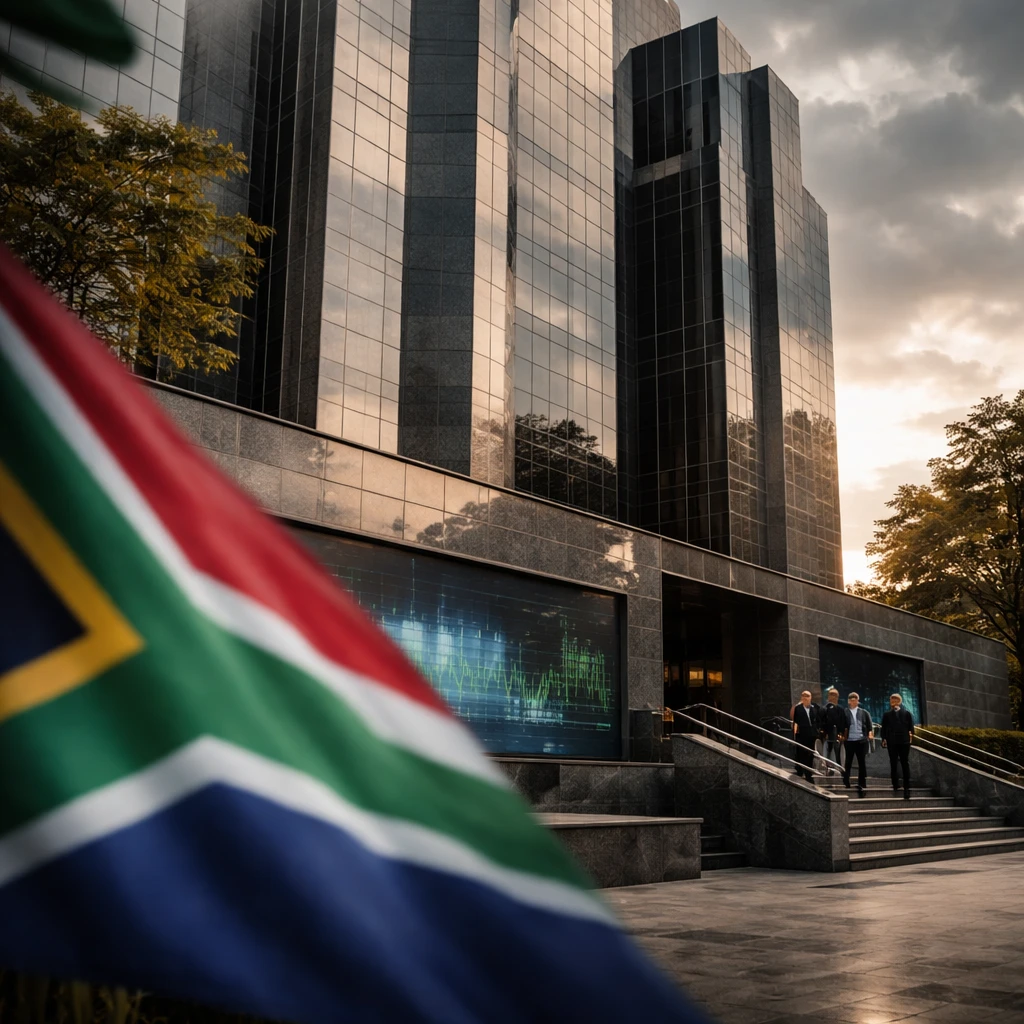
South Africa's central bank on Thursday raised its benchmark interest rate by 25 basis points to 7%, marking the first increase since 2023 as officials moved to address rising inflation risks linked to the Iran war.
The decision by the six-member Monetary Policy Committee aligned with the expectations of nearly all of the 19 economists surveyed by Bloomberg. Governor Lesetja Kganyago announced the action in Pretoria and said the committee had concluded that inflation risks had intensified.
"The committee agreed that inflation risks had intensified, and that the challenge of large and overlapping shocks would likely trigger second-round effects, requiring monetary policy response," Kganyago said. "Our decision was aimed at managing risks and ensuring that inflation returns to target." The central bank's inflation objective is 3% with a tolerance band of one percentage point on either side.
The vote was split: four MPC members supported the quarter-point increase while two preferred to keep rates unchanged. Kganyago said officials had extensive discussions about a 50 basis point hike but ultimately chose a more cautious 25 basis point rise while collecting further information.
Earlier this year, in March, the committee had opted to hold rates steady, while warning that a tighter policy stance could become necessary if the conflict in the Middle East continued to exert upward pressure on inflation. The latest decision represents a shift from that pause to active tightening.
Officials examined three scenarios that modelled varying degrees of elevated inflation and reduced economic growth as a result of the war in Iran. All three scenarios pointed to a need for additional monetary policy tightening, with the most severe projection pointing to rates reaching 7.83% by the third quarter of this year.
"We have already had one global inflation surge this decade and we may be starting another," Kganyago added. "In such adverse scenarios, it is crucial that central banks maintain their credibility and prevent higher inflation from becoming entrenched."
Market reactions after the announcement were mixed. The rand strengthened roughly 0.2% to 16.327 per dollar as of 4:12 p.m. in Johannesburg. The yield on the 10-year government bond fell nine basis points from its session high to 8.62%. Meanwhile, the benchmark Johannesburg stock index declined 1.1%.
Context and implications
The governing committee's move reflects a response to what it characterized as increasing upside inflation risks tied to external developments. The split vote and the committee's discussion of a larger 50 basis point option indicate that policymakers weighed a range of responses, ultimately choosing a measured step while keeping the door open to further tightening if inflationary pressures persist.
Officials' scenario analysis shows a range of possible outcomes for inflation and growth, all of which imply some additional tightening will be necessary should the war-driven shock materialize as modelled. The most severe path would take the policy rate close to 7.83% by the third quarter.
While the move is intended to manage inflation risks and protect the central bank's credibility, the committee acknowledged uncertainty around the trajectory of the external shock and the domestic economic response.