
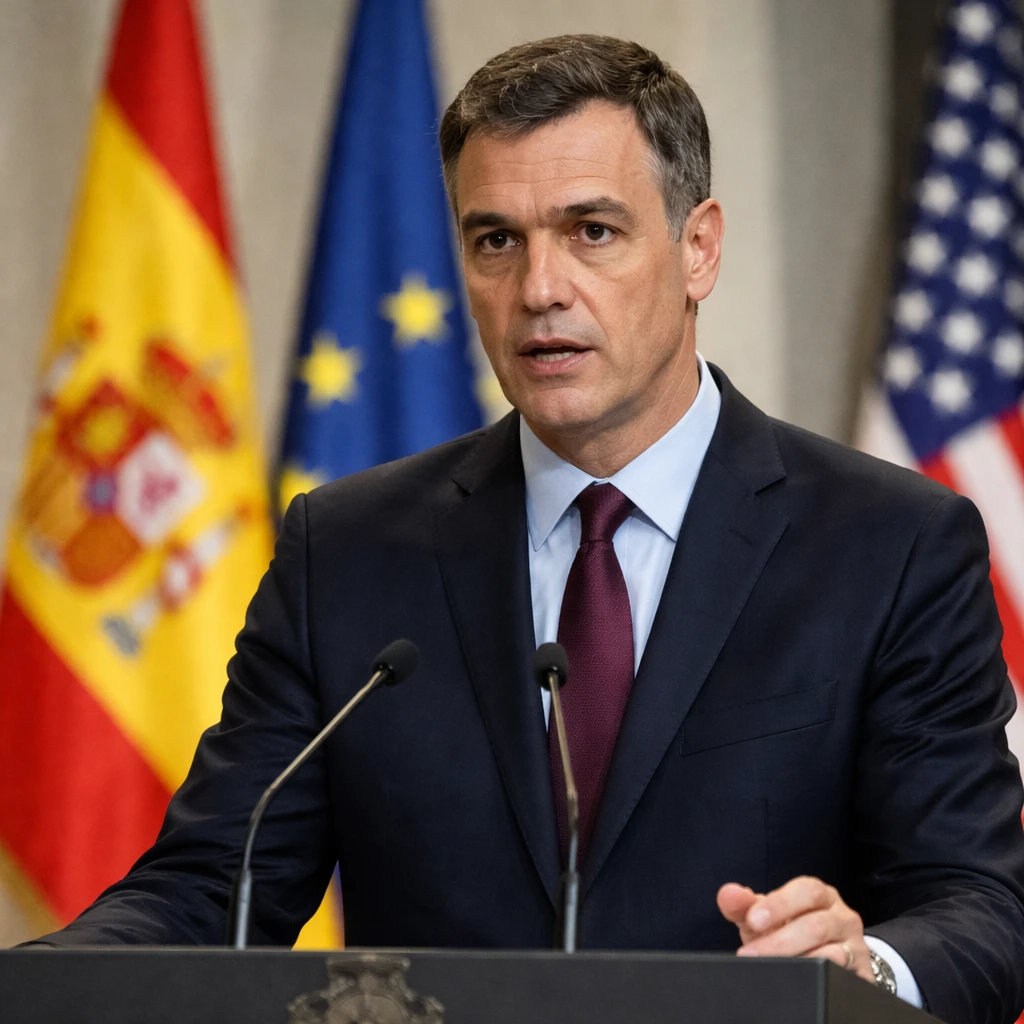
Spanish Prime Minister Pedro Sánchez has publicly accused U.S. President Donald Trump of eroding the international order by engaging in a war with Iran that, in his view, was launched without allied consultation. Sánchez made the remarks in an interview published Monday with The Rest Is Politics podcast.
In the interview, Sánchez described the confrontation as lacking multilateral coordination. "This is a unilateral war started by two nations, by two governments, without consulting or coordinating with their allies," he said.
He warned that actions by the U.S. administration which he characterizes as aimed at weakening international institutions will have consequences at home. Sánchez cautioned that such challenges could lead to "an erosion of our welfare state, and of the middle and working class." The Spanish leader linked the international stance he criticizes to domestic economic and social pressure.
Relations between Madrid and Washington have frayed on several fronts beyond the conflict with Iran. One persistent point of contention is NATO defense spending. Spain has declined to commit to a 5% of GDP defense spending target that Sánchez said other alliance members have endorsed.
Sánchez dismissed the 5% target as "an arbitrary figure, which is not based on data and facts." He argued that annual defense expenditure needs to be flexible, saying: "One year could be 5%. The other year could be 2%. And the other year could be 7%." The Spanish government plans to allocate roughly 2.1% of GDP to defense, and officials contend that this level will be sufficient to meet shared defense challenges.
Madrid has also taken positions that diverge from Washington on other international matters. The Spanish government condemned the U.S. detention of Venezuelan President Nicolás Maduro and is preparing measures aimed at major American technology and social media companies over issues described as online abuse and hate.
Despite the tensions, Sánchez said he favors a candid transatlantic partnership. "Real allies are like real friends, they tell each other the truth no matter what," he said, framing his criticisms as part of a desire for honest relations rather than permanent rupture.
Sánchez has been among the most vocal European Union leaders critical of President Trump. He previously labeled the war "illegal" and took concrete action by blocking the use of two U.S. military bases in Spain for operations related to the Iran conflict, a decision that reportedly angered the American president.
In response to Spain's positions on NATO and the Iran war, President Trump has in recent weeks threatened retaliation. Those threats have included the prospect of severing commercial ties with Spain, according to Sánchez's statements.
Context and implications
The positions outlined by Sánchez underscore a broader bilateral strain encompassing defense commitments, national security cooperation, trade relations and digital regulation. Madrid asserts its chosen defense spending trajectory and has pursued measures that challenge U.S. actions on multiple fronts while maintaining that candid dialogue is essential between allies.