
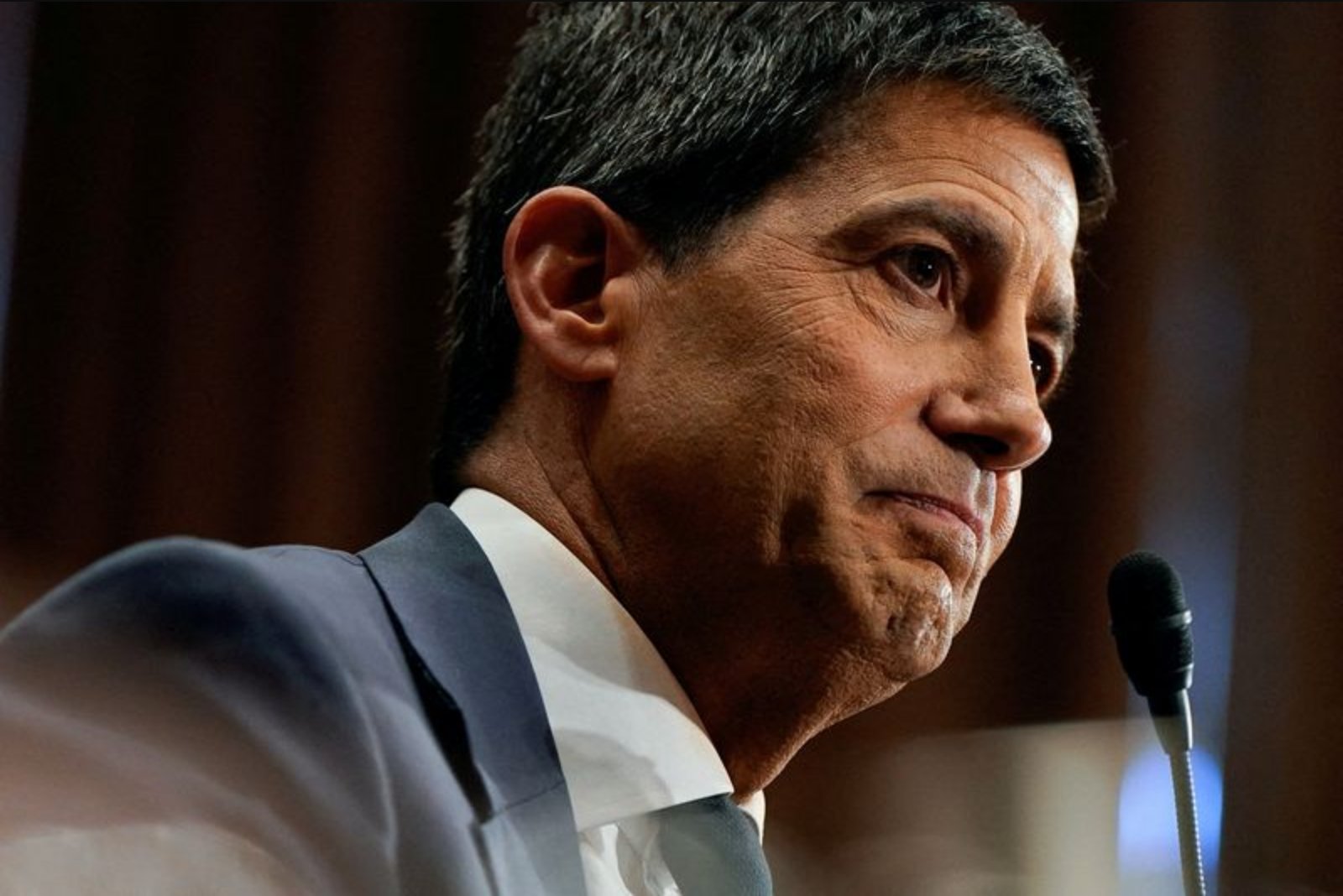
Kevin Warsh, long a critic of the Federal Reserve since leaving the central bank in 2011, provided a concise blueprint for how he would approach the job of Fed chair during his confirmation testimony last month. His statements framed inflation as principally a monetary decision, signaled a desire to shrink the Fed's balance sheet, and rejected some of the communication tools the Fed has used in recent years.
Warsh began his testimony by underlining what he described as the Fed's core statutory assignment. In written remarks he told lawmakers, "Congress tasked the Fed with the mission to ensure price stability, without excuse or equivocation, argument or anguish." He expanded on that in oral remarks with a stark formulation: "Inflation is the Fed's choice."
Those phrases encapsulate the central thrust of Warsh's critique of recent policy. He tied today's inflation back to decisions by monetary authorities, echoing an approach that places primary responsibility for price stability on the central bank. In his testimony he referenced the view that the inflation surge after the pandemic was avoidable and attributable to policy choices rather than being an ineluctable outcome of supply frictions or rebounding demand.
Warsh explicitly rejected an alternative account of the post-pandemic price rise. While many economists point to a breakdown in global supply chains combined with a rapid release of pent-up consumer demand as key drivers, Warsh said he disagrees with that framing. Instead he told lawmakers, "I think inflation comes about when the government prints too much - by which I mean the central bank and broadly speaking the government spends too much."
Linked to that diagnosis is Warsh's critique of the Fed's balance sheet. He argued that the central bank enabled expanded government spending by enlarging its balance sheet during the financial crisis and keeping it large long after the crisis subsided. Currently about $7 trillion, the balance sheet is on a path for gradual growth in the absence of policy changes. Warsh has made reducing that balance sheet a centerpiece of what he calls a "regime-change" at the central bank.
It is less clear whether Warsh intends to pair a leaner Fed balance sheet with advocacy for lower fiscal spending. Historically Fed chairs have avoided making direct prescriptions about fiscal choices even as they raise concerns about the sustainability of government borrowing. Warsh did not make explicit promises on fiscal policy in his testimony.
Warsh also proposed a different approach to how the Fed communicates with markets. He has been forthright in his opposition to forward guidance. "Unlike many of my colleagues past and present I don't believe in forward guidance," he told lawmakers. "I don't believe that I should be previewing for you what a future decision might be."
That stance directly challenges a communication strategy many central banks have used to increase the potency of policy moves by shaping expectations. What some policymakers call mapping out likely responses to economic paths Warsh characterizes as inappropriate previewing. His skepticism extends beyond post-meeting statements that hint at the direction of the next move - a form of guidance that was at issue in April when some policymakers argued the Fed's statement should be revised so that it could suggest either an increase or a decrease in interest rates rather than implicitly pointing toward cuts.
Warsh may also target other established practices, such as the quarterly economic projections that include Fed policymakers' forecasts for economic variables and their assessment of an appropriate policy path. Removing or substantially altering those projections would represent a significant shift in transparency and the way markets infer policy intentions.
On the role of data in decision-making, Warsh warned against an excessive focus on precise point estimates from economic releases. "In economics what we need to do is focus to the left of the decimal point, not to the right of the decimal point," he told lawmakers. If applied strictly, that viewpoint could mean treating readings such as April's 3.8% consumer inflation print as not meaningfully different from March's 3.3% reading, or seeing a reading of 2.9% as not materially distinct from the Fed's 2% goal.
Warsh's comments also reflected a pledge of independence from the White House on immediate rate commitments. He told lawmakers he had made no promises to President Donald Trump on interest rates, saying, "The president never asked me to predetermine, commit, fix, decide on any interest-rate decision in any of our discussions, nor would I ever agree to do so." At the same time he warned that when policy errors occur they must be corrected quickly: "if mistakes are made, central bankers - economic policy makers - need to correct them fast."
That posture leaves open the possibility of conflict. Warsh was selected by President Trump with the expectation that he would cut interest rates, yet Warsh's emphasis on inflation control suggests that raising rates to counter renewed inflationary pressure - amid higher oil prices and tariff-driven price effects - could put him on a collision course with the president's preferences.
Notably, Warsh declined to speak definitively on several important topics. He did not say whether he believes the current policy rate is too high or otherwise miscalibrated. He also did not reiterate a personal commitment to the Fed's 2% inflation objective, leaving unclear whether he endorses that numeric target, would prefer a different goal, or would de-emphasize a specific numeric anchor altogether.
Similarly, Warsh did not foreground the role of inflation expectations in his testimony. Market and public expectations about future inflation are a central pillar of contemporary monetary policy frameworks, but Warsh did not lean into that topic the way his predecessor has sometimes done.
To the other side of the Fed's dual mandate - maximum employment - Warsh offered little substantive commentary. He provided almost no view on labor-market policy trade-offs or how he would weigh employment outcomes against price stability in periods of tension.
Finally, Warsh declined to take a position on a politically sensitive legal matter involving the central bank. He did not weigh in on President Trump's effort to remove Fed Governor Lisa Cook, a case that is now before the Supreme Court and which the sitting chair described as the most important legal case in the Fed's history.
Warsh's testimony sketches a Federal Reserve chair who would prioritize monetary restraint, reduce the balance sheet, disfavor forward guidance, and place less emphasis on precise data point distinctions. At the same time, his reticence on questions about the policy rate, the explicit 2% target, inflation expectations, and employment policy leaves several consequential uncertainties for markets and policymakers to monitor as he settles into potential leadership.
Key points
- Warsh says inflation is fundamentally a monetary policy choice and criticized the Fed for enabling government spending through a large balance sheet; this is likely to affect financial markets and fiscal debate.
- He opposes forward guidance and may scale back quarterly economic projections, which would change how markets interpret Fed intentions and could increase short-term market volatility.
- Warsh emphasized swift correction of policy mistakes while declining to commit to specific positions on the current policy rate, the 2% inflation target, inflation expectations, or employment priorities - leaving key uncertainties for bond, equity, and labor markets.
Risks and uncertainties
- Potential conflict with the White House: Raising rates to control inflation could clash with the expectations of the president who nominated him - a risk for markets sensitive to political influence on monetary policy.
- Communication shifts: Ending forward guidance and altering projections could reduce transparency and increase volatility, particularly in fixed-income and interbank markets that rely on guided expectations.
- Policy ambiguity: Failure to clarify the Fed's commitment to a 2% inflation target or to address the employment side of its mandate creates uncertainty for investors and labor-market participants about the central bank's trade-offs.
Tags: monetary, inflation, fed, policy, balance-sheet