
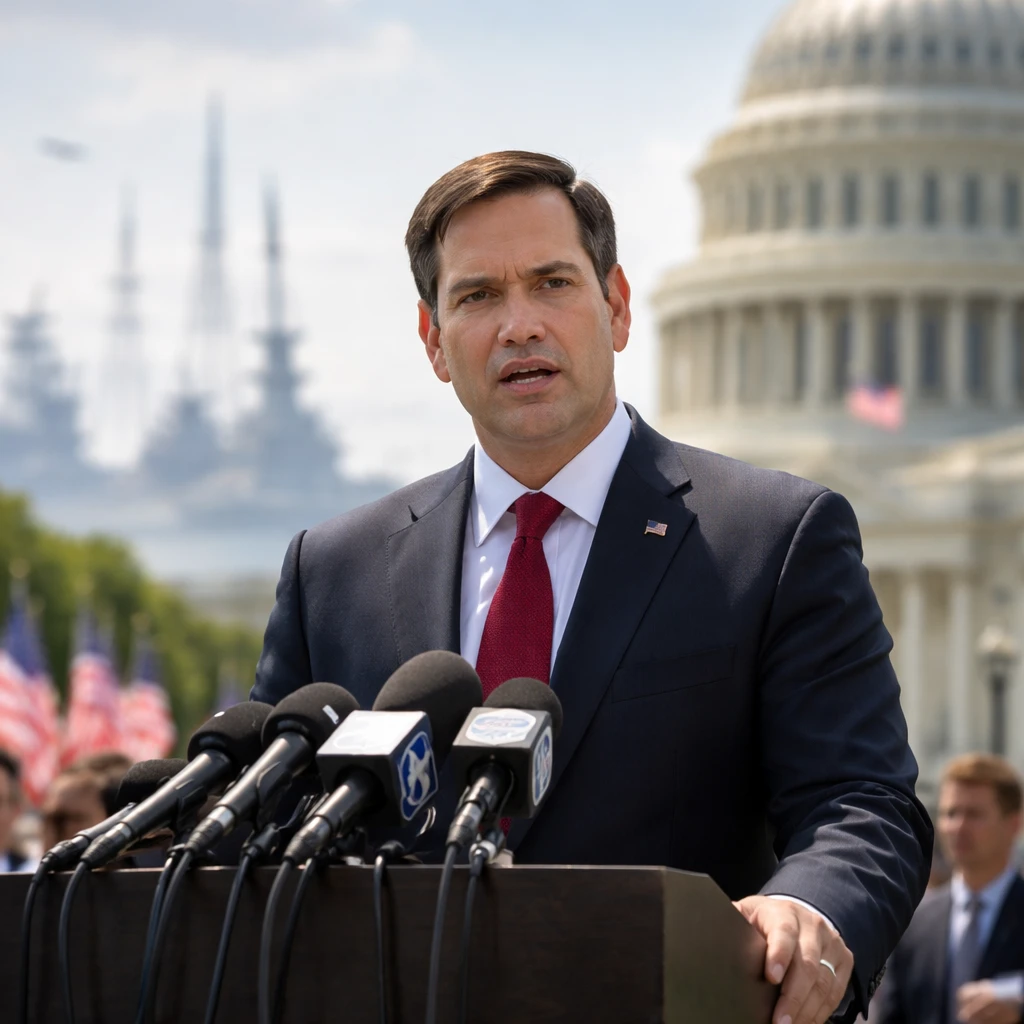
Secretary of State Marco Rubio addressed reporters on the Capitol grounds on Monday, stating that Iran is producing missiles at the rate of hundreds per month and that such production constitutes an unacceptable risk. Rubio described the situation as an imminent threat and outlined the narrow operational aims of current U.S. military action.
According to the Secretary of State, the immediate objective of the operations now under way is to destroy missile capabilities and naval assets located in Iran. He said the focus is on degrading those systems rather than broader objectives on the ground inside Iran.
Rubio confirmed that the administration informed congressional leadership and the so-called Gang of 8 about the action. He emphasized that, while the United States would like to see a new regime in Iran, regime change is not an explicit objective of the present mission.
The Secretary of State also said the United States is not positioned for ground-force operations in Iran at this time and that there are no diplomatic exchanges with Iran currently taking place. He warned reporters that the most significant strikes from U.S. forces are yet to come.
On the economic front, Rubio said the administration will roll out a program intended to mitigate energy costs tied to the current situation. He added that Treasury Secretary Bessent and Energy Secretary Wright will present steps specifically aimed at easing oil-price impacts.
Clear summary
Marco Rubio described Iran’s missile production as constituting an unacceptable and imminent threat and said U.S. military operations are concentrated on destroying Iranian missile and naval capabilities. Congress and the Gang of 8 have been notified. The mission does not have regime change as an explicit goal, U.S. ground forces are not postured for operations in Iran, and no diplomatic exchanges are underway. Rubio signaled that tougher military actions are forthcoming and announced an administration program, to be detailed by Treasury Secretary Bessent and Energy Secretary Wright, to help mitigate energy and oil costs.
Key points
- Iran is producing hundreds of missiles per month, which the Secretary of State described as an unacceptable risk; this is cited as an imminent threat motivating current U.S. operations.
- The stated operational goal is the destruction of missile capabilities and naval assets in Iran rather than broader objectives such as regime change or ground invasion.
- The administration will implement a program to mitigate energy costs; Treasury Secretary Bessent and Energy Secretary Wright will announce specific measures to address oil prices.
Risks and uncertainties
- Military escalation risk - Rubio indicated the hardest hits from U.S. forces remain ahead, implying potential for further military action.
- Energy-price volatility - The need for a program to mitigate energy costs suggests uncertainty in oil markets and potential for near-term price impacts.
- Diplomatic and operational constraints - The U.S. is not postured for ground forces in Iran and has no diplomatic exchanges in progress, creating uncertainty about next steps and long-term engagement strategies.