
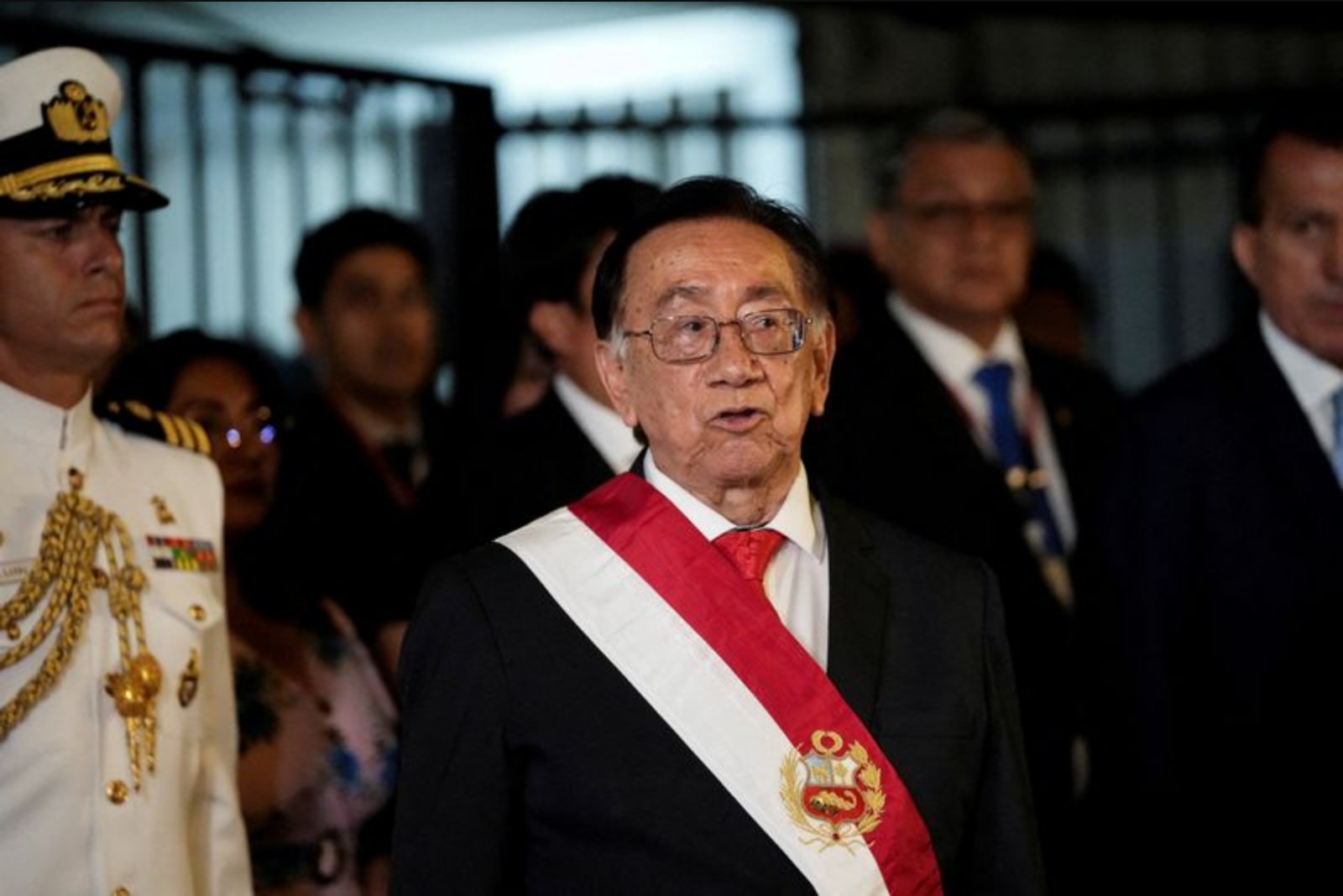
Peru experienced another rapid change at the top of government this week when Congress voted to remove President Jose Jeri amid a corruption scandal, only four months after he took office. Lawmakers then selected hard-left congressman Jose Balcazar as interim president to serve until the next elected leader assumes power on July 28.
Despite the political upheaval - the country’s seventh president in under a decade - financial markets showed only limited disturbance. Investors appear to have become accustomed to recurrent leadership changes, and recent trading in sovereign debt suggested only modest movement.
Emerging-market debt analysts reported that Peru’s 2060 sovereign bond dipped slightly on Thursday, trading at about 56 cents on the dollar, while the country’s 2032 dollar-denominated notes remained steady according to Refinitiv data. Observers point to narrow spreads between Peru’s benchmark government yields and U.S. Treasuries - among the tightest in the region behind Chile - as evidence that markets regard the country as relatively low risk.
“Portfolio investors have become desensitized to Peru’s political drama,” said Eileen Gavin, head of sovereign analysis at Verisk Maplecroft. She added that the mining-focused economy’s macro and credit risk metrics have stayed fairly exemplary throughout almost a decade of instability.
Analysts highlighted two structural supports for market calm. First, Peru’s heavy reliance on commodities, especially copper, provides predictable exposure to global commodity demand. Second, sustained confidence in the central bank’s leadership has historically shielded markets from the full weight of political shocks.
“The combination of a copper-dependent economy and a highly credible central bank has cushioned Peru from politics before,” said Jo-Marie Burt, a Peru specialist at George Mason University.
Political backdrop and the interim presidency
Congress moved quickly this week after allegations tied to corruption prompted Jeri’s removal. On Wednesday, lawmakers selected Jose Balcazar, 83, to lead the country on an interim basis through the transition period. After taking office, Balcazar pledged to oversee what he described as “unquestionable” elections in the world’s No. 2 copper exporter and said he would avoid “experimenting” with economic policy - language intended to reassure financial markets.
Balcazar’s own record is contentious. Before winning a seat in Congress in 2021, he was removed as a provisional Supreme Court justice for misconduct and subsequently disbarred. Local media this week also revived criticism of remarks he made in 2023 that were widely viewed as defending child marriage.
Election dynamics and uncertainties
The April 12 presidential vote presents another major test for Peru’s electoral institutions. A record number of presidential candidates have registered, and voters will also select a new 60-seat Senate as the country returns to a bicameral legislature. Polling indicates a large portion of the electorate remains uncommitted: an Ipsos poll this month found about 42% of respondents said they were undecided, planned to void their vote, or intended to leave the ballot blank.
Political analysts warn that the crowded field could prevent voters from coalescing around a consensus candidate ahead of the vote. “I see a lack of time for voters to coalesce around a good candidate,” said Cynthia McClintock of George Washington University. “There’s already a feeling of, ’There are so many candidates - how are we supposed to cope?’ ”
Leading many polls is right-wing Lima mayor Rafael Lopez Aliaga, though analysts say he may face difficulty winning a runoff without broader conservative support. Trailing him is Keiko Fujimori, the daughter of the late former president Alberto Fujimori.
McClintock also suggested that Congress’s frequent use of removal powers has contributed to voter disillusionment, noting that continued turnover at the presidency has been driven in part by lawmakers asserting those powers relatively freely. Jeri had succeeded Dina Boluarte, who herself stepped in after Pedro Castillo was impeached following a turbulent 17-month presidency.
Implications for markets and sectors
Market participants and analysts said that if the April elections are broadly accepted as credible, investor focus is likely to remain on economic fundamentals rather than political headlines. For now, confidence in fiscal and monetary stewardship and the country’s central role in copper production appear to be the primary anchors for investor sentiment.
But the fragmented electoral landscape and Balcazar’s controversial background introduce uncertainties that could affect political risk assessments going into the vote, particularly for sectors closely tied to sovereign credit and commodities.