
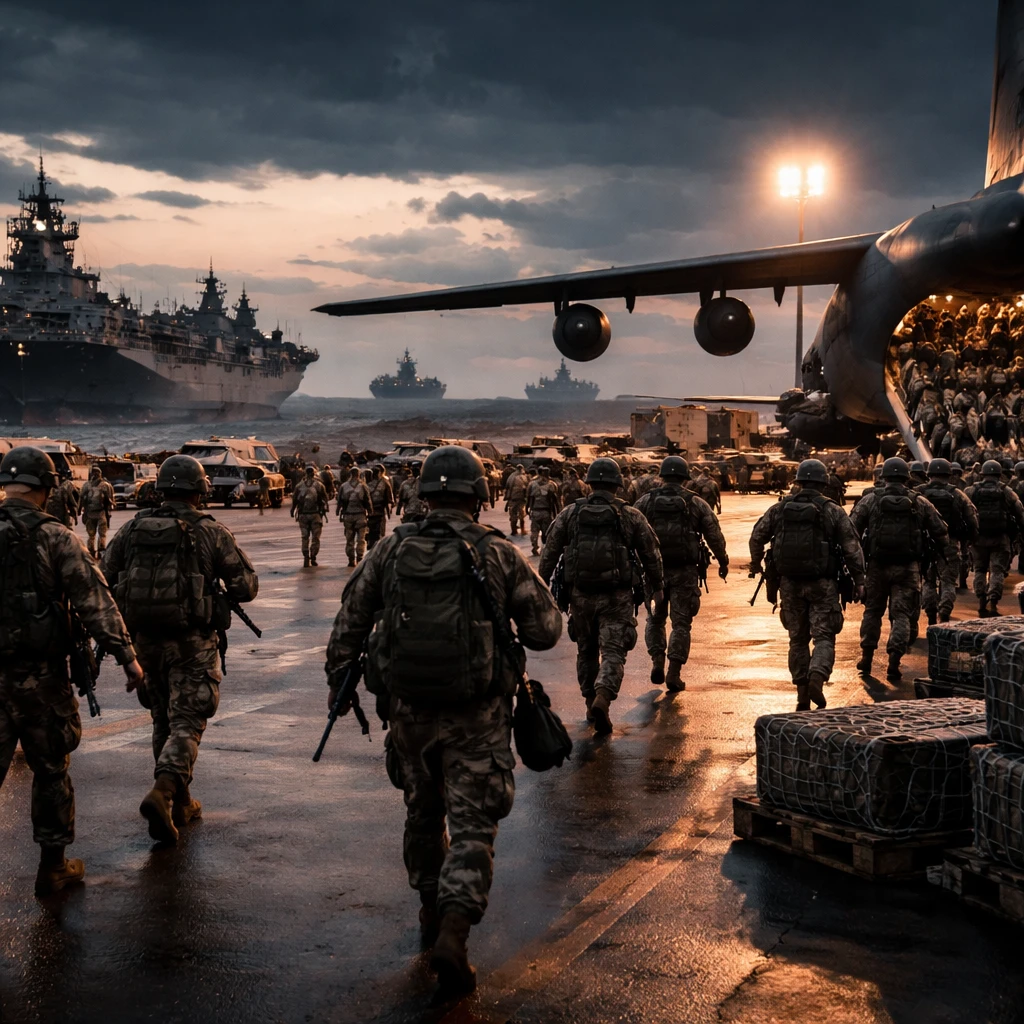
Senior U.S. defense officials have prepared granular plans to place American ground troops in Iran should the president authorize such an operation, multiple officials briefed on the discussions said. Military commanders have forwarded specific requests aimed at readying that option as the president continues to consider whether to station forces on the ground in the region.
Those officials, who discussed the deliberations on condition of anonymity because they were not authorized to speak publicly, said it remains unclear under what circumstances the president would order boots on the ground.
In a statement, White House press secretary Karoline Leavitt said: "It’s the job of the Pentagon to make preparations in order to give the Commander in Chief maximum optionality, it does not mean the President has made a decision, and as the President said in the Oval Office yesterday, he is not planning to send ground troops anywhere at this time."
Planning sessions have included discussion of how to manage the potential detention of Iranian military personnel and paramilitary operatives if U.S. forces are deployed, including consideration of where detainees would be transferred, two officials said. Those contingency preparations extend beyond force positioning to cover detention logistics.
The U.S. is preparing to deploy elements of the 82nd Airborne Division into the Middle East region, officials said. The planning incorporates the Army’s Global Response Force as well as a Marine Corps Marine Expeditionary Unit, indicating coordination across rapid-response components.
Separately, thousands of Marines are on the move toward the Middle East. Two U.S. officials said three warships and roughly 2,200 Marines from an expeditionary unit departed California earlier this week. This deployment represents the second Marine expeditionary unit sent since the conflict began; officials expect it could take several weeks before the unit is fully in place. A first Marine unit, dispatched from the Pacific, is still transiting toward the region.
Defense leaders have thus prepared both force posture and support arrangements in the event the president directs ground operations. The requests from senior commanders and the logistical steps under way reflect contingency planning at multiple levels of the military chain of command. At the same time, officials stressed that planning does not indicate a final policy decision regarding the use of ground troops.
Clear summary
U.S. military leaders have developed detailed plans and submitted specific requests to enable possible deployment of ground forces into Iran, while Marine expeditionary elements and components of the 82nd Airborne are being positioned toward the Middle East. The White House said such preparations are routine planning and do not reflect a decision to send troops at this time.
Key points
- Senior commanders have submitted requests to prepare for potential ground deployment into Iran; planning covers detainee handling and transfer.
- Elements of the 82nd Airborne Division and the Army’s Global Response Force are part of the planning; Marine Expeditionary Units are being mobilized.
- Three warships and about 2,200 Marines left California this week as a second expeditionary unit heads to the region; a prior unit remains en route from the Pacific.
Risks and uncertainties
- It is uncertain under what specific circumstances the president would authorize the use of ground forces - a political and operational decision that remains undecided.
- The timeline for deployed units to arrive and the pace at which forces would be operational in theater is unclear, creating execution and logistics uncertainty.
- Contingencies for detaining Iranian soldiers and paramilitary fighters have been discussed, but details of detention locations and procedures have not been finalized.