
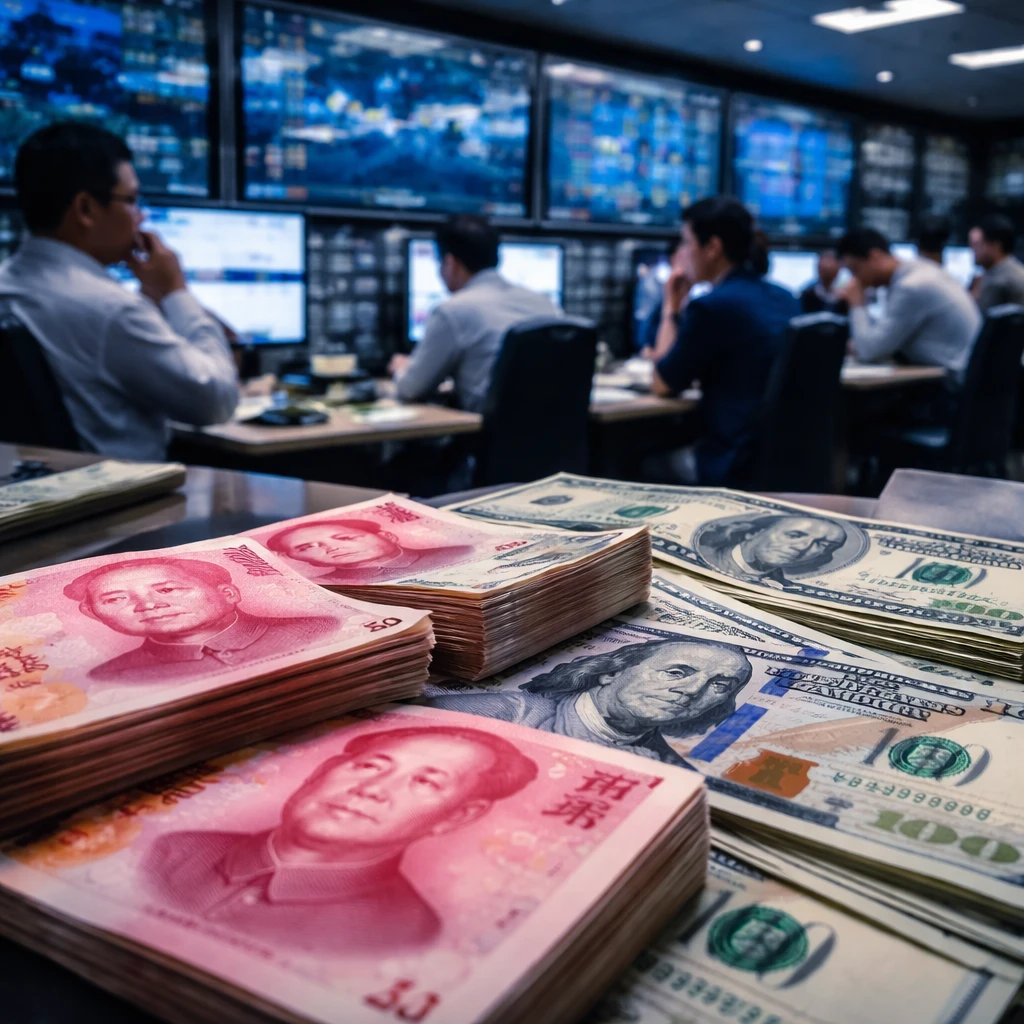
BEIJING/SHANGHAI, Feb 27 - China’s central bank has taken steps to blunt the country’s recent currency rally by removing a 20% reserve requirement on foreign-exchange forward contracts, a measure intended to make it easier and less costly for market participants to buy dollars and hedge against further yuan appreciation.
The People’s Bank of China said the reserve requirement on forex forwards will be lifted from March 2 and reiterated its objective to keep the yuan’s exchange rate at a "reasonable and balanced level." The action followed the yuan touching a near three-year high against the dollar on Thursday, before retreating on Friday after a rally driven mainly by unexpectedly strong exports. Since last April, the currency has gained in excess of 7% versus the dollar.
The PBOC’s step, combined with a weaker-than-expected setting of the currency’s daily trading band on Friday, represents the most assertive attempt yet to moderate the months-long advance. Market participants and analysts described the move as intervention designed to slow the pace of appreciation rather than to reverse it.
"It means the PBOC is intervening as the yuan’s appreciation is too fast," said Yuan Tao, an analyst at Orient Futures. He added, however, that the measure is likely to temper the speed of gains rather than fully halt them, and he expects continued dollar weakness.
Foreign-exchange flows and corporate accounts have been heavily affected by the swift move in the currency. Exporters rushed to sell dollars across both the spot and forward markets, while many importers delayed dollar purchases ahead of payments. Those behaviours helped produce sizeable net forex inflows of $79.9 billion in January, the third-largest monthly total on record based on official forex settlement data, following a record inflow in December.
Analysts and market participants said the reserve removal will lower the cost of using forwards to buy dollars, releasing some of the pent-up demand for hedging and potentially easing supply-demand imbalances in the FX market. Liu Yang, general manager of the financial market business department at Zheshang Development Group, said the change should free up that demand in the near term and help rebalance market flows. At the same time, Liu characterized the measures as mild overall, suggesting the central bank does not see a material risk of renewed yuan depreciation and still perceives room for further appreciation.
Financial institutions and investment banks commenting to clients noted the practical impact of the move. Maybank said in a client note that removing the 20% reserve would "make it less punitive for market participants to bet against the yuan," and that the action made it clear the PBOC wants the pace of appreciation to slow.
Beyond market mechanics, the rapid appreciation has had concrete earnings consequences for a growing list of listed companies. Beijing Ultrapower Software Co attributed a 28% fall in 2025 profit in part to yuan strength, saying its revenues are mainly settled in dollars and that forex conversion losses followed as the dollar weakened. Suzhou Junchuang Auto Technologies, which also settles most sales in dollars, reported a 31% decline in 2025 profit with management citing the stronger renminbi as a contributing factor. Other firms including robot maker Ninebot, Shenzhen Hello Tech Energy Co and Shenzhen Hui Chuang Da Technology have similarly reported negative impacts on profits from the currency’s rise.
Observers pointed to dynamics behind the export boom that helped power the currency higher. Shippers have broadened their buyer base beyond the United States after U.S. tariff measures were increased, which helped offset weak domestic demand that is still weighing on the broader economy. The strong run in exports supported the yuan even as the dollar remained largely stable.
"The renminbi has been strong even as the dollar is largely stable, suggesting strong market conviction that it’s undervalued," said Xu Tianchen, a senior economist at the Economist Intelligence Unit, describing the market view that underpinned the currency’s momentum.
Policy makers face a balancing act. A firmer yuan can make Chinese assets more attractive to foreign investors and reduce import costs, but it also erodes exporters’ competitiveness and squeezes profits for companies with dollar-denominated receipts. The PBOC’s reserve removal and its lighter daily reference setting signal a preference for a slower appreciation path while leaving room for the currency’s strength to continue if underlying conditions persist.
In parallel with central bank action, the recent surge in exporters selling dollars in forwards and spot markets and the inward forex flows recorded at the start of the year underline how quickly market positioning can shift and how such shifts affect corporate earnings and market liquidity.
Should you be buying 300002 right now? ProPicks AI evaluates ticker 300002 alongside thousands of other companies every month using more than 100 financial metrics. According to the ProPicks material, the system uses AI to generate stock ideas by assessing fundamentals, momentum and valuation without bias, identifying names the algorithm deems to offer attractive risk-reward. The ProPicks commentary referenced past winners identified by the system including Super Micro Computer and AppLovin, and invited readers to check whether 300002 is currently included in any active strategies or whether other opportunities exist within the same sector.