
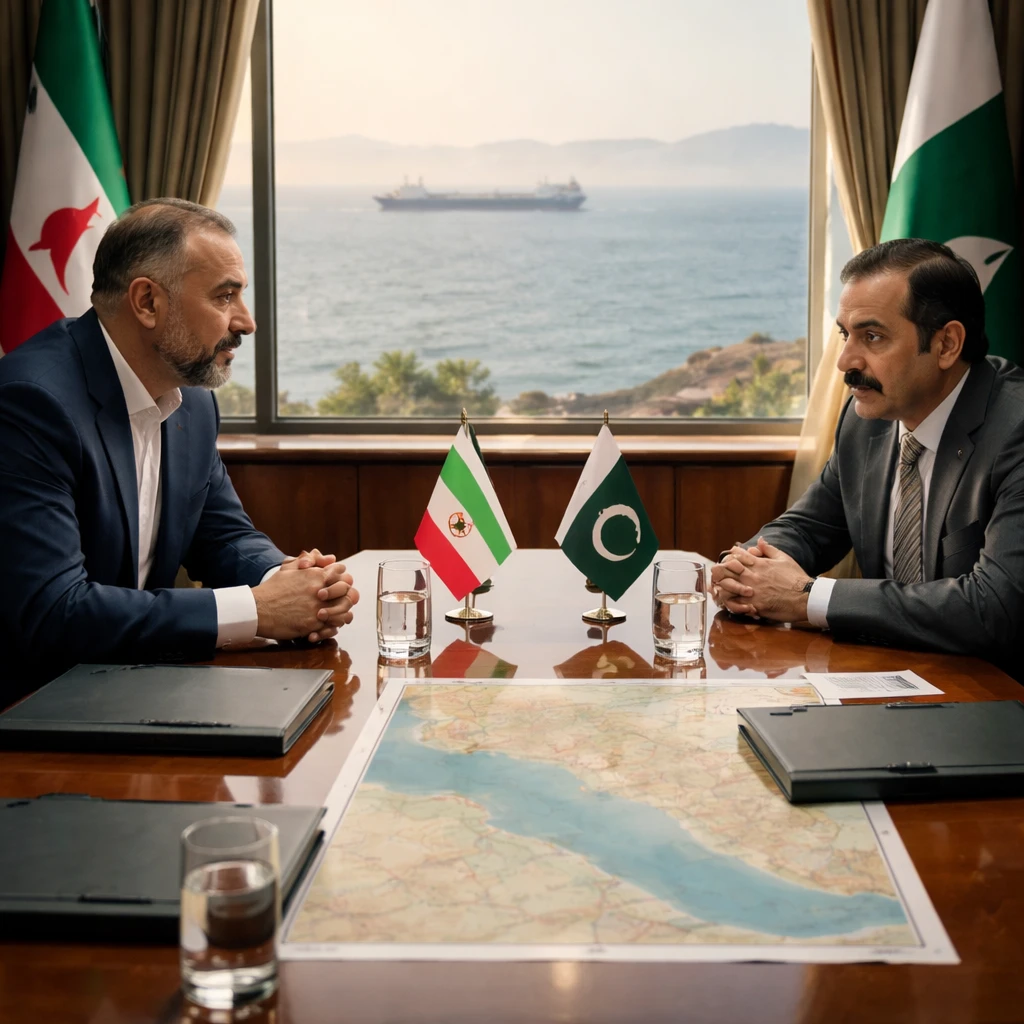
Pakistan has intensified its mediation efforts between Washington and Tehran, hosting talks this week aimed at narrowing outstanding differences over proposals to end the conflict that erupted more than two months ago, Iranian state media reported.
On Friday, Iran’s foreign minister held discussions with Pakistan’s interior minister focused on resolving the key points of contention between the United States and Tehran, according to reporting from Iranian outlets. The meeting followed Islamabad’s delivery, two days earlier, of the most recent U.S. message in the negotiations, Reuters reported, citing the semi-official Tasnim and ISNA news agencies.
Islamabad has played a recurring role as an intermediary in efforts to halt the fighting that has cost thousands of lives and sent shockwaves through global markets. Officials involved in the talks have conveyed a mix of cautious optimism and restraint as they evaluate the trajectory of what remains a fragile process.
Framework and narrowings
ISNA reported that Pakistan’s Interior Minister Syed Mohsin Naqvi is attempting to construct a framework that could lead to an end to the war and a resolution of the issues dividing the parties. A senior Iranian official, quoted by Reuters, said the gaps in the negotiations have narrowed, suggesting progress in certain areas even as other sticking points persist.
U.S. Secretary of State Marco Rubio told reporters that discussions have shown "good signs" of progress but cautioned against premature optimism, saying he wanted to "see what happens over the next few days." That mix of guarded encouragement reflects the reality that early advances in diplomacy can be fragile and subject to rapid reversal.
Persistent impasse over enriched uranium
Despite signs of movement, a significant rift emerged when Reuters reported that Iran’s Supreme Leader Mojtaba Khamenei had issued a directive forbidding the export of enriched uranium from Iran. The report described the directive as a hardening of Tehran’s position on one of President Donald Trump’s principal demands in the negotiations.
The White House pushed back against that reporting, calling the account false, according to Fox News, which cited a person directly involved in the negotiations. That public divergence over a central technical issue underscores the delicate nature of the talks and the potential for contested narratives to complicate progress.
Ceasefire and wider security impact
Washington and Tehran are currently in a protracted ceasefire that has extended beyond the initial phase of bombardments that began in late February. The conflict, which saw a joint U.S.-Israeli assault on Iran, sparked a cascade of attacks that spread across the Middle East, touching major energy-producing states in the Gulf region.
Questions remain about the status of the Strait of Hormuz, a narrow passage through which roughly one-fifth of the world’s oil supplies transit. Reports indicate that Iran and Oman had discussed establishing a toll system for ships traversing the strait, a proposal opposed by President Donald Trump. For now, the corridor is all but closed to tanker traffic, a situation that has kept upward pressure on global oil prices and raised fears of inflationary spillovers around the world.
Market moves
Market reaction has been sensitive to the ebb and flow of diplomatic signals. Oil prices climbed again on Friday after three consecutive sessions of declines. Brent crude futures were last quoted at $105.75 a barrel, well above pre-war levels near $70 a barrel. The U.S. dollar continued to trade close to six-week highs as investors sought a relative safe haven amid geopolitical uncertainty.
Analysts at BMO Capital Markets noted the shifting tone in public reports, saying that while there were early hopes of a peace deal, doubts about progress increased later in the week. Those comments reflect how quickly market sentiment can swing in response to new information or contradictory accounts from participants and media reports.
Outlook
Pakistan’s recent diplomatic engagement illustrates the persistent international concern about ending the conflict and stabilizing energy markets. The meetings in Islamabad have produced some indications of narrowing differences, yet fundamental disputes - notably the contested question of enriched uranium - and continued restrictions on shipping through the Strait of Hormuz mean that both the negotiations and market reactions remain highly uncertain.
Key points
- Pakistan conveyed the latest U.S. message to Iran and hosted high-level talks to bridge divides in U.S.-Iran negotiations - impacting diplomatic relations and energy market stability.
- Officials reported some narrowing of gaps, but a reported directive barring the export of enriched uranium created a major disputed issue - relevant to nuclear policy and negotiation dynamics.
- Oil prices and the U.S. dollar have reflected escalating risks tied to constrained tanker traffic through the Strait of Hormuz, affecting global oil markets and inflation expectations.
Risks and uncertainties
- Contradictory reports on key negotiation positions could derail momentum - a risk for diplomatic progress and for sectors sensitive to geopolitical shocks, notably oil and shipping.
- Continued closure of the Strait of Hormuz to tanker traffic keeps upward pressure on oil prices and raises broader inflation concerns - a risk to energy-intensive industries and consumer prices globally.
- Public disagreements between negotiating parties over factual accounts of directives could undermine trust and complicate any path to a final agreement - increasing political and market volatility.