
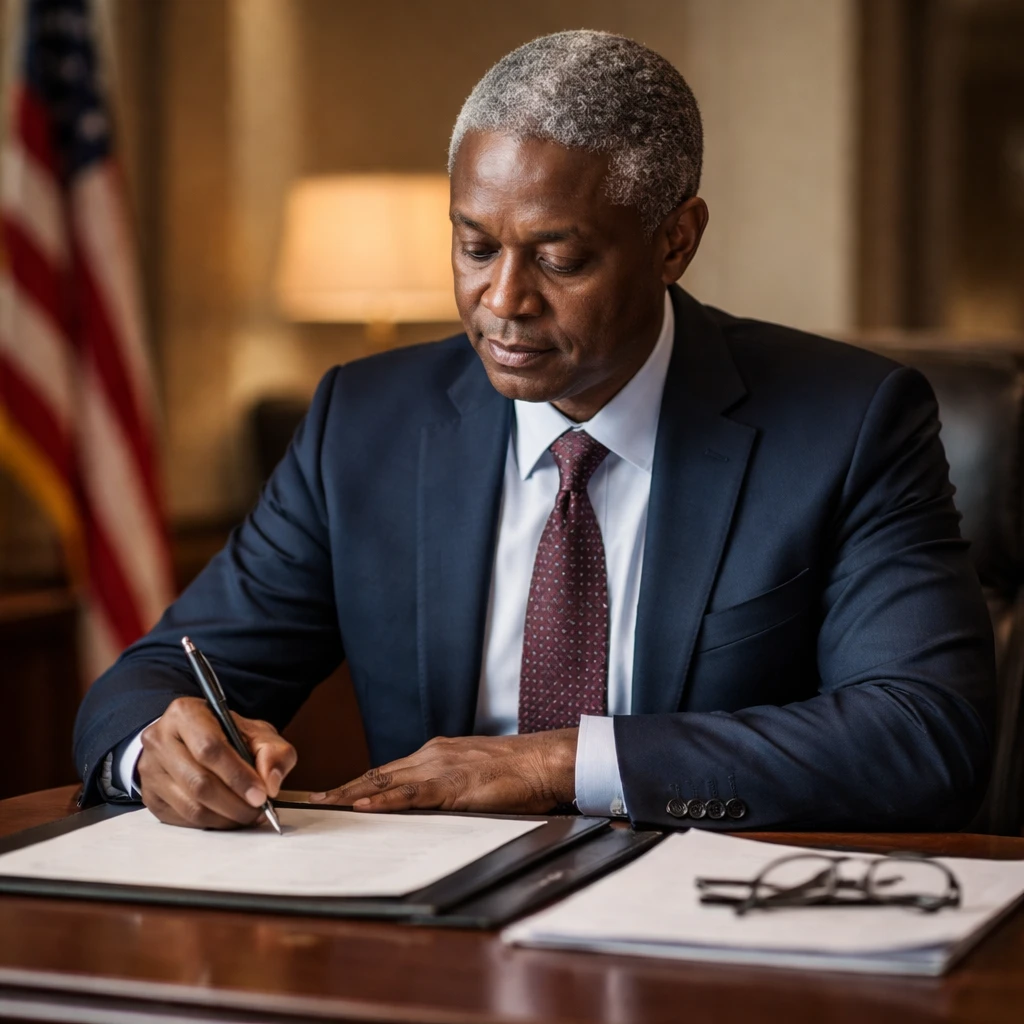
Raphael Bostic, the outgoing president of the Federal Reserve Bank of Atlanta, warned on Wednesday that political and legal confrontations targeting the central bank are eroding public confidence in its independence. Bostic described the trend as a serious concern with implications for U.S. economic performance and the country's standing as a global safe haven.
Bostic, who will complete his term on Friday, presented his observations in an essay framed as a farewell letter issued on the eve of his departure. In that piece he cautioned that U.S. economic strength and the nation's role as a refuge for global investors are not assured, and that preserving those advantages requires defending the Fed's institutional independence.
Writing from recent travels, Bostic said he encountered a broad cross-section of people who have begun to doubt whether the central bank can act without political interference. He attributed that shift in confidence to a combination of legal efforts and rhetoric directed at the Fed, which he said have prompted concerns across different segments of the population.
He emphasized that the stakes deserve public attention. Drawing on "decades of lived experience" and an extensive body of academic research, Bostic argued that economies benefit when the central bank operates independently. According to his letter, such independence is associated with lower inflation, more robust overall economic performance, and stronger confidence among consumers and businesses that long-term investments will pay off.
Although Bostic's farewell did not name President Donald Trump or his administration directly, the recent legal and rhetorical clashes he referenced have included high-profile actions and disputes. Those matters include reported attempts by the president to remove Fed Governor Lisa Cook, an active Department of Justice inquiry involving Fed Chair Jerome Powell, and frequent public calls by the president for lower interest rates.
Bostic's assessment links institutional credibility to tangible economic outcomes and to investor perceptions of the United States as a safe haven. He urged public awareness of what is at stake for inflation, investment decisions, and overall economic health, suggesting that protection of the Fed's independence is integral to sustaining those outcomes.
Clear summary
In a farewell essay released the day before he leaves office, Atlanta Fed President Raphael Bostic warned that legal and rhetorical battles have weakened public confidence in the Fed's independence, a trend he said threatens U.S. inflation outcomes, economic performance, and the nation's status as a global safe haven.
Key points
- Bostic said political and legal disputes are undermining public trust in the Fed's independence, which he views as critical to economic stability and investor confidence - impacts investors, financial markets, and overall economic sentiment.
- He cited decades of experience and academic research linking central bank independence to lower inflation and stronger economic performance - relevant to consumers, businesses, and long-term capital allocation.
- Specific controversies he referenced include reported efforts to remove a Fed governor, an investigation of the Fed chair by the Department of Justice, and repeated public demands for lower interest rates - matters affecting governance and market perceptions.
Risks and uncertainties
- Continued erosion of confidence in central bank independence could increase volatility in financial markets and reduce the attractiveness of U.S. assets to global investors - risk to capital markets and the broader financial sector.
- If public doubt persists, businesses and consumers may become less willing to commit to long-term investments, which could weigh on economic growth and corporate spending - risk to investment-driven sectors and overall demand.
- Ongoing legal and investigatory actions involving Fed leadership could create policy uncertainty, complicating the central bank's ability to manage inflation and economic performance - risk to monetary policy effectiveness and macroeconomic stability.