
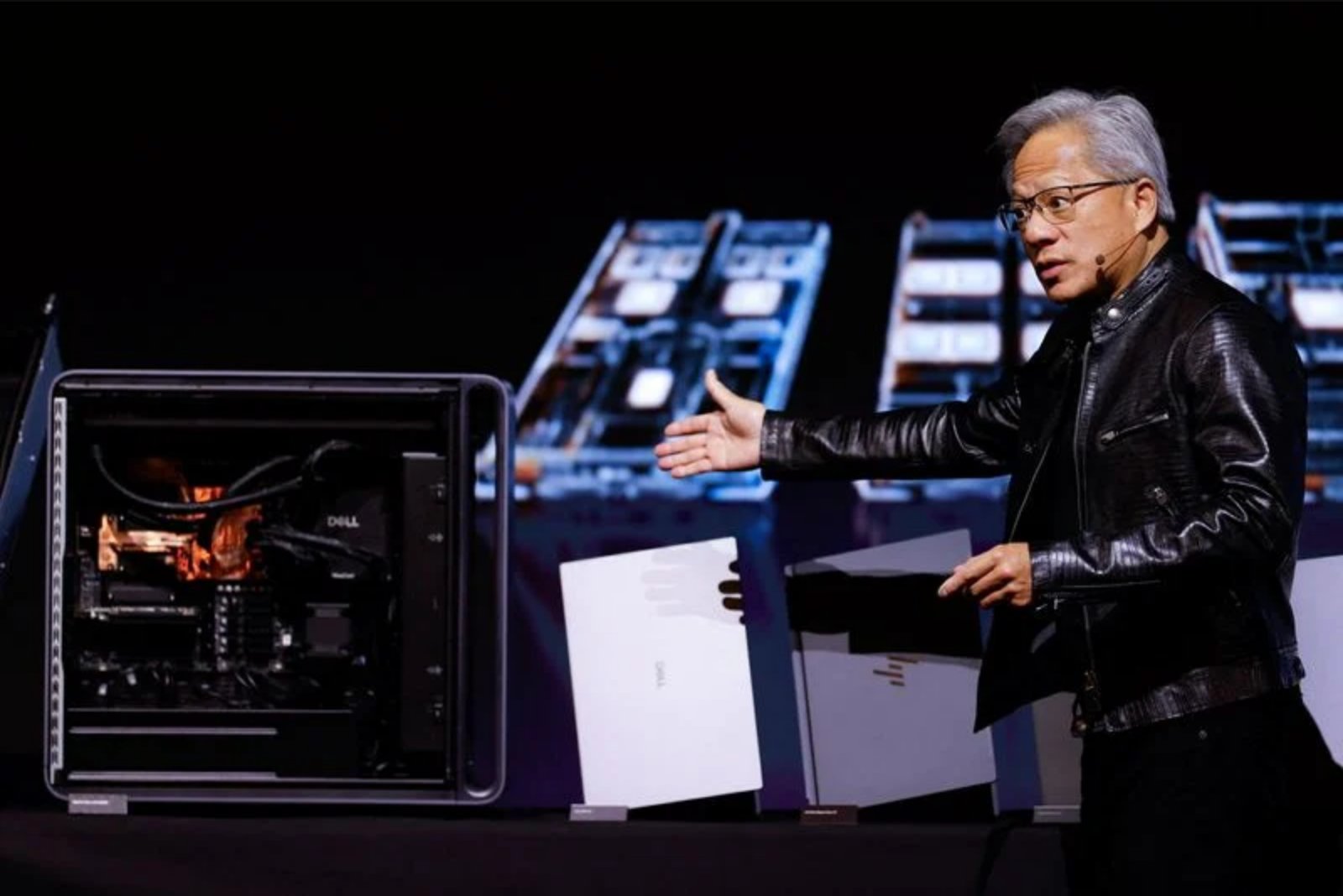
Nvidia chief executive Jensen Huang told a conference of chipmakers and hardware manufacturers in Taipei that while the company has capacity to support "very, very robust growth" from the AI boom, it is still hampered by supply constraints. The remarks came a day after the $5 trillion semiconductor firm introduced a new chip intended to compete with products from Advanced Micro Devices and Intel.
Huang's comments underline Nvidia's role as a key gauge of the AI market given the widespread use of its processors in data centres. On paper the message could have been encouraging for Asian suppliers to the company, but markets in the region were unsettled, with investor nerves driven by doubts over whether a U.S.-Iran ceasefire would hold.
Trading reflected the cautious tone. MSCI's broad index of Asia-Pacific shares excluding Japan fell 0.1%, and S&P 500 e-mini futures slid 0.4%. Oil prices cooled as Brent crude traded down 0.7% at $94.30, retracing earlier gains after Iran warned it might withdraw from talks with the United States.
There were also signs of de-escalation and continued friction in the Middle East. Lebanon announced a partial ceasefire earlier in the week between Hezbollah and Israel, but the Israeli military reported intercepting two projectiles fired from Lebanon on Tuesday.
Market moves in the region were uneven. Korean equities proved particularly volatile, swinging from an intraday gain of 1.7% that set a new record high to a decline of as much as 3.3%. Shares in Hong Kong and mainland China helped steady the wider Asian benchmark despite the swings.
Selective equity and commodity moves included notable stock and index performances: UK100 -0.68%, HK50 +1.28%, INTC -4.67%, NVDA +6.26%, AMD -1.16%, LCO -0.76%, ESM26 -0.38%, DG -0.61%, KS11 -1.98%, STXXc 10.00%, SSEC -0.04%, PANW +6.67%, MIPFJHC00PUS -1.58%, FDXMc1 +0.37%.
In European pre-market activity, pan-region futures were higher by 0.4%, German DAX futures rose 0.3% and FTSE futures inched up 0.1%.
Beyond equities and commodities, legal and corporate developments added to the market backdrop. A U.S. jury found investor Andrew Left guilty of securities fraud on Monday, according to the Justice Department. The verdict marks a setback for a group of high-profile short sellers who have long challenged public companies with allegations of fraud and mismanagement. Left is scheduled to be sentenced on August 31.
Items that could influence markets during the day included corporate reports from Palo Alto Networks and Dollar General, and economic releases such as France's April budget balance and U.K. data on Bank of England consumer credit, mortgage lending and money supply for April. Several sovereign debt auctions were also on the calendar: France offering 3-month, 7-month and 1-year bills; Germany selling 4-month, 10-month and 2-year paper; and the U.K. marketing 11-year government debt.
The trading day closed with persistent uncertainty around geopolitical developments and supply-side constraints in the semiconductor chain, while specific corporate and fiscal events provided further catalysts for risk appetite.
The day also included a market-oriented note querying whether Intel was undervalued, referencing a fair value calculator that uses a combination of 17 valuation models to assess stocks. The piece positioned that tool as a means to evaluate INTC alongside other equities.