
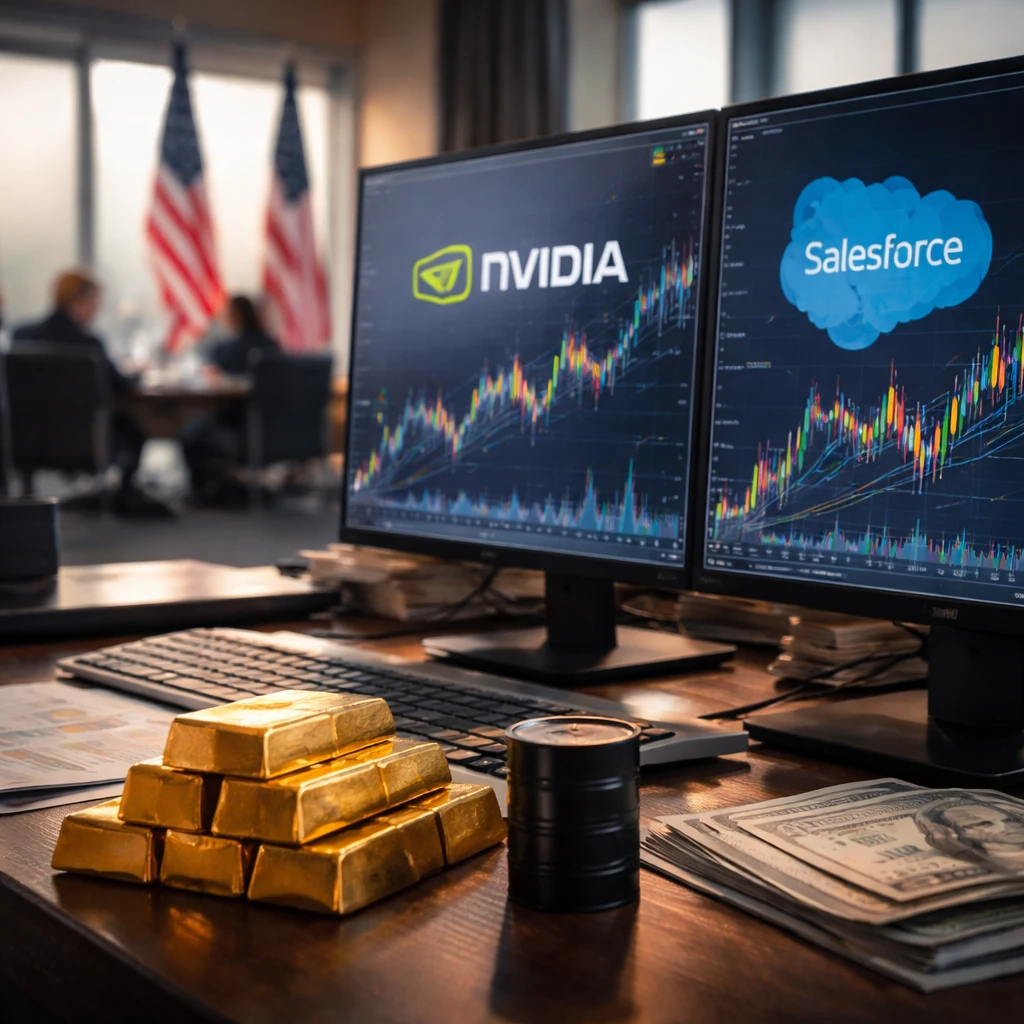
U.S. stock futures were broadly subdued on Wednesday as traders positioned themselves for a pair of high-profile earnings reports from Nvidia and Salesforce, two companies whose results are expected to shed light on how deep the artificial intelligence boom will ripple across corporate America.
By 03:01 ET (08:01 GMT), futures tied to the major indexes showed only small changes. The Dow futures contract was mostly unchanged, S&P 500 futures were up roughly 5 points, or 0.1%, and Nasdaq 100 futures had advanced about 29 points, also roughly 0.1%. Those limited moves came after the main Wall Street averages posted gains in the prior session.
Investor attention in recent days has been dominated by developments linked to AI. In particular, the market reacted to an announcement from AI firm Anthropic about a slate of partnerships, a move that helped calm some of the earlier investor anxiety that new AI models could seriously disrupt demand for traditional software and data businesses.
At the same time, market participants continue to scrutinize substantial investments in AI infrastructure by major technology companies. Observers have questioned when the heavy spending on AI computing will translate into meaningful revenue and profits, and have noted what some see as a "circular" pattern in recent AI-related commercial arrangements.
One high-profile example of that spending and dealmaking is Meta's reported agreement to buy 6 gigawatts of AI computing power from Advanced Micro Devices as part of a $100 billion arrangement that may lead Meta to hold roughly 10% of AMD's stock. AMD characterized the agreement as strengthening its ability to compete with its principal rival Nvidia, and shares of AMD jumped on the news.
Alongside these technology-sector dynamics, policy moves and geopolitical developments have kept additional pressure on markets. A fresh layer of uncertainty surrounds the status of new tariffs announced by President Donald Trump. After a Supreme Court decision struck down prior sweeping "reciprocal" levies, the administration imposed a temporary 10% global import tariff and has signaled a desire to raise the tariff to 15%. At a State of the Union address on Tuesday, President Trump said "everything was working well" with his tariff agenda and described the Supreme Court ruling as "unfortunate."
Nvidia in the spotlight
Nvidia will report results after the U.S. market close, and investors and analysts have framed the company's earnings as a bellwether for the broader AI trade and for how equity markets tied to the nascent technology may perform. Nvidia is widely viewed as central to the AI computing supply chain, and its results are being watched for indications about demand for AI hardware and the pace at which related spending converts into corporate profits.
The release comes at a moment when the so-called "Magnificent Seven" mega-cap technology stocks have largely lost the momentum that drove them higher after the launch of OpenAI's ChatGPT in late 2022. Those companies were among the principal beneficiaries of the AI enthusiasm that followed ChatGPT's debut, and their cumulative gains fueled broader market advances in recent years. But in the early months of 2026 that narrative has cooled, leaving investors more cautious.
Laurence Booth, Global Head of Markets at CMC Markets, summed up the broader market sensitivity by noting that "it's not only Nvidia investors who will be nervous ahead of the company's results; the entire global equity market may be on edge, given the importance of the AI trade."
Salesforce earnings to follow
Following Nvidia's report, Salesforce will also post quarterly results after the closing bell. The San Francisco-based cloud software company has been one of the most visible casualties of investor concern about the implications of advanced AI models for the software-as-a-service sector.
Salesforce shares have declined more than 26% year-to-date, reflecting investor unease about the outlook for software firms as AI capabilities evolve. Market sentiment around the stock entered the earnings window on a gloomy footing, a mood that analysts at Vital Knowledge said was compounded by an underwhelming forecast from IT services provider Workday earlier in the week.
In their note, Vital Knowledge analysts warned that "the AI-linked medium/long-term existential overhang weighing on all of software will not go away anytime soon." They added, however, that if Salesforce can deliver a "decent" fourth-quarter performance, provide "respectable" guidance for the current year and show tangible progress with its AI offerings, the company - and potentially the broader software-as-a-service cohort - could extend the rally that materialized in some names on Tuesday.
Gold edges higher amid tariffs and diplomacy
Precious metals also drew investor attention. Spot gold rose 0.9% to $5,190.21 an ounce, while U.S. Gold Futures gained 0.6% to $5,209.51 per ounce. The advance came after gold fell 1.6% the previous day, following four consecutive sessions of gains.
Part of the ascent in bullion reflected investor reaction to the newly imposed U.S. tariffs and the uncertainty they inject into global trade and inflation expectations. The temporary 10% global tariff began being collected on Tuesday, with the administration seeking to increase the rate to 15%, a policy change that has introduced fresh ambiguity into trade flows and inflation projections. The tariff action followed a U.S. Supreme Court ruling that struck down earlier sweeping duties imposed under emergency powers, a legal development that prompted the administration to reintroduce tariffs under a different statutory authority.
Geopolitical developments were another factor supporting the metal. The United States and Iran were set to hold a third round of talks later in the week in Geneva concerning Tehran's nuclear program, and markets were closely monitoring that diplomatic engagement.
Oil holds near multi-month highs
Crude oil prices remained near seven-month highs as market participants awaited the Switzerland negotiations. Brent futures ticked up 0.4% to $70.86 a barrel, while U.S. West Texas Intermediate crude futures were 0.5% higher at $65.93 a barrel. Both benchmarks remained close to levels not seen since early August.
Prices have been supported by the U.S. deployment of military assets to the Middle East, a move intended to press Iran toward agreement on ending its nuclear program. U.S. envoys, including special representative Steve Witkoff and presidential adviser Jared Kushner, were due to meet Iranian counterparts on Thursday as part of the diplomatic engagement.
Promotional note from market tools cited
The article also referenced a market research tool that evaluates Nvidia among thousands of companies. That service uses more than 100 financial metrics to assess stocks monthly and highlights prior winners including Super Micro Computer with a reported gain of +185% and AppLovin with a reported gain of +157%. The tool claims to apply AI to identify risk-reward characteristics across the current universe of companies and to flag opportunities that fit its strategies.
In aggregate, the trading day was shaping up as one in which AI-related corporate results, trade policy, and geopolitics converged to set the agenda for prices across equities, metals and energy. Investors entering the close of the quarter were parsing earnings as potential confirmatory signals for whether recent commitments to AI spending will translate into sustainable profit growth and whether policy and diplomatic developments will add more volatility to macro and market outcomes.