
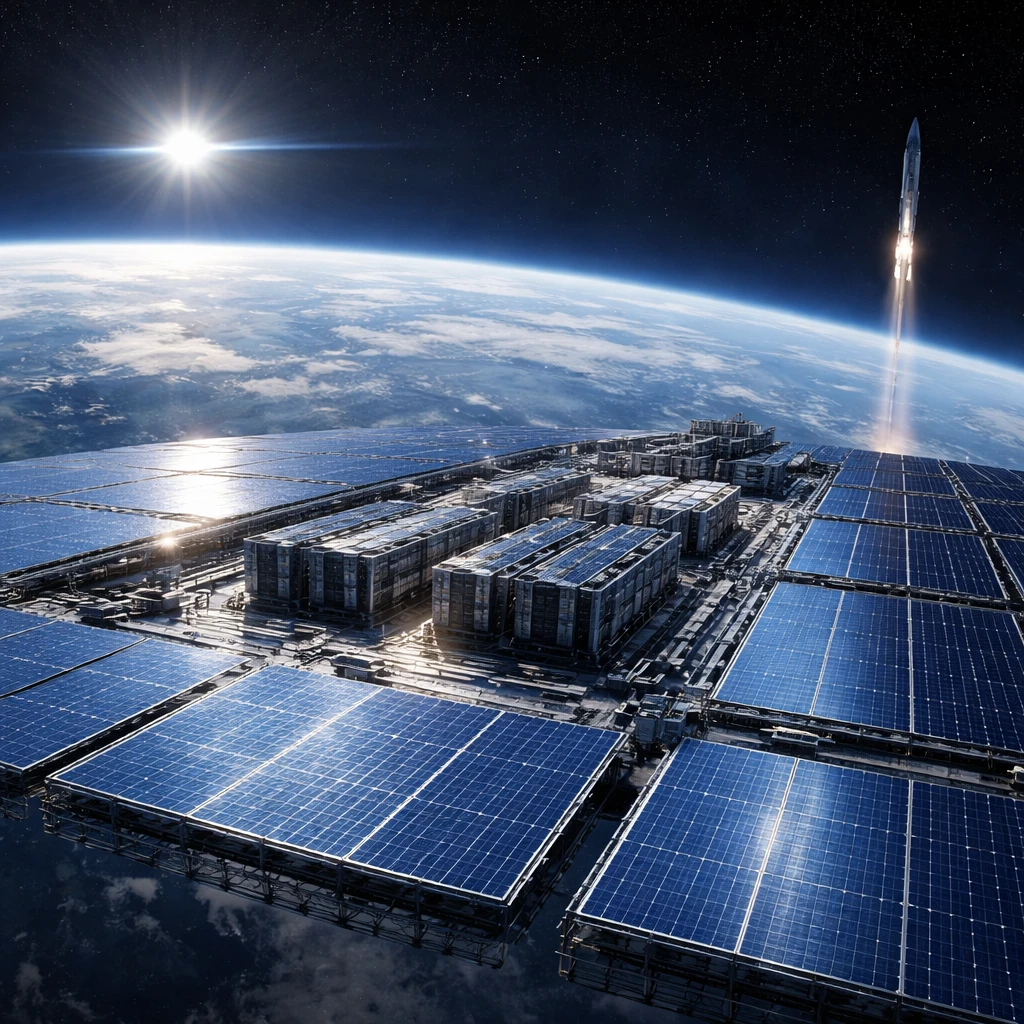
Elon Musk used a recent episode of the Dwarkesh Podcast to outline a sweeping view of how artificial intelligence could be powered in the years ahead, and where the bulk of compute infrastructure might ultimately be located. In his telling, SpaceX occupies a strategic position at the center of that potential shift.
Musk argued that energy - not processing chips - is emerging as the primary limitation on AI growth. "The limiting factor for AI is power generation," he said, noting that data centers are already "running into serious issues just getting enough electricity."
From that premise he drew a line to space. Musk suggested that orbit offers unique advantages for large-scale power generation: constant sunlight, the absence of atmospheric attenuation, no night cycle, and no land constraints. "The long-term future of AI compute is in space," he said. "You can put solar panels in orbit where they get sunlight 24/7, no atmosphere, no night cycle, and no land constraints."
He went further on the economics: once launch costs fall through full reuse and solar arrays are mass produced, space-based power could become substantially cheaper than terrestrial alternatives. "Once you have fully reusable rockets and mass production of solar arrays, the economics flip," Musk said. "Space ends up being the cheapest place to generate energy."
That economic argument elevates launch capability from exploration to essential infrastructure. "You need a way to move a lot of mass to orbit cheaply and reliably," he said. "That’s exactly what SpaceX is designed to do." The implication in his remarks is that the company’s ability to reduce the cost and increase the cadence of delivering mass to orbit is central to enabling orbital energy and compute platforms.
Musk described a future in which expansive solar-powered platforms in orbit host compute clusters, supplying AI models with abundant clean energy. He acknowledged engineering challenges - maintenance in orbit, radiation shielding and data transmission - but characterized them as engineering problems rather than fundamental physical barriers. "Everything we’re talking about is solvable with existing physics," he said. "It’s just an engineering problem."
He emphasized the pace of demand as a driving force. "The amount of compute required is growing exponentially," Musk said. "If you try to build all of that on Earth, you’re going to hit walls - regulatory, environmental, and power-grid limits." In his view, those terrestrial constraints will accelerate consideration of off-Earth compute solutions.
The line of thought aligns with Musk’s concurrent efforts at xAI, which he said is working to match the scale of the largest generative AI players. "We’re building some of the biggest training clusters in the world," he said, and noted that energy consumption is already a dominant cost factor. "That’s why power generation matters more than almost anything else."
Musk also tied the data-center and energy buildout back into his work at Tesla, which he portrayed increasingly as an AI and energy infrastructure company rather than solely an automaker. "Tesla is really an AI robotics company," he said. "Cars are robots on wheels. Optimus is a humanoid robot. And all of it runs on massive neural networks." He added that as autonomy improves, the compute demands - and therefore energy needs - will grow substantially. "Every order of magnitude improvement in AI requires an enormous increase in compute," he said.
Energy becomes the common thread in Musk’s depiction of a future economy spanning Earth and space. He said both Tesla and SpaceX are aiming to expand solar production dramatically. "We need on the order of 100 gigawatts of solar per year," Musk said. "That’s what it takes to support the future economy - AI, transportation, and eventually off-planet infrastructure."
He argued that orbit removes many inefficiencies of ground-based solar. In orbit, panels would not require heavy supports, would avoid weather damage and would not lose power during nighttime. "It’s just pure energy generation," Musk said.
While acknowledging the vision sounds futuristic, Musk framed it as an economic inevitability rather than distant science fiction. "At some point it simply becomes irrational to keep building all the compute on Earth," he said. "The numbers push you into space."
In Musk’s description, SpaceX evolves beyond rockets and planetary ambitions to serve as the backbone for an AI-energy economy where data centers float above the planet, powered by near-constant sunlight and feeding ever-larger AI systems. "The future civilization will be built on abundant energy and massive compute," he said. "And space is where those two things ultimately scale best."
Summary
On the Dwarkesh Podcast, Elon Musk presented a case that power generation is now the binding constraint on AI expansion and made the case for moving significant compute capacity to orbit. He argued that SpaceX’s launch infrastructure and future mass production of solar arrays could make space-based power and data centers cheaper than terrestrial alternatives, with engineering and regulatory hurdles regarded as solvable.
Key points
- Energy is the primary bottleneck for AI scale, according to Musk, shifting the focus from chips to power generation.
- Space-based solar arrays and orbital data centers could offer continuous sunlight and avoid many terrestrial constraints, potentially becoming cheaper with reusable rockets and mass production.
- The plan intersects with Musk’s other projects - xAI and Tesla - which both tie back into rising compute and energy needs for AI and robotics.
Risks and uncertainties
- Engineering challenges remain - maintenance in orbit, radiation protection and data transmission - though Musk described them as solvable engineering problems.
- Terrestrial limits such as regulatory, environmental and power-grid constraints could complicate or delay shifts in where compute is located.
- The economic case depends on achieving fully reusable rockets and mass production of solar arrays; without those advances the projected cost advantages may not materialize.