
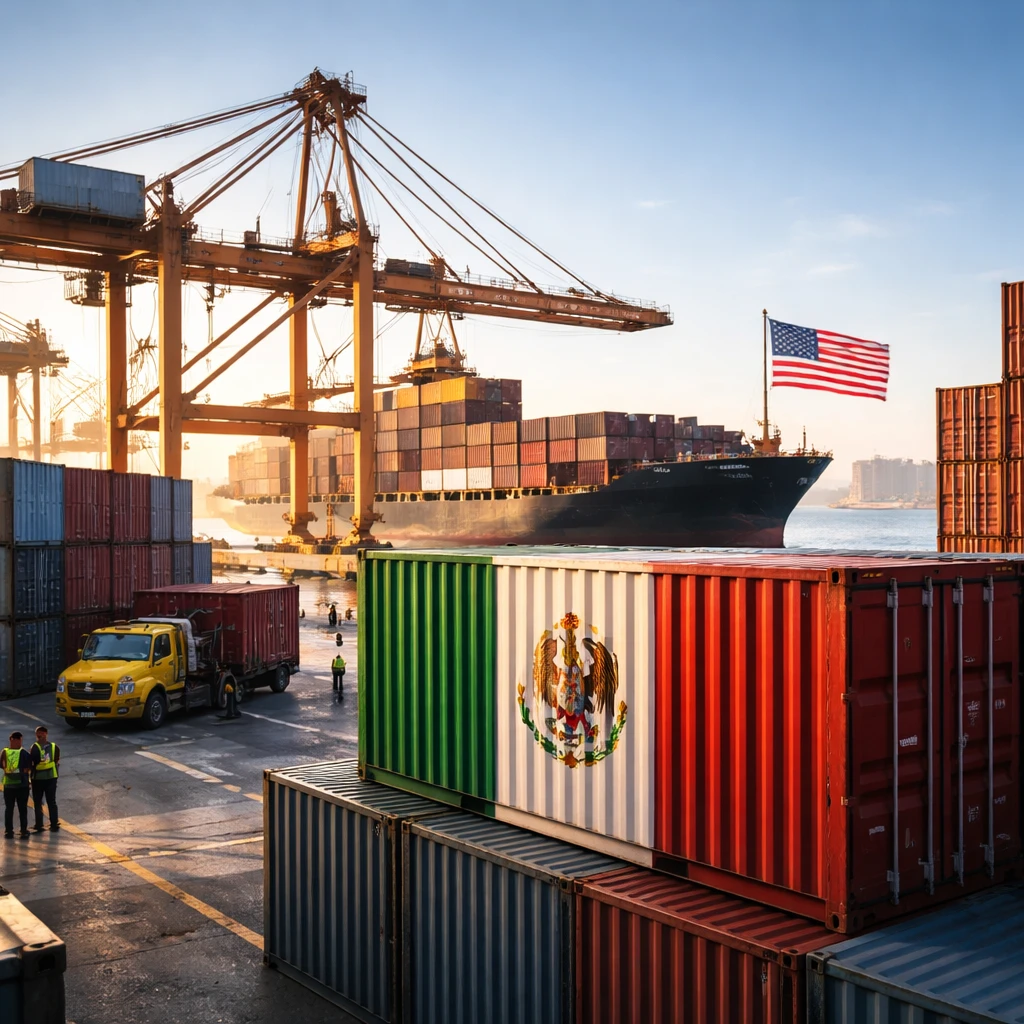
Mexico's Economy Ministry on Wednesday issued a formal clarification that goods meeting United States-Mexico-Canada Agreement (USMCA) rules of origin would not be subject to a proposed 10% tariff from the United States tied to an investigation into forced labor enforcement.
The ministry said the clarification followed consultations with the Office of the U.S. Trade Representative (USTR). In its statement, the ministry indicated that roughly 85% of Mexico's exports to the United States qualify under USMCA rules of origin and therefore would be excluded from the proposed tariff measure.
The tariff proposal under consideration from the U.S. Trade Representative would impose a 10% import duty on goods from Mexico and about a dozen other economies, among them Canada, the European Union, Argentina and Britain. The package of possible tariffs forms part of an investigation that asserts 60 countries have not effectively prevented imports of products made with forced labor originating in third countries.
In addition to the economies facing the proposed 10% duty, the USTR indicated another group of 45 economies would see additional duties at a higher rate of 12.5% under the same inquiry.
Mexico's Economy Ministry also noted that the proposed tariffs would not alter measures already enforced under Section 232 of U.S. trade law, explicitly including autos, steel and aluminum among goods already covered by those orders.
On timing, the ministry emphasized that the tariffs as proposed would not take effect immediately. The U.S. process would leave the measure subject to a 45-day consultation period before any implementation, according to the ministry's advisory.
Summary
The Economy Ministry said products that meet USMCA rules of origin are exempt from a proposed 10% U.S. tariff tied to a forced labor probe, following consultations with the Office of the U.S. Trade Representative. Approximately 85% of Mexico's exports to the United States qualify under those rules and would not be covered by the proposal. The measure would not affect goods already under Section 232 orders, and it would be subject to a 45-day consultation before any potential enforcement.
Key points
- Approximately 85% of Mexico's exports to the United States qualify under USMCA rules of origin and would be exempt from the proposed 10% tariff.
- The USTR's proposal would apply a 10% tariff to Mexico and about a dozen other economies, and an additional 12.5% duty to another 45 economies.
- Goods already covered by Section 232 orders, specifically autos, steel and aluminum, would not be affected by this proposed measure.
Risks and uncertainties
- The proposal remains preliminary and subject to a 45-day consultation process, so its final scope and timing are uncertain.
- Exports from Mexico that do not meet USMCA rules of origin could still face the proposed 10% tariff, creating potential exposure for those specific supply chains and products.
- The broader investigation cites 60 countries and contemplates duties for up to 45 additional economies at a 12.5% rate, leaving uncertainty for multinational suppliers and trading partners outside the USMCA framework.