
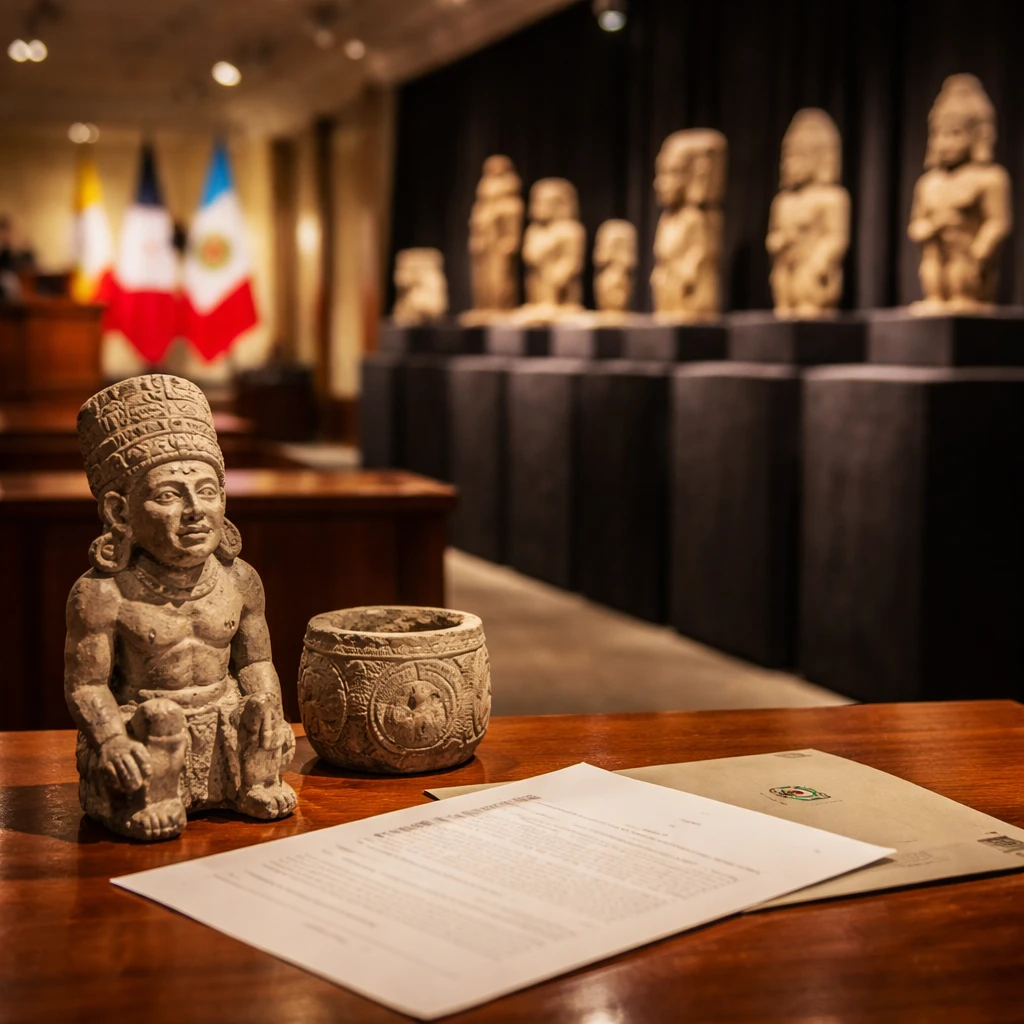
Mexico's federal government said on Thursday it has begun legal action to prevent an auction house in Paris from going ahead with the sale of 40 pre-Colombian artifacts that Mexican authorities regard as national patrimony.
Culture Secretary Claudia Curiel announced on the social platform X that the government has initiated "appropriate legal proceedings before the relevant authorities" and has contacted diplomatic channels to pursue the repatriation of the objects. In her post she framed the move as both a state responsibility and an act of historical justice.
The items are part of a pre-Colombian collection Millon has advertised under the title "Les Empires de Lumiere" and that the auction house planned to sell in person in Paris on Friday, according to Curiel. The auction house did not immediately respond to requests for comment, and its website displayed a maintenance message on Thursday.
Legal basis cited by Mexican authorities
Curiel posted a copy of a letter she sent to Millon on Tuesday in which she referenced findings by Mexico's National Institute of Anthropology and History, INAH. The institute concluded that 40 of the objects Millon had advertised are protected by Mexican legislation.
In the letter, Curiel wrote that the goods are "property of the Nation, unalienable and incontrovertible," and noted that their export has been prohibited since 1827. She added that, for that reason, the presence of these objects outside Mexico amounts to what the letter described as illicit extraction.
Longstanding repatriation efforts and recent disputes
Mexico has for many years sought the return of artifacts from private collections in other countries that it identifies as part of its pre-colonial cultural heritage. Curiel's statement noted that while some returns have been negotiated with other governments, many artifacts remain the subject of protracted disagreements.
The public record includes high-profile, unresolved cases such as the bejeweled headdress attributed to the Aztec ruler Moctezuma, which is housed at Austria's Weltmuseum. The museum has said that moving the piece would damage its fragile quetzal feathers.
In 2023 Mexico undertook a separate legal action against Millon over 83 objects the auction house had offered for sale that Mexican authorities determined were part of the country's cultural patrimony. At that time, Millon told an art trade outlet that it intended to proceed with the sale and asserted that its lots had "irreproachable origin" and complied with the criteria set by French law and UNESCO.
What happens next
The immediate trajectory of the current case will depend on rulings by the relevant judicial and administrative authorities in France and on the diplomatic exchanges between Mexico and foreign counterparts. Mexico's public statements emphasize legal remedies and repatriation as the government's objectives, while the auction house has not provided a substantive reply to the latest public notification.