
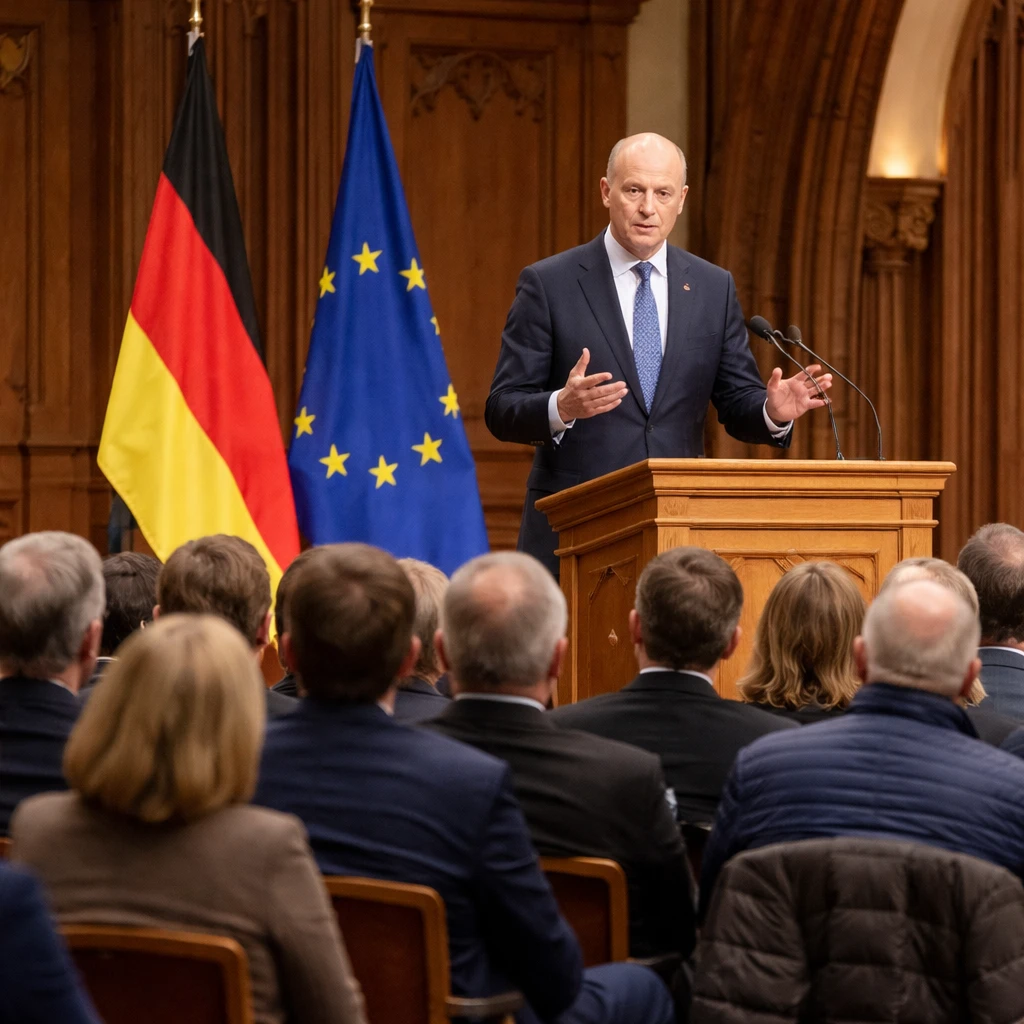
German Chancellor Friedrich Merz announced on Wednesday that he plans to pursue "strategic partnerships" with China during a trip scheduled for next week, outlining a foreign policy that tightly links economic cooperation and national interest.
Speaking at his party's Ash Wednesday gathering in Passau, Bavaria, Merz said Germany must cultivate international partners who share its values and willingness to jointly shape the future. He framed this effort not simply as diplomacy but as essential to sustaining prosperity and social protections in Germany.
"We have a strategic interest in finding partners in the world who think the way we do, who act the way we do, and who above all are prepared to shape the future together so that we remain a country with prosperity and a high level of social security," Merz said.
The chancellor emphasized that Germany can no longer treat foreign and economic policies as separate domains. In his remarks he directly addressed the protectionist direction of U.S. policy, arguing it is not the path Berlin will follow.
Merz criticized the U.S. emphasis on tariffs, saying: "If the Americans believe that, with their tariff policy, they should exert influence around the world - if they believe that tariffs are more important than taxes at home - then that is something Americans can, of course, decide for themselves. But it is not our policy."
He reiterated Germany's refusal to mirror Washington's tariff-first stance: "You can do it, but we will not go along with it. And if you overdo it, then we Europeans are certainly able to defend ourselves against it."
As part of his argument for cohesion within Europe, Merz pointed to a recent dispute linked to Greenland as an illustration of EU unity. He warned that the European Union would take countermeasures should the United States impose additional tariffs that affect Europe.
Describing Berlin's planned diplomatic posture, Merz said Germany would pursue a "double strategy". He explained this approach as offering engagement and readiness for renewed partnerships while maintaining sufficient unity within the European Union to resist policies it finds unacceptable.
Merz described the approach as "an outstretched hand and, at any time, a renewed partnership - but also enough cohesion and unity within the European Union so that we can defend ourselves sufficiently against things we do not want."
Merz's comments come as he prepares to travel next week and seek strategic ties with China while drawing a clear line between Germany's policy and that of the United States on tariffs. The chancellor positioned Germany and Europe as willing to engage globally but also prepared to defend their economic interests collectively within the EU framework.