
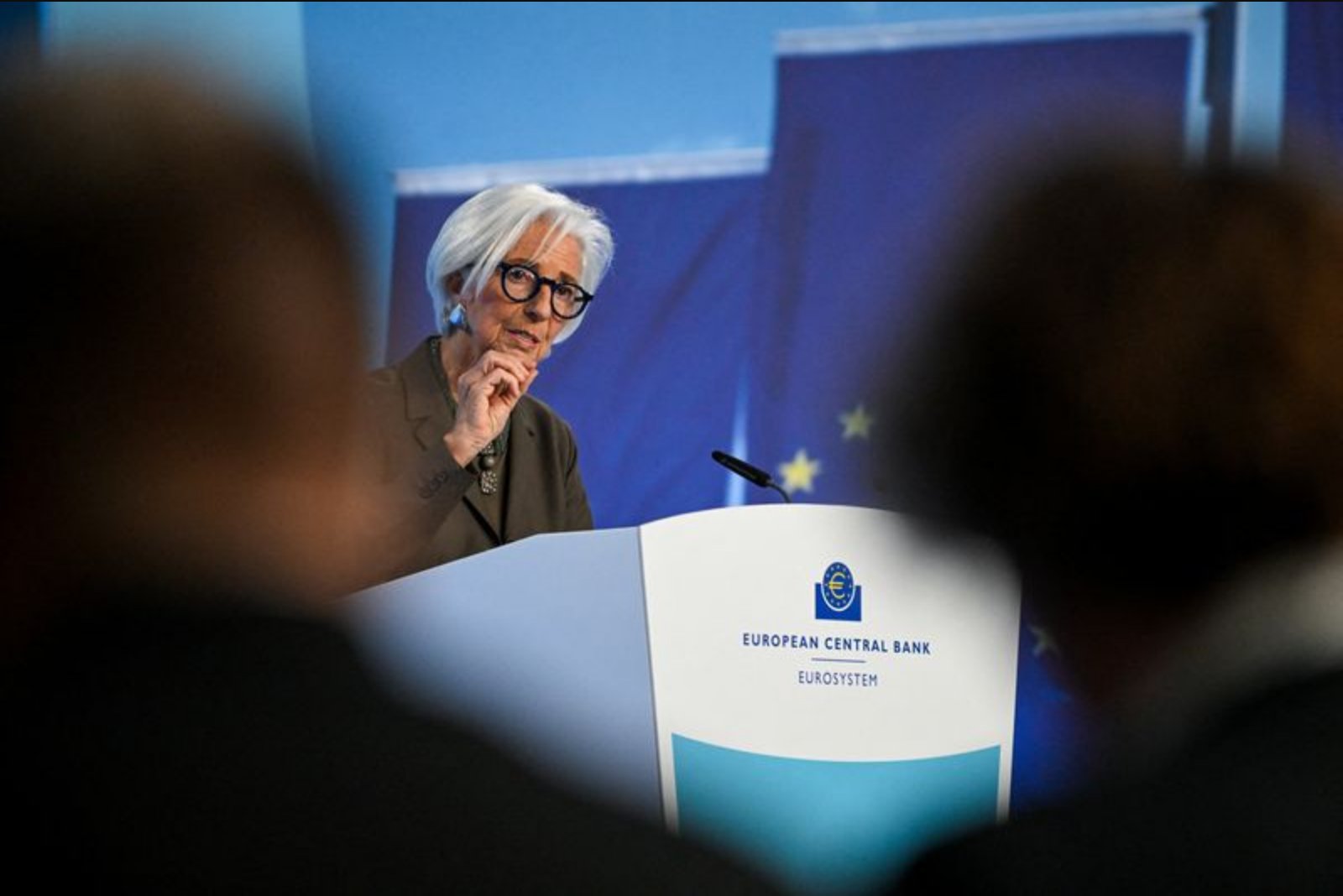
LONDON, Feb 18 - Reports that European Central Bank President Christine Lagarde is considering leaving her post before the scheduled end of her eight-year term in October 2027 have prompted renewed discussion over the future leadership of the euro zone's central bank and what that could mean for monetary policy.
According to published accounts, Lagarde has not settled on precise timings but has expressed a preference that incumbent French President Emmanuel Macron and German Chancellor Friedrich Merz play central roles in determining her successor. An ECB spokesperson said that Lagarde remains focused on her duties and has not made any decision concerning the end date of her term.
The prospect of an earlier-than-expected departure has added momentum to the contest to replace Lagarde, though market participants broadly expect the bank to keep interest rates at their current level of 2% for an extended period. Traders and many analysts said any immediate market impact is likely to be limited, given current inflation dynamics and the expectation that frontrunners would adhere to broadly similar policy frameworks.
"I don’t think Lagarde’s possible departure significantly raises market uncertainty... This is not like the (Mario) Draghi-era where creative and unconventional policy was a constant feature," said Ross Hutchison, head of euro zone market strategy at Zurich Insurance Group. "The ECB is in a good place ... This reduces the immediate risks of a change of leadership."
Market-implied interest rate expectations showed little movement on Wednesday. Traders still appeared to price in a period of policy stability followed by the prospect of at least one rate cut by year-end. Germany's two-year government bond yield, which is highly sensitive to expectations for short-term rates, was essentially flat at roughly 2.06%. The 10-year German yield also held steady at near 2.75%. The euro weakened marginally, trading around $1.184, down about 0.1%.
Investors and analysts are now scrutinising the record and public positions of likely successors. Spain's former central bank governor Pablo Hernandez de Cos and Klaas Knot, the ex-head of the Dutch central bank, have emerged as prominent names in the discussion. Views differ on their leanings: Klaas Knot is often described as a "pragmatic hawk," while Hernandez de Cos is viewed as comparatively more dovish, yet both are seen as having balanced profiles.
"Knot was seen as a 'pragmatic hawk' and De Cos as more dovish, but that both showed balanced profiles, which would ensure policy continuity," said Frederik Ducrozet, head of macroeconomic research at Pictet Wealth Management.
Analysts emphasised the institutional nature of ECB decision-making, noting that policy is produced through consensus-building among Governing Council members. "Whoever replaces Lagarde is unlikely to radically shift or change the way the ECB works," said Andrzej Szczepaniak, senior European economist at Nomura.
Nevertheless, some commentators warned that the optics of an early departure for political reasons could harm the central bank's reputation. Concerns cited in commentary include the potential for public perceptions that national governments are shaping the choice of a powerful European policymaker.
Political timing is a point of sensitivity. President Macron cannot seek a third consecutive term, and the French presidential election scheduled for spring 2027 could see the far-right Rassemblement National come to power, according to the accounts. The report on Lagarde's intentions follows a separate recent development in which France's central bank governor François Villeroy de Galhau announced he would step down earlier than planned to allow President Macron to appoint his successor.
Frederik Ducrozet cautioned that, while Lagarde's purported motive to shield the ECB from populist political pressure might be honourable, it would be hard to justify: "Lagarde 'may have honourable intentions - protecting the ECB from populist political pressure - but this decision would be difficult to justify,'" he said. "I’m not sure this is a risk worth taking."
For now, market participants appear to be taking a wait-and-see approach. With inflation described as under control in the prevailing commentary and likely candidates perceived as policy-orthodox, traders have kept their focus on near-term economic data and the existing expectation that the ECB will hold rates before potential easing later in the year.