
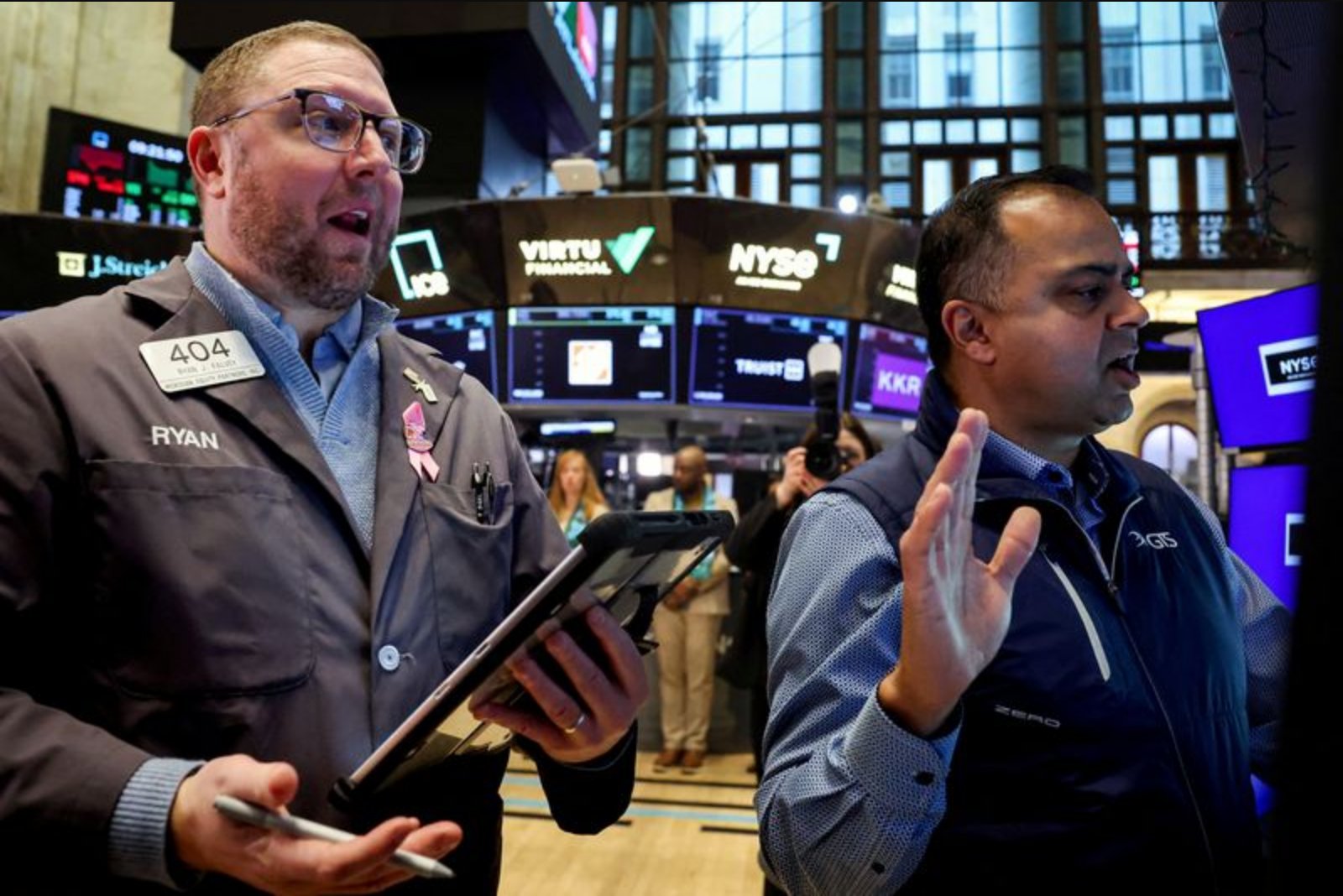
Markets around the world reacted violently on Monday to a weekend military strike by U.S. and Israeli forces on Iran, with energy prices and volatility surging while most bond and stock benchmarks retreated. Oil and gas registered their largest daily increases in years, complicating the outlook for inflation and growth and presenting a thorny choice for Treasury investors: buy sovereign debt on the basis of rising geopolitical risk and potential growth damage, or sell in anticipation of higher inflation as energy costs climb. Early moves suggest inflation concerns are currently dominating investor behaviour.
The shockwaves were broad. Nearly every major Asian and European index fell in the 1-3% range, while the most conspicuous exceptions were China and some U.S. indices where the Nasdaq and the Russell 2000 advanced. Many investors and analysts were left parsing which forces - risk-off flows, commodity shocks, or central-bank responses - will ultimately steer markets in the near term.
Key market moves
- Stocks: Asian and European benchmarks declined about 1-3% on the day. In the United States, the Dow ended the session down 0.15%, the S&P 500 edged up 0.04%, the Nasdaq rose 0.4% and the Russell 2000 gained 0.9%.
- Sectors and notable shares: Four of the S&P 500's 11 sectors finished higher, including technology and industrials, each up roughly 1%, and energy, which rose about 2%. Consumer staples, consumer discretionary and healthcare each fell by 1% or more. Among named stocks, Northrop Grumman and Marathon Petroleum rose, with Marathon Petroleum up 6%, while AES dropped 17% and Norwegian Cruise Line fell 10%.
- Foreign exchange: The U.S. dollar posted its strongest day since July. The yen slid about 1%, while the Swiss franc fell by more than 1% against the dollar, its largest decline since May amid speculation the Swiss National Bank acted to curb appreciation. The recent rally in the Chinese yuan appeared to stall. Bitcoin climbed roughly 5%.
- Bonds: U.S. Treasury yields jumped, moving as much as 11 basis points at the short end and producing a bear-flattening of the curve.
- Commodities: Oil settled up about 6% as supply-disruption fears mounted. Benchmark European liquefied natural gas surged as much as 50% intraday before settling near a 40% gain after Qatar halted production, marking the largest single-day rise since Russia's invasion of Ukraine four years ago. Average U.S. gasoline prices rose above $3 per gallon. Precious metals diverged, with gold up about 1% and silver down roughly 4%.
Explaining the moves
Energy was the dominant theme. Fears of disruptions to supply pushed crude and other energy contracts markedly higher. Though oil pulled back from earlier peaks, its close up 6% has meaningfully altered year-on-year comparisons used in inflation models, shifting the input-cost backdrop for many forecasters and investors. Liquefied natural gas drove some of the most extreme price action: after Qatar announced a halt to production, benchmark European LNG prices briefly more than doubled the intraday typical swing, rocketing over 50% before retracing to about a 40% advance.
Currency markets produced a notable surprise. The Swiss franc, typically seen as a haven currency, depreciated more than 1% versus the dollar. The scale of that decline - the largest since May - and the central bank's public statement that it is prepared to act to prevent "excessive" franc appreciation fueled widespread speculation that the Swiss National Bank intervened in markets to resist a sudden inflow of safe-haven capital. The available signals point to intervention having occurred.
Meanwhile, U.S. equities presented a study in contrasts. After opening lower in line with global declines, Wall Street recovered to end the day narrowly mixed overall, with technology and small-cap indices proving resilient and outpacing the modest losses in other regions. Given the severity of the geopolitical shock and the associated rise in energy prices and bond yields, the limited downside in U.S. markets could be interpreted as either resilience or complacency. Investors will be watching closely to see whether the pattern holds in the days ahead.
Near-term catalysts to watch
- Further developments in the Middle East, especially those affecting energy supply lines.
- Australia - current account (Q4).
- Japan - unemployment (January).
- Euro zone - flash estimate of inflation (February).
- United Kingdom - budget update and economic forecasts to be announced by the Chancellor.
- Brazil - GDP (Q4).
- Speeches by U.S. Federal Reserve officials, including New York Fed President John Williams, Kansas City Fed President Jeffrey Schmid and Minneapolis Fed President Neel Kashkari.
Bottom line
Monday's trading session underscored the market's sensitivity to geopolitical shocks that can ripple through energy, currency and bond markets. Fast-moving moves in oil and LNG have immediate implications for inflation readings and the growth outlook, complicating the positioning for investors in Treasuries and risk assets. How markets interpret the balance between higher geopolitical risk and higher inflation will be a central question for the coming days.