
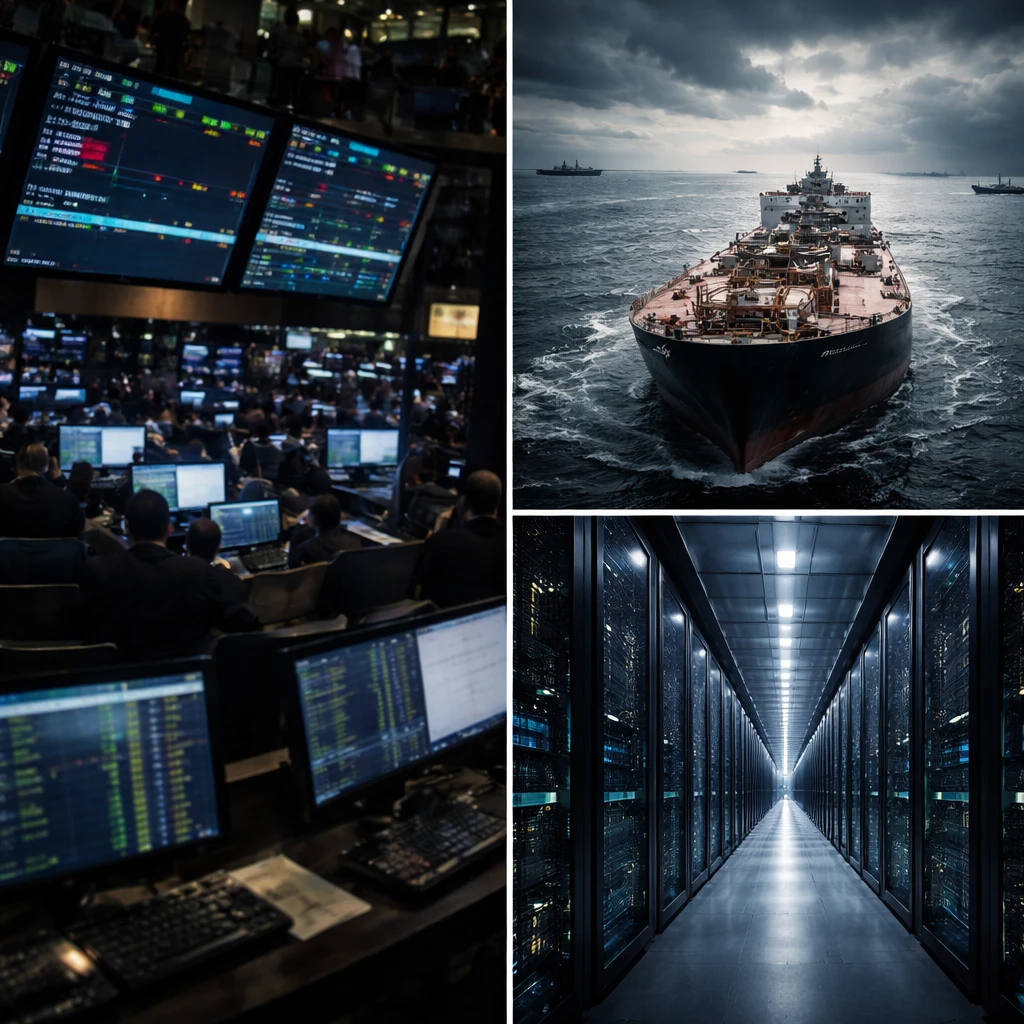
U.S. equity futures were largely subdued as investors weighed inconsistent signals about the status of talks aimed at ending hostilities involving Iran. By 03:54 ET (07:54 GMT), futures on the Dow were down about 60 points, or 0.1%, S&P 500 futures were off roughly 8 points, or 0.1%, and Nasdaq 100 futures had slipped about 39 points, or 0.1%.
Those moves followed a session in which the main U.S. averages finished marginally higher after a rebound driven in part by technology stocks. Optimism around generative artificial intelligence continued to buoy sentiment in the sector, with large AI initiatives prompting market interest across hardware and software providers. The market narrative has also been influenced by reports of a near-trillion-dollar valuation tied to a proposed initial public offering from Anthropic, the maker of the Claude AI model.
Futures and market backdrop
The modest losses in U.S. futures reflected an uneasy market tone rather than a decisive directional shift. Investors cited mixed messages about whether mediated communications between Tehran and Washington are ongoing, creating uncertainty about the geopolitical path ahead and the potential economic repercussions.
Separately, fresh data pointed to continued resilience in U.S. manufacturing activity despite the broader geopolitical tensions linked to the conflict involving Iran. That resilience has provided a partial offset to headline risk, but did not remove caution from trading floors early in the session.
Diplomatic noise adds uncertainty
Developments in the Middle East remained a key focus. Lebanon announced a partial ceasefire between Iran-backed Hezbollah fighters and Israel, though Israel's military reported intercepting two projectiles fired from Lebanon on Tuesday. Against this backdrop, U.S. President Donald Trump offered mixed public commentary on the status of negotiations with Iran, saying at one point that he believed a peace deal could be reached within a week and later describing talks as "progressing rapidly." He also said there "was a little glitch" in the negotiations, a comment observers linked to reported Iranian objections to Israeli actions in Lebanon.
At the same time, it was unclear whether mediated exchanges between the United States and Iran had resumed, and Mr. Trump had previously indicated indifference over whether Iran had paused participation in those discussions. That oscillation in official remarks contributed to the tentative tone in markets.
Oil eases but remains elevated
Against the diplomatic uncertainty, Brent crude futures declined by 1.6% to $93.42 a barrel by 04:13 ET, slipping from recent peaks above $100 but remaining well above pre-conflict levels. U.S. West Texas Intermediate futures were down about 1.4% at $90.90 a barrel.
Oil markets had rallied the previous session after reports that Tehran had stopped sending mediated messages to Washington. While the immediate price pressure eased, the conflict has coincided with a significant reduction in energy flows through the Strait of Hormuz - now operating at a fraction of levels seen before the outbreak of hostilities in late February - a development that has kept supply concerns and inflationary risks on investors' radars.
Hewlett Packard Enterprise posts a blockbuster quarter
Hewlett Packard Enterprise delivered record second-quarter results and pushed up its long-term financial ambitions by two years, underscoring strong demand for servers and networking equipment tied to the build-out of AI data centers. In extended-hours trading, HPE shares jumped 36%.
The company reported revenue of $10.68 billion, up 40% year-over-year and above the average analyst estimate of $9.79 billion. Adjusted earnings per share were 79 cents, beating the consensus estimate of 53 cents. Management raised its fiscal 2026 revenue growth outlook to a range of 29% to 33%, up from an earlier projection of 17% to 22%. It also now forecasts annual networking segment revenue growth of 72% to 75%, compared with a prior range of 68% to 73%.
HPE competes in the server and data-center markets with firms such as Dell and Super Micro Computer. The company attributed its stronger results to the pace of AI infrastructure deployment, which has driven elevated demand for the specific server and networking configurations HPE supplies.
Alphabet outlines large equity raise to fund AI spending
Alphabet Inc. announced plans to raise $80 billion in equity capital to help cover the rapidly rising costs of its AI infrastructure. The package includes a $30 billion underwritten public offering - structured across depositary shares representing mandatory convertible preferred stock, Class A common stock and Class C capital stock - plus a $40 billion at-the-market offering expected to commence in the third quarter of 2026.
In addition, Berkshire Hathaway has agreed to participate with a $10 billion private placement. Alphabet said the capital program reflects the scale of investment required to keep pace with rising demand for its AI offerings, noting that demand from both enterprises and consumers is currently exceeding the company’s available compute capacity.
Market implications and areas to watch
The combination of diplomatic uncertainty, constrained energy flows through critical shipping lanes, and large, visible capital commitments by major technology companies created a layered market picture. Energy and defense-sensitive sectors remained exposed to developments in the Middle East, while technology hardware suppliers and data-center equipment vendors were in focus as AI-related spending supported strong top-line momentum at companies such as HPE. Meanwhile, the scale of Alphabet's planned funding round highlighted the capital intensity of competing in the generative AI ecosystem.
Investors will likely continue to monitor public statements by officials involved in the negotiations with Iran, oil market dynamics around the Strait of Hormuz, incoming macro data on manufacturing and demand trends, and quarterly updates from companies exposed to AI infrastructure spending.