
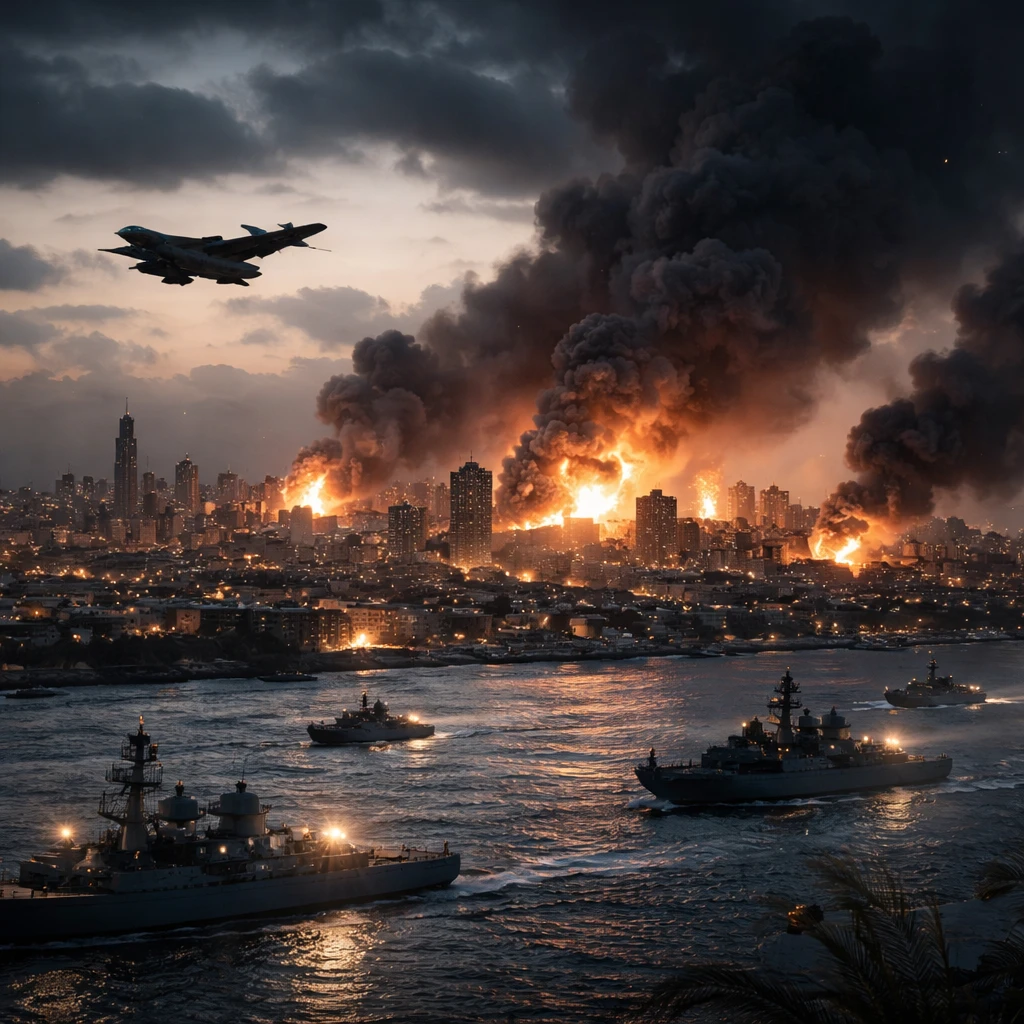
President Donald Trump said on Saturday that the U.S. military has commenced "major combat operations" in Iran, a development that coincided with reports of explosions across parts of the Middle East and strikes targeting locations in Iran's capital.
In a video posted on Truth Social, the president framed the operations as a defensive effort, saying: "Our objective is to defend the American people by eliminating imminent threats from the Iranian regime, a vicious group of very hard, terrible people." He also asserted that Iran had continued to pursue nuclear capabilities despite prior negotiations intended to curb its program.
The president recounted a previous operation, saying: "[In] operation midnight hammer last June, we obliterated the regime’s nuclear program at Fordow nets. And Isfahan. After that attack, we warned them never to resume their malicious pursuit of nuclear weapons, and we sought repeatedly to make a deal. But Iran refused." He added that Iran had sought to rebuild its nuclear program and to develop long-range missiles capable of threatening U.S. allies and forces abroad.
A U.S. official confirmed that American forces carried out strikes by air and sea. Iranian officials reported that several ministries in the southern part of Tehran were targeted. Explosions were also reported in Jerusalem following what Iranian sources described as counterattacks. Earlier on Saturday, Israel conducted a daylight strike on Iran’s capital, with smoke visible over downtown Tehran.
Market reaction and strategist views
Market strategists contacted after the developments said the immediate outlook is one of elevated volatility, but most cautioned against reading the episode as a permanent structural change to asset-pricing paradigms.
Keith Lerner, chief investment officer and chief market strategist at Truist Advisory Services, said investors were already contending with a complex set of forces before the latest escalation. "As if AI disruption and renewed tariff uncertainty were not enough for investors to contend with, geopolitical tensions flared late in the month following a joint U.S.-Israel strike on Iran," Lerner said. He added that historically such events tend to exert only short-term effects on markets, while noting that oil prices remain an important variable to watch. Taken together, Lerner said the conditions point to heightened volatility - a dynamic that he described as consistent with a midterm election year.
Michael Brown, a senior strategist at Pepperstone, said he expected crude prices to gap higher when markets reopen, alongside gains in traditional havens such as gold, the Japanese yen, the Swiss franc and U.S. Treasuries. He warned that equities and higher-beta currencies could face downward pressure but emphasized that geopolitical shocks rarely produce lasting moves in major asset classes once the initial reaction subsides.
William Jackson, chief emerging markets economist at Capital Economics, said the wider economic consequences will depend heavily on developments in oil markets. "Our estimates suggest that the political risk premium baked into the oil price has already risen substantially," his firm said, adding that Brent oil futures could move toward $80 per barrel even if strikes remain limited.
What to watch next
- Oil prices and any sustained change in the political risk premium embedded in energy markets.
- Safe-haven flows into gold, the yen, the Swiss franc and U.S. Treasuries during the initial market reaction.
- Performance of equities and higher-beta currencies, which could experience short-term pressure if risk aversion persists.
Strategists collectively framed the episode as a potential shock that could push volatility higher in the near term but were reluctant to conclude it would cause a lasting re-pricing across major asset classes without further escalation or a sustained change in oil fundamentals.