
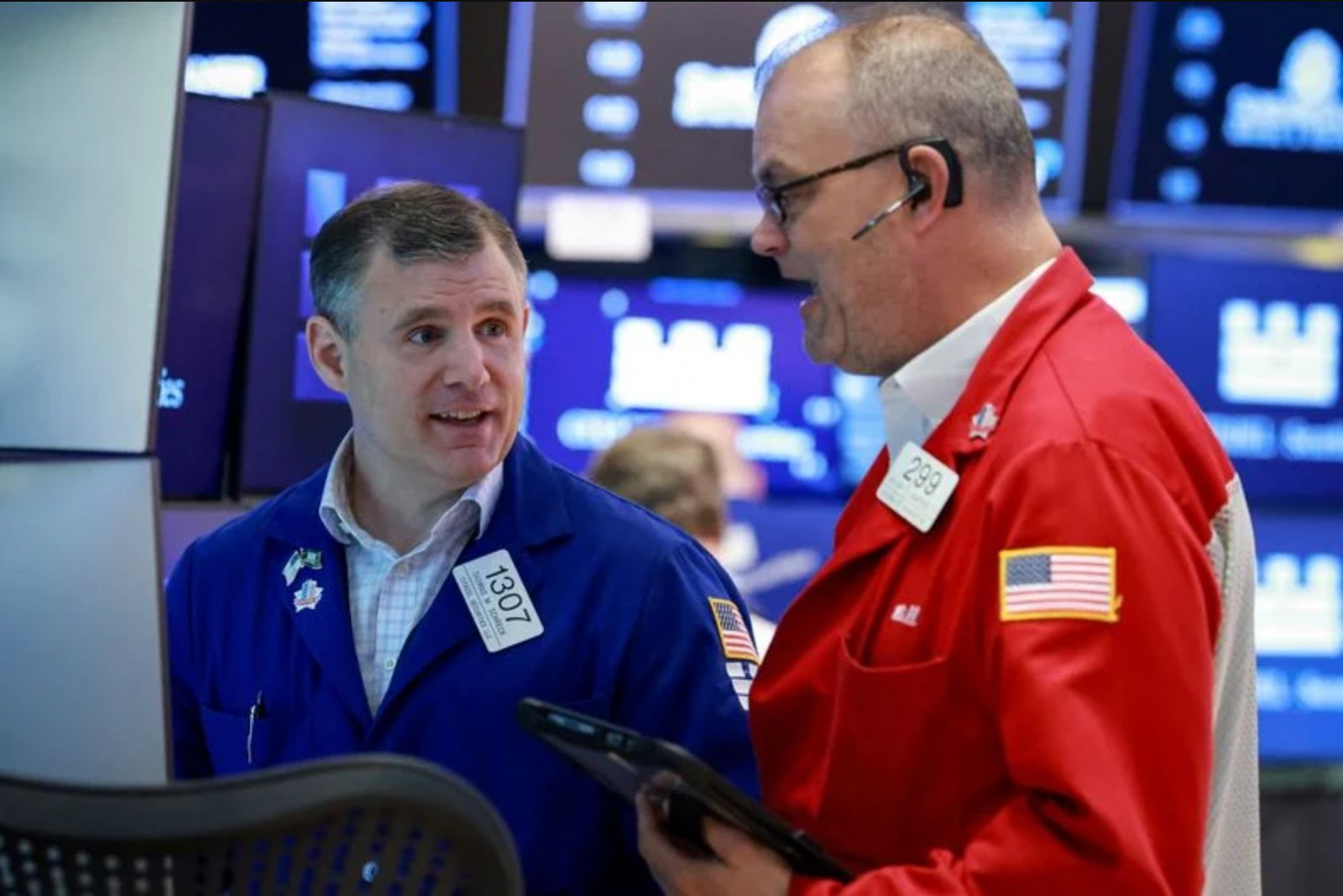
The trading session on Thursday was characterized by a decisive recovery for Wall Street after an initial period of weakness. Although some indices opened with losses exceeding 1%, the market trajectory shifted throughout the day. The Nasdaq managed to close without net changes, while the S&P 500 staged a recovery from an intraday low to finish up 0.41%. Most notably, the Dow Jones Industrial Average maintained its momentum to close 1.7% higher, setting a new record high.
Market Dynamics and Sector Performance
The divergence in sector performance highlights a rotation of capital away from certain technology-heavy areas into more traditional sectors. In the S&P 500, only two sectors experienced declines: technology, which fell by 1.4%, and consumer staples, which saw a marginal decrease of 0.1%. Conversely, nine other sectors posted gains. Financials led the upward movement with a 2.7% increase, followed closely by healthcare, which rose by 3%. Individual stock movements reflected this broader trend: Blackstone climbed 7.5% and Humana gained 6.8%, while semiconductor-related names like Broadcom and Micron Technology faced significant selling pressure, dropping 12.6% and 7.7% respectively.
This market behavior suggests that investors are actively seeking opportunities in various sectors regardless of the prevailing macroeconomic or geopolitical news flow. The underlying environment is supported by financial conditions that remain among the loosest seen in recent years. This sentiment is further reinforced by the VIX, which is hovering near its lowest points for the year. In terms of implied volatility, the 3-month euro/dollar rate dipped below 5% this week, marking the first time such levels have been seen since 2021, suggesting a high degree of market composure.
Private Credit and Asset Management Pressures
While equity markets appear stable, the private credit sector is facing renewed scrutiny as redemption requests increase. Large alternative asset managers are seeing heightened demand for liquidity from their investors. Blackstone, the largest player in the global alternative asset space, reported that investors in its $79 billion flagship private credit fund sought to redeem 10% of their shares in the second quarter, an increase from the 7.9% seen in the first quarter. To manage these outflows, Blackstone has capped withdrawals at 5%. Similar patterns are emerging elsewhere; Cliffwater noted that investors in its $31 billion private credit fund attempted to redeem 17% of their holdings in Q2, though they were also subject to a 5% withdrawal cap.
Cryptocurrency Volatility
The digital asset market experienced significant downward movement on Thursday. Bitcoin fell to a four-month low, trading around $61,000. This represents a loss of approximately 20% over the last two weeks and a roughly 50% decline from its peak above $126,000 in October. Part of this downward momentum is attributed to MicroStrategy, the largest corporate holder of bitcoin, which announced its first sale of the asset since 2022. Despite this volatility, some analysts remain optimistic. Geoff Kendrick of Standard Chartered has maintained a bullish stance, predicting bitcoin could reach $100,000 by the end of the year, suggesting that current price levels may represent an attractive buying opportunity for long-term investors.
Macroeconomic Outlook and Key Indicators
As the market prepares for upcoming data, attention is shifting toward the U.S. labor market. While recent indicators suggest some warning flags, the broader data trend appears to be moving upward, potentially indicating a turnaround in economic momentum. The release of U.S. nonfarm payrolls on Friday will be a critical driver for market sentiment. Other global factors to watch include developments in the Middle East and various central bank communications from officials in New Zealand, Australia, England, and India. Additionally, upcoming GDP revisions in the Eurozone and inflation data from Taiwan will provide further context for the global economic landscape.