
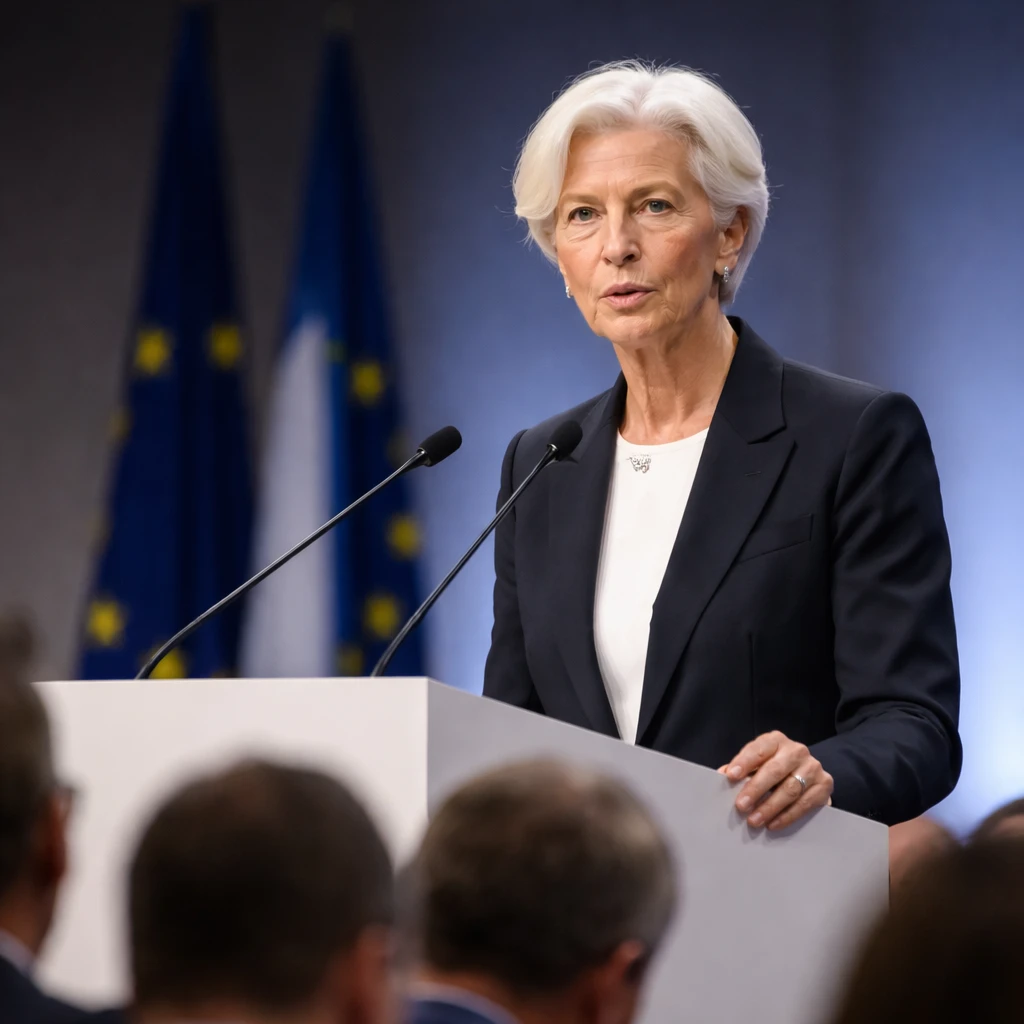
European Central Bank President Christine Lagarde said Monday that the euro zone economy has become more resilient to shocks, a development that has eased the central bank's ability to tighten policy without precipitating financial instability.
In remarks delivered at the ECB forum on Central Banking, Lagarde said the 21-nation currency area is likely to encounter an increasing number of inflation shocks in the years ahead. That prospect, she said, presents policymakers with a choice: to treat some episodes of price volatility as pass-through events that can be ignored, or to confront others with decisive monetary action.
The ECB implemented a rate increase this month in response to an energy shock tied to the Iran war, becoming the first major central bank to move on that specific disturbance. Officials are now in active discussion about whether an additional rate step will be necessary to rein in ongoing price pressures.
Lagarde attributed much of the euro area's improved ability to absorb shocks to an expanded monetary-policy toolkit, a stronger overall financial architecture and a range of policy instruments designed to enhance stability. She specifically highlighted measures such as joint bank supervision as elements that have bolstered resilience across the bloc.
"While we are more likely to face shocks that push inflation away from target, the resilience Europe has built means their effects on our economy are more contained," Lagarde said. "We may therefore more often find ourselves in an intermediate zone, between shocks we can look through and those we must react to forcefully."
The comments underscore the tension confronting ECB policymakers: balancing the costs of acting on every bout of inflation volatility against the risk of allowing price pressures to become entrenched. The recent rate move marked a notable instance of the bank responding to a geopolitically linked energy shock, and officials continue to assess whether follow-up tightening is required.
Key points
- The euro zone has increased its resilience to economic shocks, easing the transmission of monetary-tightening measures without triggering financial stress.
- The ECB raised interest rates this month in response to an Iran-war related energy shock and is debating whether further hikes are needed to control inflation.
- Strengthened tools and institutional arrangements - including joint bank supervision - are cited as contributors to the bloc's improved shock absorption.
Sectors affected
- Financial sector - due to references to financial stress and bank supervision.
- Energy sector - given the rate move was prompted by an energy shock tied to the Iran war.
- Monetary policy-sensitive markets - as interest-rate decisions influence borrowing costs and asset prices.
Risks and uncertainties
- A rising frequency of inflation shocks could complicate policy decisions, forcing trade-offs between ignoring temporary volatility and acting decisively.
- Policymakers are uncertain whether further rate hikes are necessary following the recent move that addressed the Iran-war induced energy shock.
- While greater resilience has contained shock effects so far, there remains the risk that some shocks will require forceful policy responses to prevent persistent inflation.