
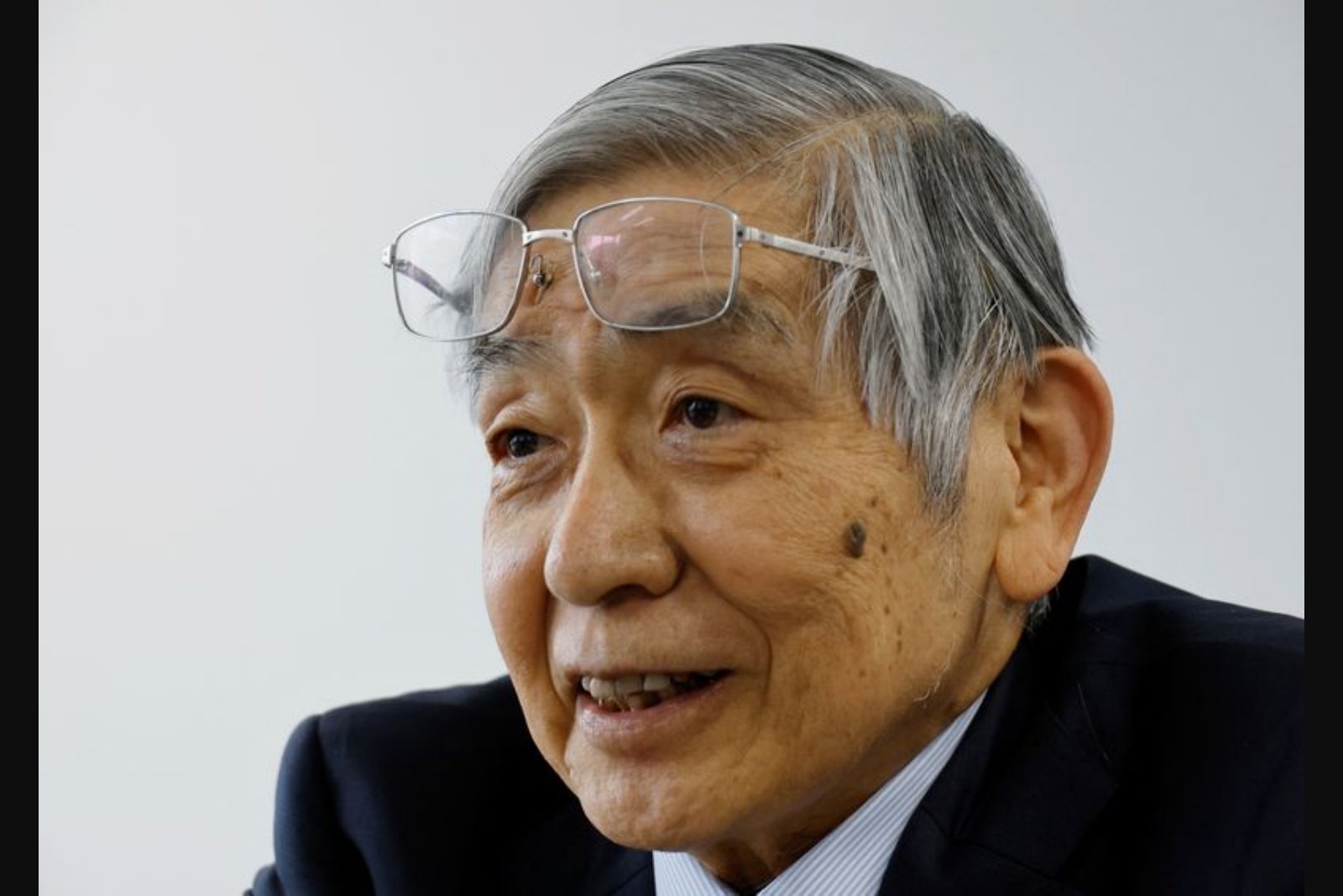
Former Bank of Japan governor Haruhiko Kuroda said Japan should continue raising interest rates and move toward tighter fiscal policy, arguing the economy is already "in great shape" and that fresh fiscal easing risks intensifying inflationary pressures.
In a wide-ranging interview, Kuroda - who introduced large-scale monetary stimulus in 2013 as part of the Abenomics-era push to end deflation - said the central bank could likely increase rates around twice a year through 2026 and 2027 if growth and wage momentum remain firm. He described the current macro backdrop as distinct from the conditions that prevailed when Abenomics was launched, noting a shift from deflation and a strong yen to an environment of sustained inflation and a weaker currency.
"When Abenomics was deployed, Japan was suffering from deflation and a strong yen. Now, Japan is experiencing inflation and a weak yen. Japan needs to move toward tighter fiscal and monetary policy," Kuroda said. He argued the BOJ should "gradually raise interest rates towards levels deemed neutral to the economy" and that fiscal policy should move in a tightening direction as well.
Kuroda also questioned the advisability of increasing spending and cutting taxes at this juncture. He acknowledged the role of government support in spurring innovation and lifting long-term potential growth, but warned that fiscal measures intended to blunt the impact of rising living costs would be counterproductive because they would add to inflation and push up bond yields.
Those comments underscore a clear policy divergence between Kuroda and the current administration led by Prime Minister Sanae Takaichi. While Kuroda has urged more restrained fiscal settings, Takaichi has pursued expansionary measures, expanding spending and pledging to suspend an 8% sales tax on food for two years to ease household cost pressures.
Kuroda, now a senior fellow at the National Graduate Institute for Policy Studies, also highlighted the Bank of Japan's pace of policy normalisation following a sustained period of stimulus under his leadership. He noted that the BOJ exited his era of monetary stimulus in 2024 and has since raised rates multiple times, including a move in December. The BOJ's key policy rate currently stands at 0.75%, and Kuroda suggested there may be scope to lift that rate toward a range of about 1.5% to 1.75% in coming years provided the economy maintains its current momentum.
The former governor cautioned that aggressive fiscal expansion at a time of above-target inflation and a tight labour market - conditions that have contributed to steady wage gains - could magnify inflationary dynamics. He warned that fiscal easing directed at cushioning consumers from higher prices would likely be counterproductive by feeding further inflation and exerting upward pressure on government bond yields.
Kuroda's remarks come amid heightened market attention since Takaichi's large election victory on February 8 and concerns over whether her administration will push for looser monetary and fiscal policy. Market unease over fiscal trajectories helped trigger a late-year selloff in the yen and Japanese government bonds, forcing the administration to moderate its policy rhetoric at the time.
Recent market moves have kept the currency in focus. A report that Prime Minister Takaichi raised concerns about further rate hikes with BOJ Governor Kazuo Ueda prompted some yen weakness, with the currency at 155.80 per dollar on Wednesday. Japanese authorities have relied on verbal interventions to prevent the yen from moving past the 160 per dollar level, but such measures have not reversed the broader weakening trend that is lifting import costs and contributing to wider inflation.
Kuroda judged the yen’s recent level to be "somewhat too weak" relative to an equilibrium implied by Japan’s near-term growth, price developments and competitiveness. He drew attention to the limitations of currency intervention, observing that while interventions can have temporary effects, their durability is not guaranteed. Kuroda also noted his own past role overseeing exchange-rate policy as Japan’s top currency diplomat from 1999 to 2003.
On communication strategy, Kuroda said the bold "shock-therapy" messaging he used during his decade of stimulus to convince markets and the public that inflation would return has little role in the current phase of policy normalisation. With the BOJ gradually lifting rates toward neutral, he argued, excessive commentary risks disturbing markets and is unnecessary. He said Governor Ueda’s more measured and vague public statements are appropriate and that a low-profile approach makes sense while normalising policy.
His assessment highlights tensions between sustaining growth, managing inflation and navigating the political pressures that accompany fiscal decisions. Kuroda’s view is that a careful, coordinated move toward tighter monetary and fiscal settings is the prudent path if the economy continues to demonstrate strength and wage gains persist.
Summary
Haruhiko Kuroda, former BOJ governor, said Japan should continue raising interest rates and tighten fiscal policy because the economy is in strong condition. He warned that the current administration’s spending increases and tax suspensions could fuel inflation and raise bond yields. Kuroda favoured gradual BOJ rate increases toward neutral, endorsed muted communications from the central bank, and suggested the BOJ’s policy rate could be pushed toward 1.5% to 1.75% if the economy sustains momentum.
Key points
- Kuroda recommends further BOJ rate hikes - roughly twice a year in 2026 and 2027 if conditions hold - and a move toward tighter fiscal policy.
- He warns that expansionary fiscal moves such as increased spending and temporary tax relief on food could stoke inflation and lift government bond yields; this is particularly relevant for fixed income markets and sectors sensitive to import costs.
- The yen’s weakness is seen as somewhat excessive relative to Japan’s near-term fundamentals, a development that raises import costs and has implications for consumer-facing sectors and inflation dynamics.
Risks and uncertainties
- Expansionary fiscal policy that cushions households from higher living costs could amplify inflation and increase bond yields - a risk for bond markets and inflation-sensitive sectors.
- Continued yen depreciation could raise import costs and feed into broader inflation, affecting retailers, consumer goods companies and households.
- Political friction between the government’s fiscal stance and the BOJ’s monetary normalisation could complicate the central bank’s rate-hike timetable, introducing uncertainty for markets.