
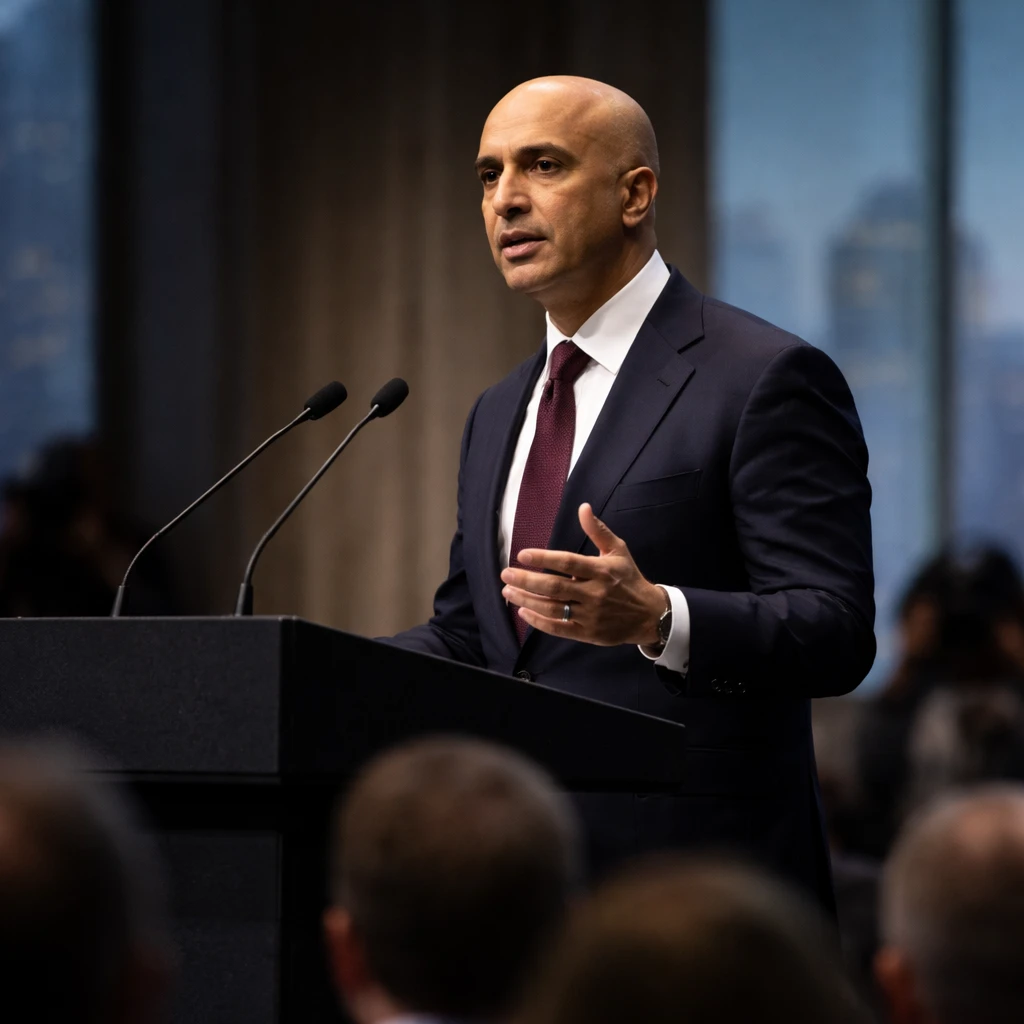
Federal Reserve Bank of Minneapolis President Neel Kashkari said on Tuesday that the recent strike on Iran has intensified uncertainty around the U.S. economic outlook and made it more difficult to forecast the trajectory of central bank interest-rate policy.
Speaking at an event hosted by Bloomberg in New York, Kashkari recalled he had considerable confidence in the economic outlook until the joint U.S.-Israel attack on Iran took place a few days earlier. That confidence, he said, has been materially affected by the new geopolitical shock.
As a Fed official with a voting seat on the Federal Open Market Committee this year, Kashkari said he entered 2026 anticipating that easing inflationary pressures would open the door to a single interest-rate reduction. He described that expectation as conditional, however, and noted that the recent events require reassessment.
"When it comes to monetary policy, we need to see with this new shock, potentially a new shock hitting the global economy...how long is the effect, and how big is the effect?" Kashkari said. He emphasized the central bank's need to observe incoming data before concluding whether the disruption will be short-lived or persistent.
Kashkari framed the current uncertainty in comparative terms, asking whether the situation will resemble the impact seen after Russia's invasion of Ukraine or the effects following Hamas' attacks on Israel. "The question I think that we are wrestling with, and markets are wrestling with, is, how long is this going to last? How bad is it going to get?" he said, noting that the answers will have consequences for monetary policy.
The Fed reduced its target range for the federal funds rate by three quarters of a percentage point last year, bringing the overnight target to between 3.5% and 3.75%, as officials sought to cushion a softening labor market while continuing work to return elevated inflation to the 2% goal.
Financial markets had been pricing in the likelihood of rate cuts in 2026, but those expectations narrowed as oil prices rose and threatened the disinflationary progress seen earlier. Kashkari observed that such market shifts could be reversed if it becomes clearer that the conflict involving Iran and U.S. policy will materially drag on economic activity.
The Minneapolis Fed chief warned that inflationary consequences of external conflicts can be unpredictable. He said the Fed usually focuses on underlying inflation indicators to assess the outlook for price pressures, but that approach may be complicated now if headline inflation remains elevated for an extended period following years of above-target inflation.
"If headline inflation is going to be elevated for an extended period of time, coming off of five years of elevated inflation, boy, that's a...scenario that we need to pay close attention to," Kashkari said. He stressed the importance of monitoring how such developments could influence inflation expectations.
Before the attack on Iran, Kashkari said he had viewed the economy as reasonably healthy. He expected inflation to ease and characterized the labor market as "pretty good" while beginning to soften. In that context, he said policy appeared appropriately positioned, giving the Fed the latitude to let policy gradually move back toward neutral.
With the new geopolitical shock, Kashkari said the path forward is less clear. "I felt like policy was in a pretty good place and we have the luxury of just letting it gradually glide back to neutral," he said, underscoring the uncertainty that now clouds that outlook.
Kashkari also commented on leadership changes at the central bank. He said he looks forward to working constructively with Kevin Warsh, who has been named to succeed Jerome Powell as Fed chair when Powell's term as chair ends in May. Kashkari indicated he is open to engaging with Warsh on criticisms of the institution and on Warsh's views for managing the Fed's large balance sheet and its rate-control framework.
On the question of Powell's future at the Fed, Kashkari said he would "love it" if Powell remained as a governor after his chair term concludes. Powell can retain a governor seat until 2028, and Kashkari noted that many expect he will continue in that role to help safeguard the Fed's independence amid political pressure.
Summary
Neel Kashkari said the U.S.-Israel strike on Iran has increased uncertainty about the economic outlook and complicated the Federal Reserve's policy path. He entered 2026 expecting that easing inflation would allow one rate cut, but now wants to see how this geopolitical shock influences inflation, oil prices and growth before making policy moves. Kashkari also commented on the incoming Fed chair and the possibility of Jerome Powell remaining as a governor.
Key Points
- Kashkari says the recent attack on Iran has reduced his confidence in the near-term economic outlook and complicated rate-cut prospects for 2026.
- The Fed cut its target range last year by 0.75 percentage points to a 3.5%-3.75% range, balancing support for a softening job market with the aim of returning inflation to 2%.
- Kashkari is preparing to work with incoming Fed chair Kevin Warsh and prefers that Jerome Powell remain as a governor after his chair term ends in May.
Risks and Uncertainties
- Geopolitical escalation could keep headline inflation elevated for longer, complicating the Fed's disinflation strategy - an outcome that would affect inflation-sensitive sectors such as energy and financial markets.
- Rising oil prices have already prompted markets to reduce expectations for rate cuts in 2026; further increases could further delay or alter the timing of policy easing, impacting sectors reliant on interest-rate expectations.
- If the conflict produces a sustained drag on economic activity, it could change the Fed's path and monetary accommodation plans, with implications for the broader economy and capital markets.
Note: This article reflects remarks made by Neel Kashkari at a Bloomberg-hosted event in New York and summarizes his views as reported.