
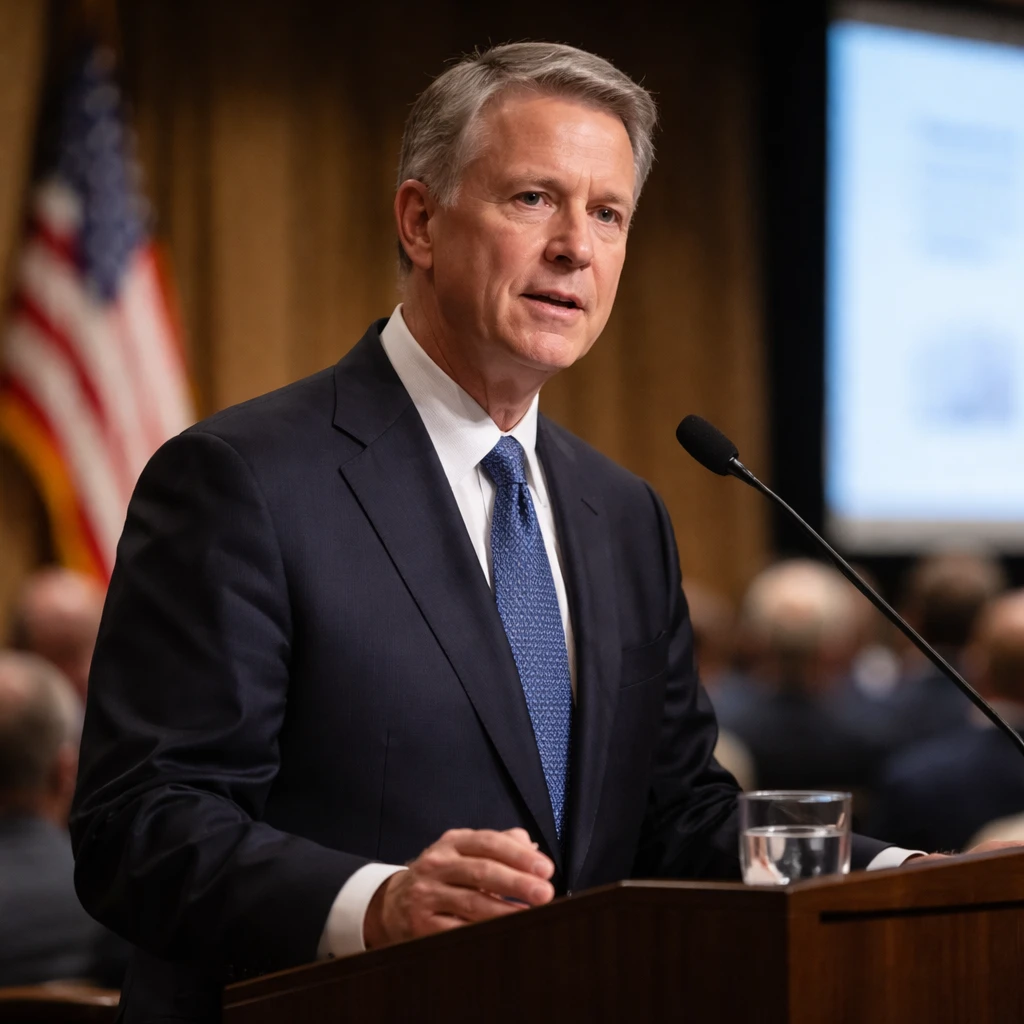
Kansas City Federal Reserve President Jeffrey Schmid urged caution on U.S. monetary policy at an economic forum in Albuquerque, New Mexico, saying the central bank should maintain restrictive settings while growth remains firm and inflation is elevated.
"With inflation still running hot, it appears that demand is outpacing supply across much of the economy," Schmid said, underscoring his view that the balance between spending and productive capacity has not yet normalized.
Schmid voiced skepticism that recent productivity improvements or developments in artificial intelligence will immediately resolve inflationary pressures. While he acknowledged that higher productivity and AI could eventually support "a non-inflationary, supply-driven growth cycle," he added we are not there yet and advised that interest rates should remain high enough to restrain spending and investment.
"Further rate cuts risk allowing high inflation to persist even longer," Schmid warned, noting that continued above-trend economic growth could keep price pressures elevated.
He pointed to the current inflation reading, which remains close to 3 percent, as evidence that demand is still outpacing improvements in supply. Schmid also suggested that some of the recent productivity gains may reflect lower labor market churn rather than purely technological advances.
"My contacts broadly agree that we are now in a low-hire, low-fire, low-quit labor market. One positive from this lack of churn is higher productivity," he said, while also cautioning that it is unclear whether productivity will continue to grow at the recent pace. Schmid is not a voting member of the Federal Open Market Committee this year.
Schmid's remarks stand in contrast to statements from the Trump administration and Fed chief nominee Kevin Warsh, who have pointed to strong productivity data as a reason to consider lower interest rates. By contrast, Schmid argued that such data do not yet justify easing policy.
Policymakers left interest rates unchanged at last month's Federal Reserve meeting, and markets expect the central bank to hold rates steady at least through the June 16-17 meeting. A stronger-than-expected January jobs report released on Wednesday reinforced expectations that the Fed will maintain its current stance in the near term.
New U.S. inflation data is scheduled for release on Friday, a development market participants will watch closely for further signs of whether demand-supply dynamics are shifting.