
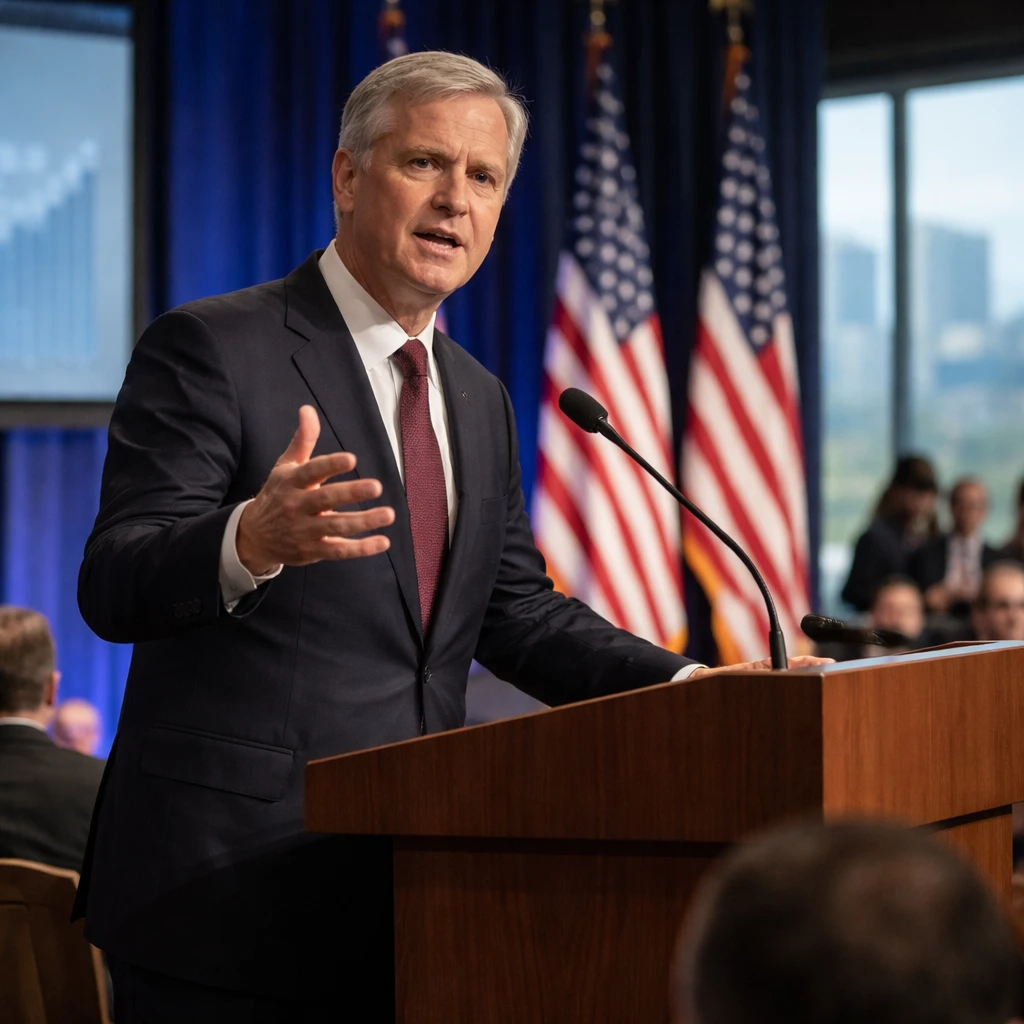
Federal Reserve Bank of Kansas City President Jeff Schmid said Tuesday that inflation continues to run well above the central bank's goal, describing the most recent readings as nearly a full percentage point higher than the Federal Reserve's 2% target.
Addressing an audience in Denver, Colorado, Schmid emphasized that inflation has remained above the central bank's objective for almost five years and cautioned against complacency. His remarks underscored the persistence of price pressures even as policymakers weigh whether to change the current stance on interest rates.
Policymakers are widely expected to leave interest rates unchanged at the Fed's meeting this month, following a similar pause in January. Schmid noted that most Fed officials have signaled a preference for holding rates steady while waiting for clearer evidence that inflation is moving toward the 2% target.
On the composition of inflation, Schmid said elevated price pressures are apparent both in tariff-affected goods and in services. He cited recently released data showing the Fed's preferred underlying inflation measure rose 3% in the 12 months through December, a pace that he said indicates there was no progress toward the 2% objective during 2025.
Schmid touched on the potential role of technology in future growth, expressing optimism that artificial intelligence and other emerging technologies could eventually support non-inflationary expansion. However, he was careful to point out that such a transition has not yet been achieved.
Turning to labor-market signals, Schmid referenced data suggesting the labor market is in balance. He highlighted particularly strong demand for health-care workers, a trend he expects to continue as the population ages. That labor demand, he warned, is squeezing profit margins in the health-care sector and could be a source of further inflationary pressure.
Schmid also observed that health care accounted for nearly all new job creation in 2025, reinforcing his point about sector-specific labor tightness and its implications for prices and corporate margins.
Summary
Jeff Schmid of the Kansas City Fed said inflation remains nearly a percentage point above the 2% target, with elevated underlying inflation and sectoral pressures in goods and services. He noted the Fed is likely to keep rates on hold while awaiting clearer evidence of disinflation, and he singled out health-care labor demand as a potential driver of additional inflation. While he expressed optimism that AI and other technologies may ultimately support non-inflationary growth, he said that outcome has not yet been realized.
Key points
- Inflation remains elevated - nearly a percentage point above the Fed's 2% target; underlying inflation rose 3% in the 12 months through December. (Impacted sectors: consumer goods, services)
- The Fed is expected to hold interest rates steady this month, with most policymakers preferring to wait for further evidence that inflation is moving toward target. (Impacted markets: interest-rate sensitive assets, fixed income)
- Strong demand for health-care workers is tightening margins in the health-care sector and accounted for nearly all new job creation in 2025. (Impacted sector: health care)
Risks and uncertainties
- Persistent underlying inflation could delay progress to the 2% target, prolonging uncertainty for monetary policy decisions. (Impacted markets: bonds, interest-rate sensitive equities)
- Ongoing wage-driven cost pressure in the health-care sector could contribute to further inflation and compress provider margins. (Impacted sector: health care)
- While emerging technologies may eventually support non-inflationary growth, Schmid noted that such benefits have not yet materialized, leaving timing and impact uncertain. (Impacted sectors: technology, broader economy)