
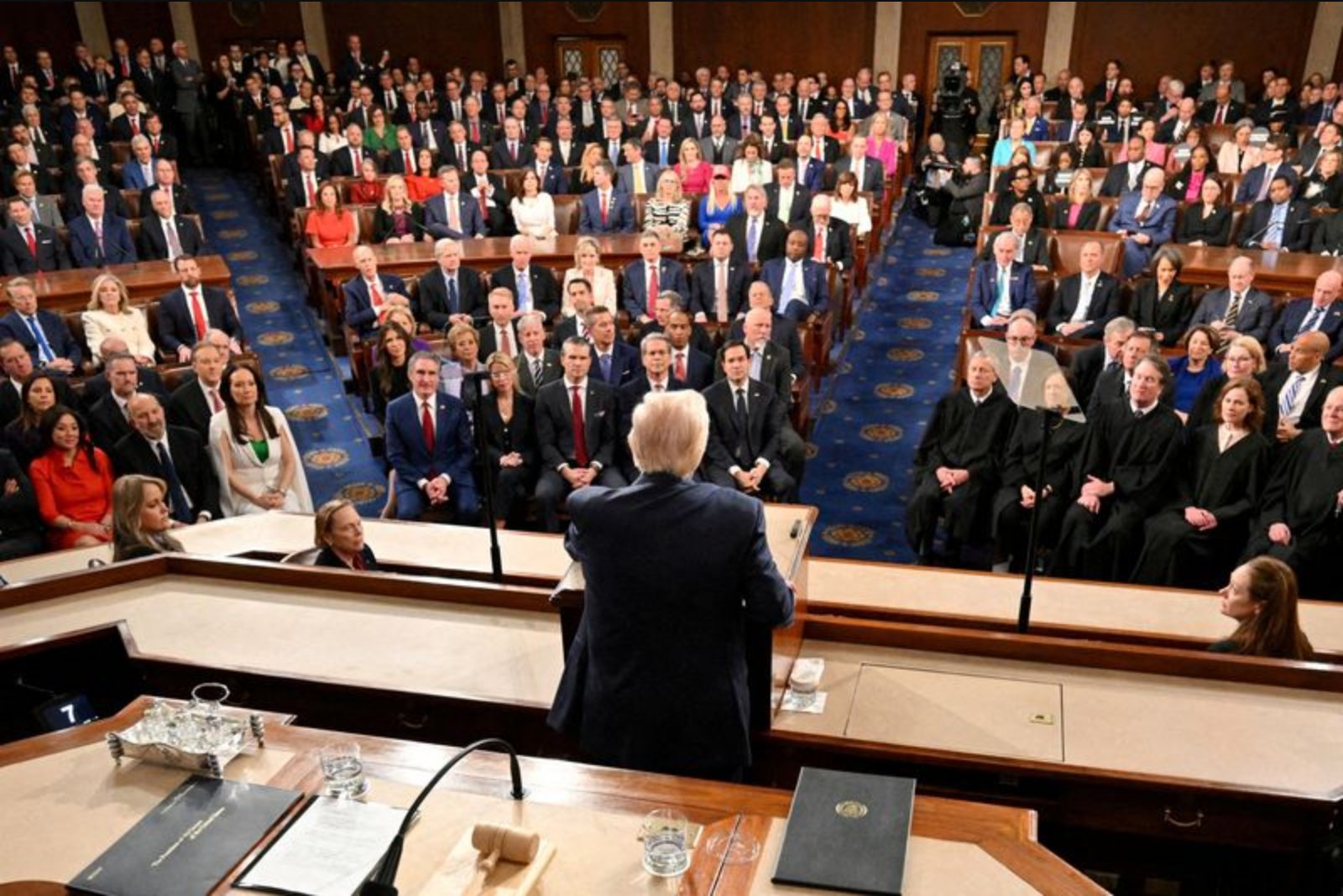
President Donald Trump’s State of the Union address on Tuesday evening comes at a sensitive juncture for financial markets already unsettled by recent volatility and legal developments affecting trade policy. With the Supreme Court having overturned his emergency-powers tariffs just days earlier, investors are braced for a speech that could touch on several policy areas with the potential to move markets - from trade and affordability to the administration’s posture on Iran.
Equity investors have faced a choppy stretch during Trump’s second term. The S&P 500 has climbed 13% in the 400 days since his January 2025 inauguration, but the benchmark has shown little net gain so far in 2026. That underperformance comes as Wall Street trails international stock markets and the U.S. dollar trades near lows last seen in 2022.
Market strategists say the speech could amplify investor anxiety rather than soothe it. "Just as the winter storms in the Northeast have been adding to the piles of snow on the roads, I’m afraid that this speech is just going to add to the levels of anxiety in the market," said Sam Stovall, chief investment strategist at CFRA. He added that this year’s crowded policy agenda "makes everything a little less predictable."
Historically, State of the Union addresses have not been major market catalysts, in part because they typically serve as platforms for presidents to tout achievements and sketch broad policy aims. Market participants and strategists caution, however, that specific statements in this speech could carry substantial market implications. They note that President Trump could use the speech to outline a case for a military campaign against Iran or to argue for more forceful replacement tariffs than those he has touted so far.
Michael Rosen, chief investment officer at Angeles Investments, pointed to a range of items on the president’s agenda that could unsettle markets if mentioned in decisive terms. Rosen singled out Iran, where any hard ultimatum could push crude oil prices sharply higher, and Federal Reserve governance as two areas with potential to jolt investors.
White House press secretary Karoline Leavitt said in a statement that the president will use the speech to highlight the administration’s accomplishments. She said he will also spell out "an ambitious agenda to continue bringing the American Dream back for working people."
Affordability is expected to be a central theme in the address. Market watchers say housing costs and other affordability issues are likely to be emphasized as politically salient ahead of midterm congressional elections in November. The president has previously professed victory over inflation while proposing measures aimed at reducing the costs of home ownership.
Among the proposals anticipated to be discussed are government-supported investment accounts for newborns, often referred to in coverage as "Trump accounts," which are being positioned as part of the administration’s affordability agenda. Tom Graff, chief investment officer at Facet, noted that new proposals on mortgage affordability could influence the bond market. He also flagged the proposed 10% cap on credit card interest rates as an item that Wall Street is watching closely for any new details.
Market participants also warn that any hint of direct stimulus - such as stimulus checks to taxpayers ahead of the midterm elections - would raise concerns about rising deficit levels and could push bond yields higher, Rosen said.
Even if the president frames the speech as a victory lap, some investors say that may not be reassuring unless it is coupled with a clear, predictable policy path. Analysts at Beacon Policy Advisors suggested in a note to clients that a victory-focused address might matter less to investors if it is paired with a continued reliance on executive action to implement policies. That combination, some strategists said, could sustain the same sort of market uncertainty observed over the past year.
"That’s been the recipe for so much chaos, confusion and uncertainty in the last year that the idea of more of that in 2026 would spook a lot of folks," Stovall said, summarizing investor unease about further executive-driven policy moves.
With markets already sensitive to policy shifts, the State of the Union will be parsed not just for rhetoric but for any concrete details that could translate quickly into market moves - whether in equities, fixed income or energy. Investors and strategists say the content and tone of the speech, combined with follow-up actions, will determine whether the address calms markets or compounds their current anxieties.