
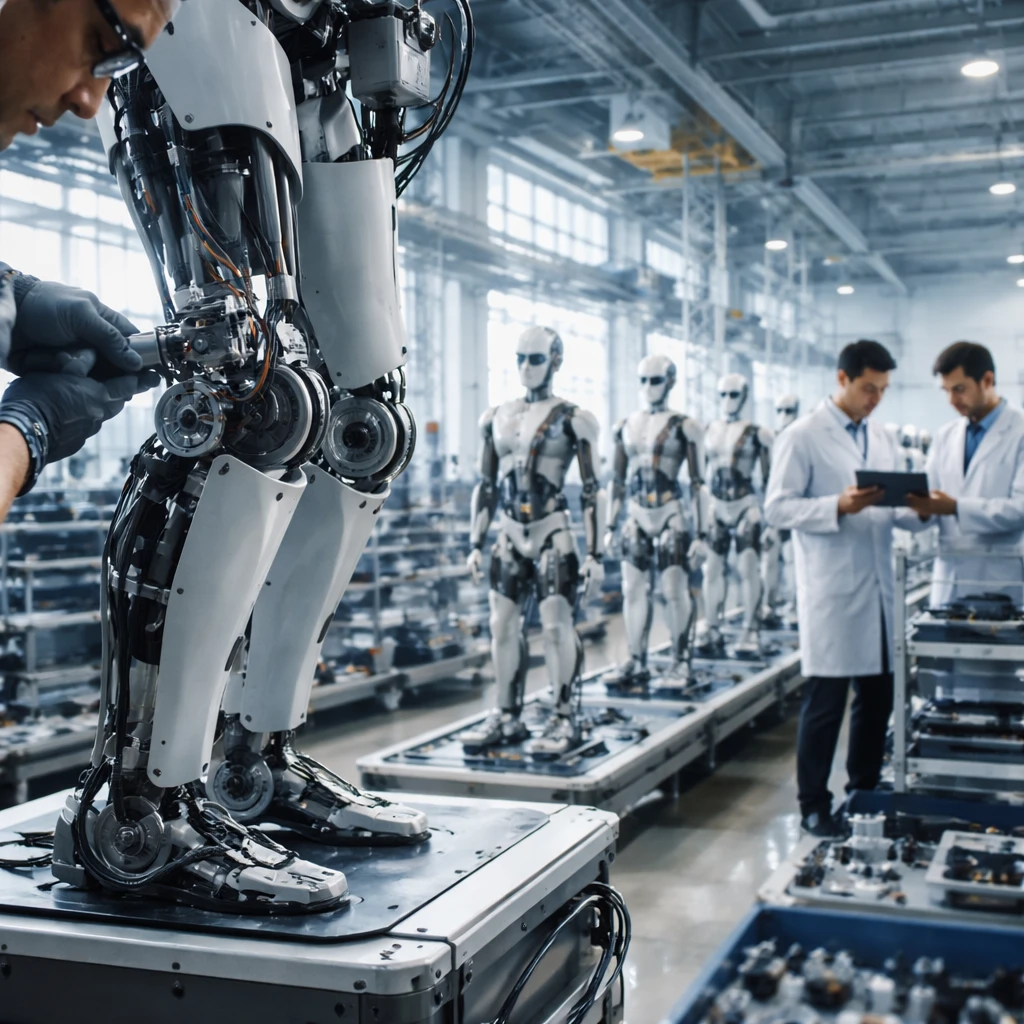
The landscape for humanoid robots is rapidly evolving from a simple division of labor into a contested field where both the United States and China are vying for technological and manufacturing dominance. A Morgan Stanley report cited by industry participants highlights the shift: China is no longer merely a source of low-cost manufacturing. In 2025 the country shipped over 12,000 humanoid robots, and projections cited in industry discussion target roughly 28,000 units for 2026.
That scale matters because critical mechanical subsystems - specifically high-precision actuator assemblies - remain concentrated in Chinese supply chains. Suppliers such as Leaderdrive and Minth Group Ltd (HK:0425) are named by manufacturers as makers of the actuator assemblies that provide the controlled motion necessary for humanoid robots to operate. The current practical reality is stark: a fully functional U.S.-designed humanoid cannot presently be built without parts sourced from China.
To manage geopolitical friction and maintain access to components, Chinese vendors and their partners have started to pursue onshore production. The approach taking shape is joint ventures that establish factories on U.S. soil. Those arrangements are intended to give U.S. firms more direct exposure to manufacturing know-how while allowing Chinese suppliers to keep their position in the parts market.
OpenAI’s procurement activity has underscored the desire among leading AI companies to reduce external dependencies. In late January OpenAI issued an RFP looking specifically for U.S.-based suppliers for bearings, motors and actuators. That move signals an effort to de-risk the hardware side of AI-enabled robotics and to reduce reliance on Shenzhen-based suppliers. Nonetheless, scaling a domestic supply chain to match China’s production trajectory will be a heavy lift for U.S. industrial players.
Adding a further layer of market pressure is Tesla Inc (NASDAQ:TSLA). The industry is watching for Optimus Gen 3, which analysts expect to debut before the end of March. Market observers anticipate a first-principles redesign intended to demonstrate how humanoid robots might be mass-produced at lower unit cost. Beyond design, Tesla’s prospective advantage lies in the data it can collect. By operating robots in its own facilities through 2026, Tesla could generate extensive real-world training data while competitors remain focused on prototype stabilization in unstructured environments.
Software companies are also navigating the cross-border dynamics. Firms like OpenMind are attempting to reconcile regulatory demands and operational realities by hosting Chinese hardware on U.S. servers. This hybrid approach reflects the entanglement of Silicon Valley software and Chinese manufacturing that underpins the current robot revolution.
For now, the question of coexistence between U.S. and Chinese industrial ecosystems remains open. Policy makers can push to onshore manufacturing, and buyers can issue procurement mandates, but the supply chains and the competitive advantages they confer are deeply intertwined. The near-term outcome will hinge on whether U.S. industrial ramp-up can match China’s production momentum and whether leading platform operators translate hardware deployments into sustained data advantages.