
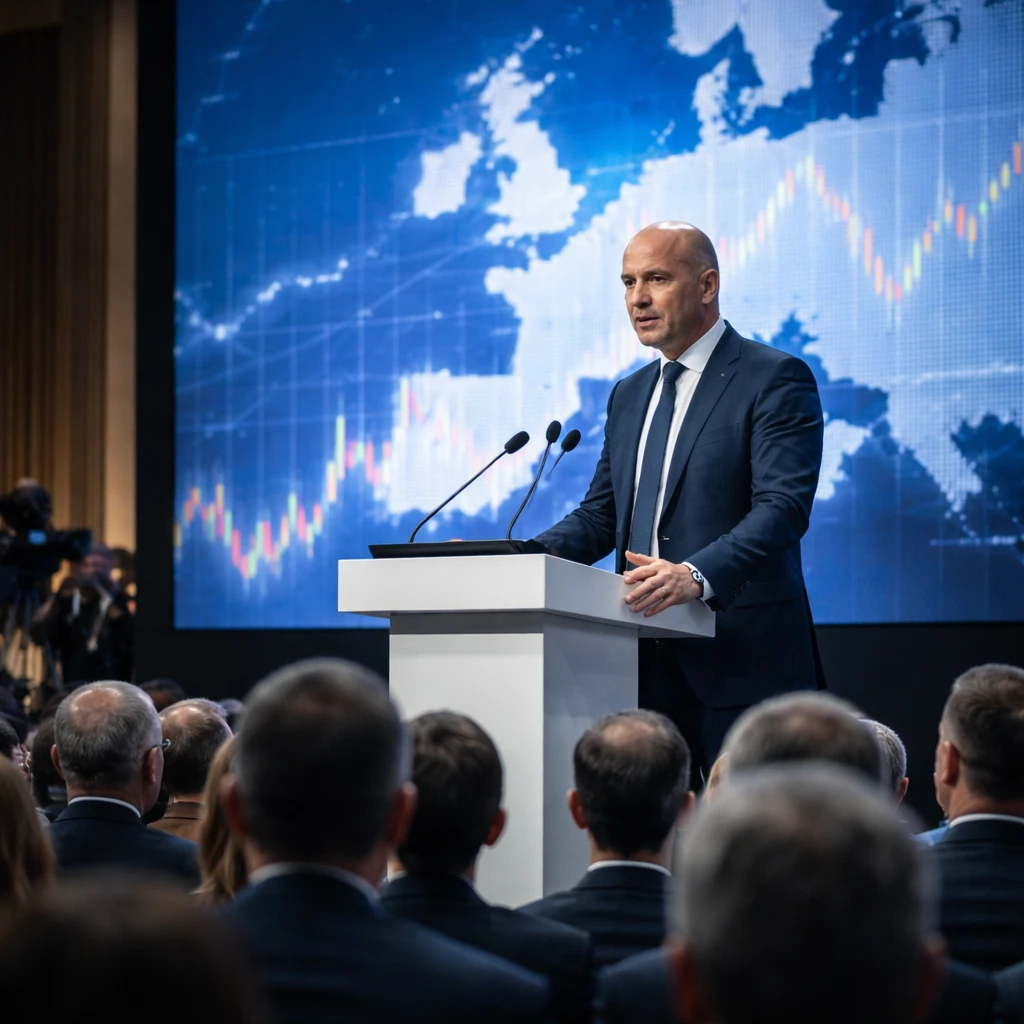
Nicolai Tangen, chief executive of Norges Bank Investment Management (NBIM), told CNBC at the Euronext Annual Conference in Paris that Europe’s capital markets are in a state of crisis and require urgent consolidation.
Speaking to conference attendees, Tangen said Europe must "get our act together" and move toward unified capital markets across the continent. He warned investors naturally gravitate to markets offering the greatest liquidity and highest valuations, and that without reform Europe will be less attractive to global capital.
NBIM oversees Norway’s sovereign wealth fund, valued at just over $2 trillion — the largest fund of its type. The portfolio spans more than 7,200 companies in 60 countries and holds stakes representing around 1.5% of the world’s publicly listed stocks.
Tangen described a material reorientation in NBIM’s equity mix over the last decade, with U.S. stocks now accounting for nearly 40% of the fund’s holdings. He noted the fund’s largest individual stakes include a 1.3% position in Nvidia, a 1.2% position in Apple and a 1.3% position in Microsoft.
Attributing the shift to Europe’s relative weakness in technology and innovation, Tangen pointed to the dominant position of U.S. companies in artificial intelligence as a key reason for the lack of comparably strong European firms in that area. "It is because of the U.S. companies' dominant position in AI we do not have strong companies in Europe in that field," he said.
The sovereign wealth fund reported an annual profit of 2.36 trillion kroner in 2025, equal to $246.9 billion, a result Tangen said was driven largely by strong performance in the technology sector.
While he acknowledged some signs that Europe is improving its adoption of AI, Tangen emphasized that technological uptake alone will not be sufficient without structural market reform. "We cannot have such a fragmented capital market in Europe. We won't get the liquidity, we won't get the depth of the market," he said, warning that the continent risks falling further behind unless it implements change to ease cross-border trade and investment.
In his speech at the conference, Tangen outlined several specific areas he believes require action. These include harmonizing financial and corporate legislation across European jurisdictions, rethinking competition and innovation policy to better support scale in key sectors, and improving mechanisms that allow capital to flow more freely through the European system. He also noted NBIM holds stakes in 2.3% of all listed European companies.
Direct in his assessment, Tangen asked rhetorically whether European capital markets are in crisis and answered "Probably," urging that the situation be used as a catalyst for reform. "We know what needs to be done. And it must be done, otherwise we will lose. We will fall. It is time to act," he said.
Context and implications
Tangen’s comments underline a strategic shift within one of the world’s largest institutional investors toward U.S. technology names, and place a spotlight on the interplay between market structure, regulatory harmonization and the ability of capital to support large, innovative companies within Europe.
The call for unified rules and deeper capital market integration is framed as a response to observable investor behavior favoring markets that offer liquidity and valuation depth. Tangen framed the debate as both a challenge for policymakers and a practical determinant of where global capital is allocated.