
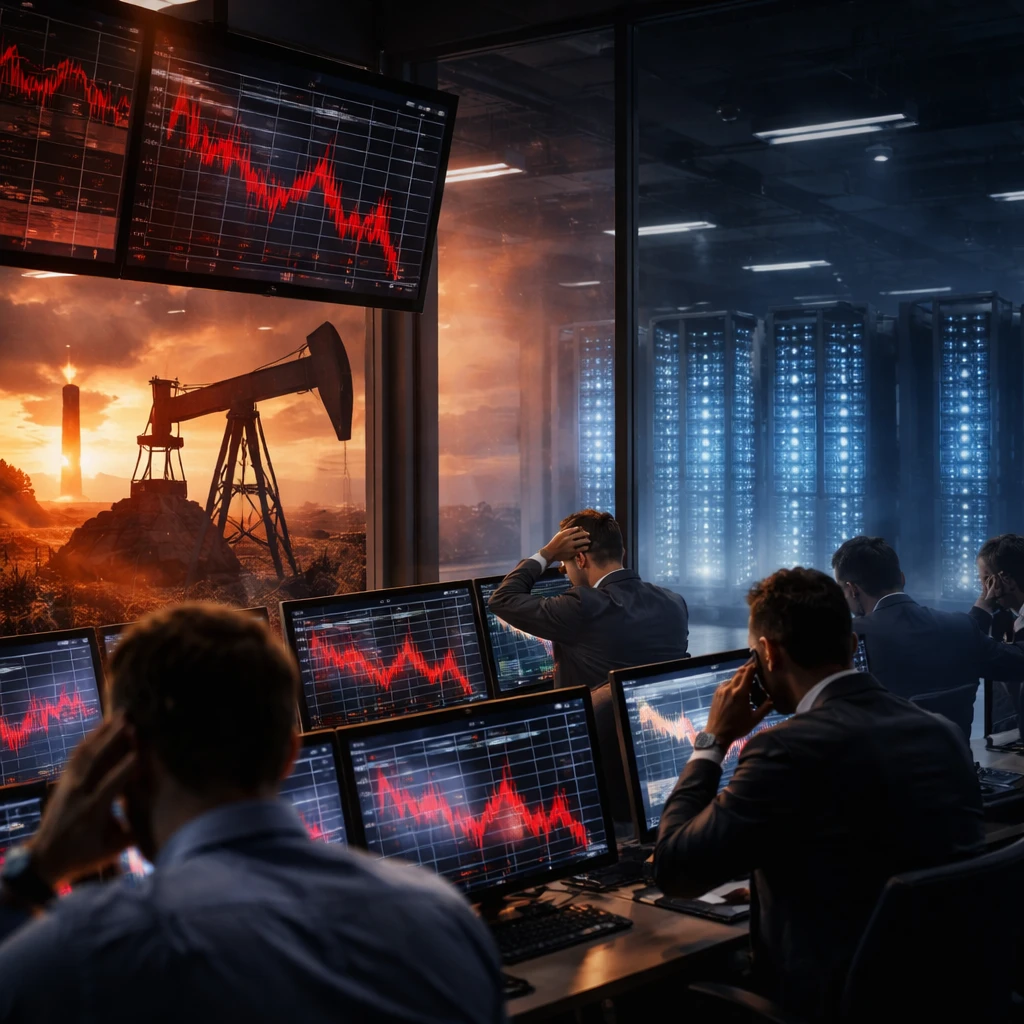
The S&P 500 experienced a bumpy week of trading, retreating roughly 2% as bouts of volatility reflected market responses commonly seen during periods of heightened geopolitical tension. A recent Goldman Sachs report argues that these moves are consistent with historical patterns and that the longer-term outlook for corporate profits will hinge on two principal themes: energy disruptions and the trajectory of artificial intelligence investment.
Energy shocks and the GDP multiplier
Goldman Sachs states that, in most cases, modest increases in oil prices produce only muted direct effects on S&P 500 earnings. However, the investment bank warns that a prolonged and severe interruption to energy supplies could present meaningful downside risk to its 2026 EPS growth forecast of 12%.
Using a top-down framework, Goldman estimates that each 1 percentage point change in real U.S. GDP growth translates into a roughly 3-4% change in S&P 500 earnings per share. The implication is that large negative hits to output, potentially amplified by higher fuel costs, would ripple through corporate profits across multiple sectors.
Energy companies tend to gain from higher crude prices, but Goldman notes those benefits are often offset at the index level. Consumer-facing companies and industrial firms that rely heavily on oil as an input face rising costs that can erode margins and weigh on overall economic activity - which in turn feeds back into corporate earnings.
The AI investment cycle as a valuation backbone
Separately, Goldman identifies the ongoing AI investment cycle as the most important structural influence on market valuations. The report describes an emerging "Virtuous Cycle" in which heavy capital expenditures by large-scale technology firms drive demand for semiconductors and related infrastructure, and then flow into the revenues of other S&P 500 companies.
That cycle, Goldman says, begins with semiconductor companies such as Nvidia and extends to infrastructure providers including major cloud services and utilities that must expand power capacity to support the construction and operation of massive data centers. The bank underscores that "S&P 500 earnings are increasingly dependent on the trajectory of AI investment."
Goldman highlights that the hyperscalers' substantial CapEx effectively channels spending into other parts of the market, creating a self-reinforcing loop of growth for certain index constituents. At the same time, the analysts caution that for the cycle to be durable, companies will ultimately need to show that AI spending is producing measurable productivity improvements or driving broader revenue gains in the economy.
Service offering mention
The report also references third-party analytical tools used by some investors. One such service evaluates Nvidia and thousands of other companies monthly across more than 100 financial metrics. That service uses algorithmic methods to highlight stocks based on fundamentals, momentum, and valuation, and it cites past winners including Super Micro Computer and AppLovin.
Bottom line
Goldman’s analysis presents a dual narrative for markets: energy-related shocks pose an outsized risk to the consensus earnings path if disruptions are sustained, while the nascent AI investment cycle continues to underpin valuation support provided it ultimately translates into measurable economic and corporate benefits.