
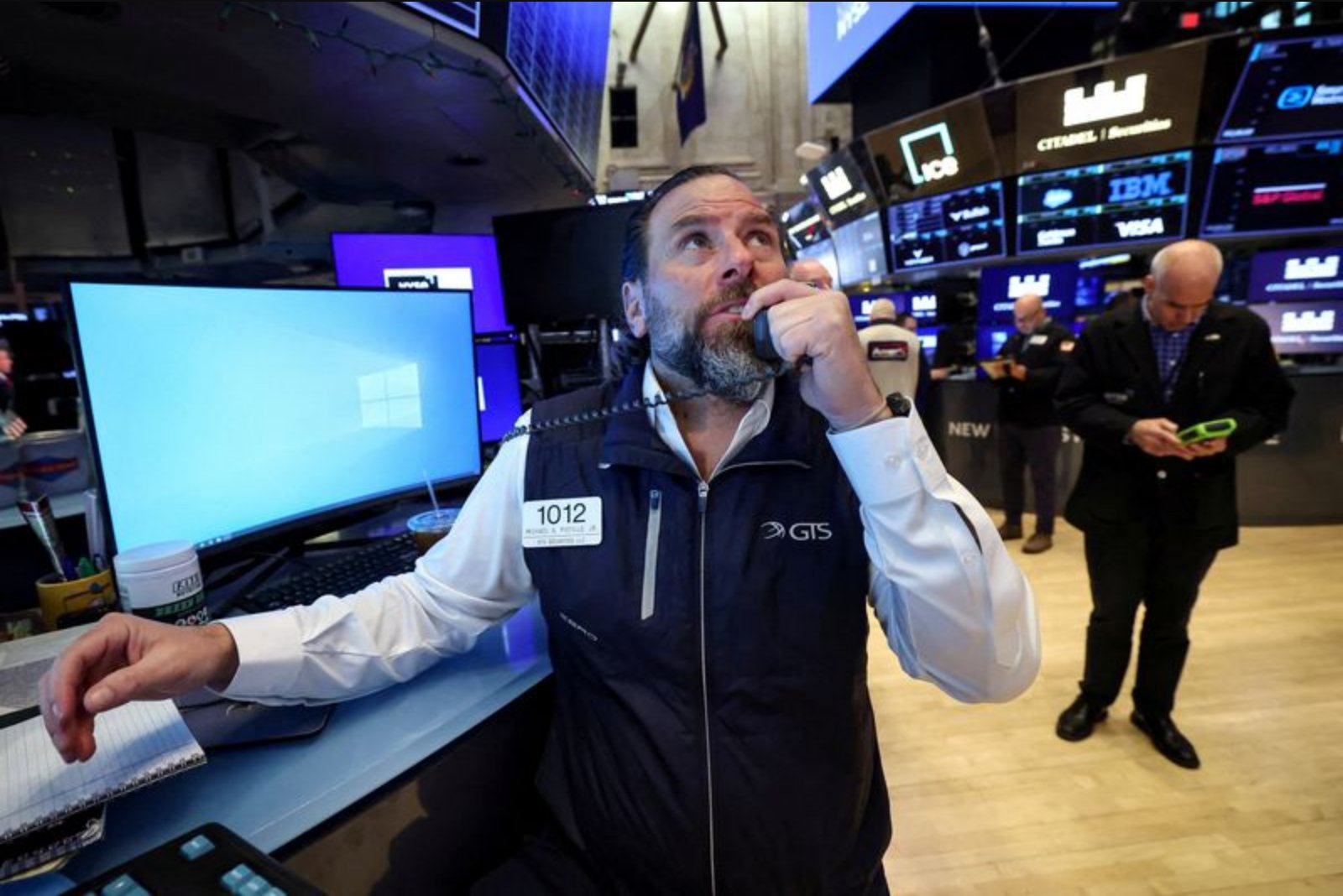
Feb 13 - U.S. stock index futures were trading flat on Friday after a pullback across equity markets tied to AI-related concerns, with investors remaining on the sidelines as they awaited the January Consumer Price Index, scheduled for release at 8:30 a.m. ET. The CPI print is expected to show prices rising at a steady pace and arrives two days after a stronger-than-expected jobs report that amplified fears the Federal Reserve could hold interest rates higher for longer.
All three major indexes were on track for their worst week since November as fears connected to artificial intelligence swept beyond software names to affect other areas of the market such as brokerages and trucking. Despite the week’s weakness, markets showed some resilience: Fed fund futures had reversed most of earlier losses, with investors pricing roughly a 70% chance of a rate cut in June and a total of about 60 basis points of easing across the year.
In early electronic trading at 05:36 a.m. ET, Dow E-minis were down 103 points, or 0.21%, S&P 500 E-minis were lower by 6 points, or 0.09%, and Nasdaq 100 E-minis had lost 9.25 points, or 0.04%. On Thursday, the S&P 500 and the Dow had each fallen by more than 1%, while the Nasdaq dropped 2% as the AI-led selling intensified.
Within the chipmaking-equipment cohort, Applied Materials stood out in premarket activity, jumping 11.5% after forecasting second-quarter revenue and profit above Wall Street expectations. Lam Research and KLA Corp also moved higher, gaining 1.3% and 1.8% respectively. As earnings season passes its midpoint, capital expenditure tied to AI has become a central theme for the group of large-cap technology companies often described as the "Magnificent Seven," whose combined investments are projected to total roughly $650 billion.
Commenting on the investment cycle, BNY’s head of markets macro strategy, Bob Savage, warned in a note: "The central question for equity investors is whether today’s surge in capex can translate into durable earnings growth sufficient to justify higher leverage and stretched valuations." He added that market support appears conditional, noting that credit flows remain robust and that rates are easing slightly at the margin, but that equity momentum is no longer automatic.
Nvidia’s upcoming earnings later this month were highlighted as the next major test for the AI-focused trade. Networking equipment vendor Arista Networks jumped 11% on Friday after raising its annual revenue outlook above expectations, underscoring how individual corporate guidance is shaping investor sentiment amid the broader rotation and profit-taking.
While many software stocks held steady, AppLovin slipped in premarket trading after suffering its largest single-day drop since March during the previous session as part of the AI-driven selloff. The marketing platform had declined almost 10% in that earlier session and is down 45% year-to-date.
On trade developments, the United States and Taiwan signed a final reciprocal agreement that confirmed a 15% levy on imports from Taiwan while agreeing to remove or reduce tariffs on nearly all U.S. goods. Separately, reports indicated that U.S. President Donald Trump plans to roll back certain tariffs on steel and aluminum goods.
Market participants also encountered promotional commentary regarding Applied Materials: a recurring analytical tool referred to as ProPicks AI evaluates AMAT alongside thousands of other companies each month using over 100 financial metrics. The product claims to apply AI to identify stock ideas by assessing fundamentals, momentum, and valuation without bias, citing prior notable winners such as Super Micro Computer (+185%) and AppLovin (+157%). The commentary encouraged readers to check whether AMAT appears in any ProPicks AI strategies or if there are alternative opportunities within the same sector.