
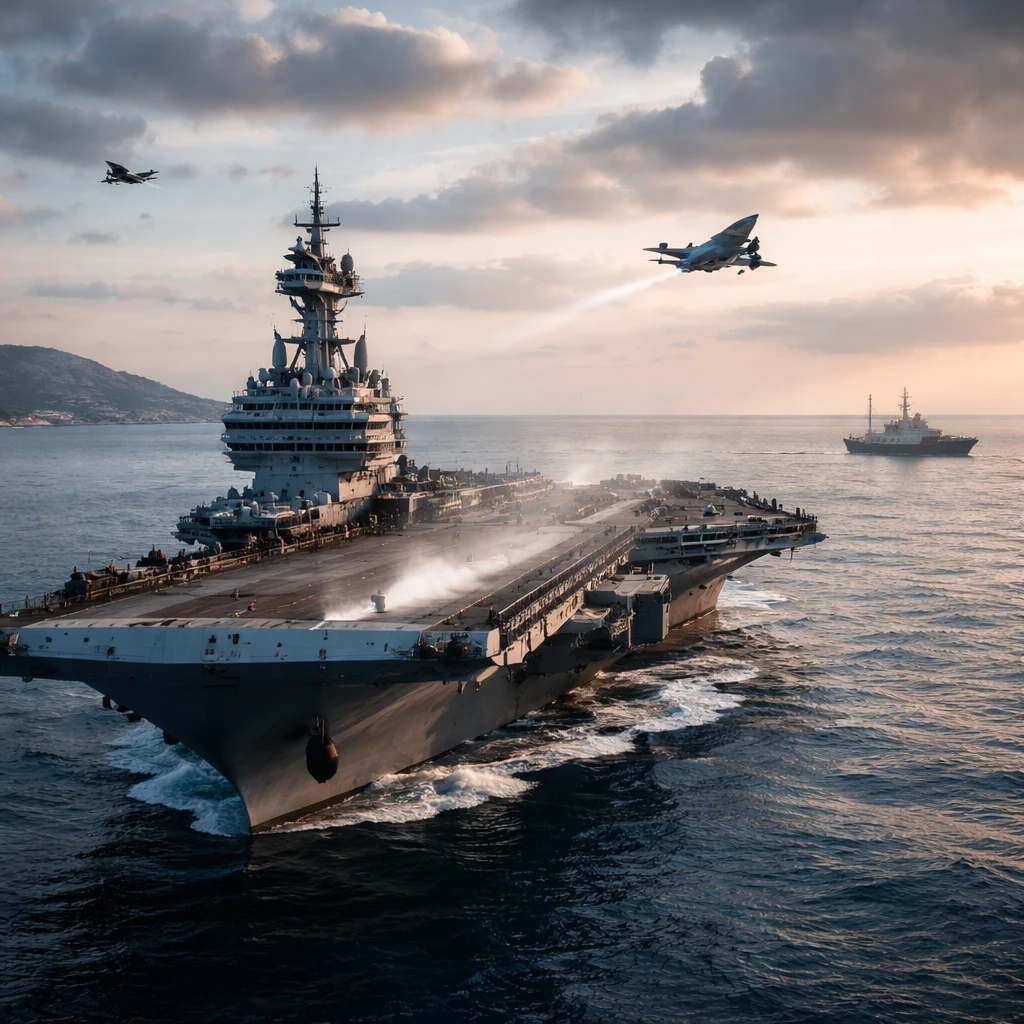
France is dispatching the aircraft carrier Charles de Gaulle to the Mediterranean and is seeking partners to form a coalition to protect maritime traffic, President Emmanuel Macron said in a televised address on Tuesday.
Macron said the move responds to disruptions to crucial shipping corridors as the Middle East conflict expands. "We have economic interests to protect, because oil prices, gas prices and the international trade situation are being profoundly disrupted by this war," he said, stressing the link between security operations and economic stability.
The president described the situation as serious, with the Straits of Hormuz closed and the Suez Canal and Red Sea shipping routes under threat. He said France had already taken specific military and security measures in the region.
Among those measures, France has sent a frigate to Cyprus and has engaged hostile unmanned aerial vehicles over Gulf partners, he said. "Rafale jets are among the assets being used in the operations," Macron added, indicating a mix of naval and air capabilities in current missions.
Macron framed France's actions in the context of formal defense ties. "We have defense agreements that bind us to Qatar, Kuwait, and the United Arab Emirates. The latter are particularly targeted, and we owe them solidarity," he said, underlining obligations to Gulf states under existing pacts.
On the diplomatic and humanitarian fronts, France is assisting citizens wishing to leave areas affected by the fighting. Macron said two flights were scheduled to arrive in Paris on Tuesday evening for evacuees. He also noted that security has been reinforced at certain locations within France.
Addressing responsibility for recent military moves, Macron said Iran "bears primary responsibility" for the U.S.-Israeli action. He added: "the United States of America and Israel have decided to launch military operations; they were conducted outside international law, which we cannot approve."
Macron did not provide additional granular details about the proposed coalition's membership, command arrangements, or timelines for the carrier's engagement, beyond the assets and measures he listed.
Summary
France is deploying the Charles de Gaulle to the Mediterranean, has moved naval and air assets to support Gulf partners, and is coordinating evacuations and reinforced domestic security as regional hostilities threaten key maritime and energy-related trade routes.