
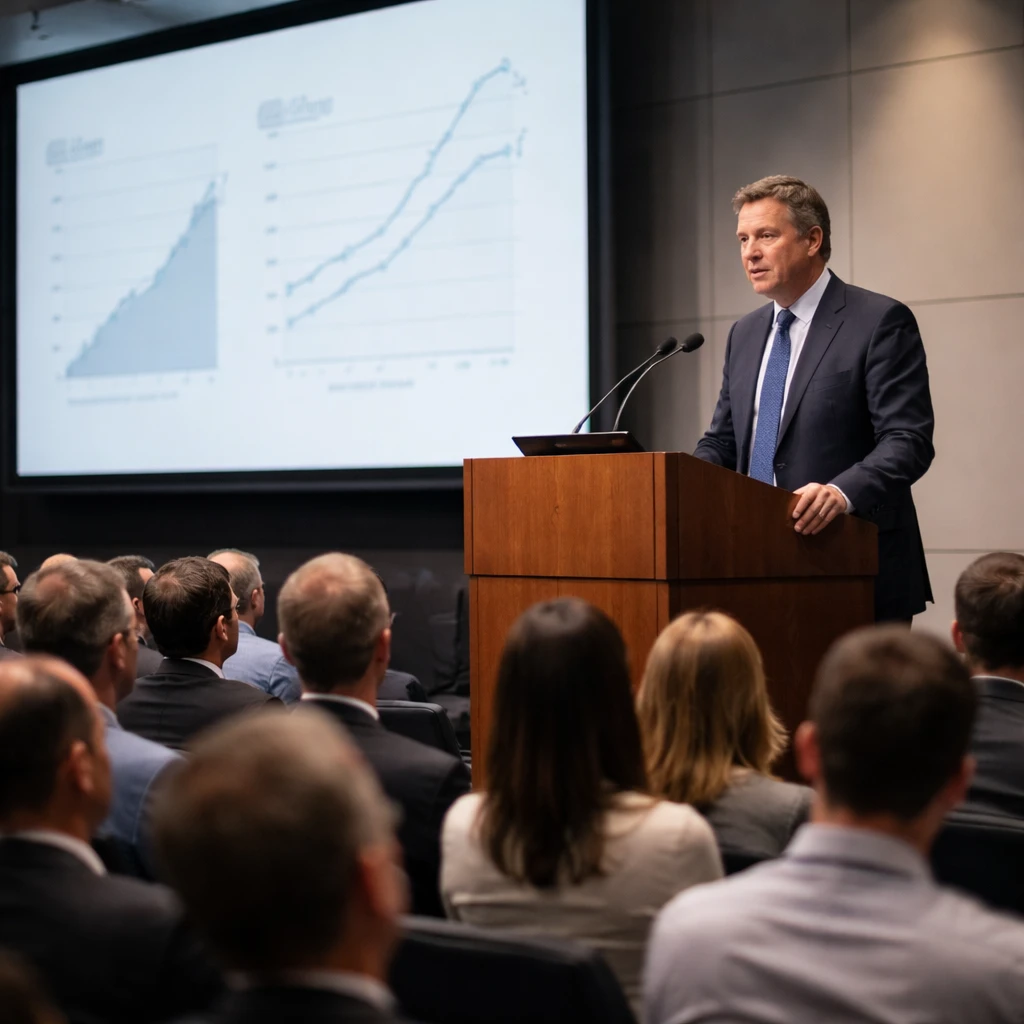
Federal Reserve Governor Michael Barr said on Tuesday that the central bank is likely to maintain its current interest rate stance "for some time" while it monitors inflationary pressures and incoming economic information. Speaking to the New York Association for Business Economics, Barr urged a measured approach to monetary policy amid persistent inflation concerns.
"The prudent course for monetary policy right now is to take the time necessary to assess conditions as they evolve," Barr said, signaling that rate changes are not imminent as officials await clearer evidence on price dynamics.
Barr spelled out an explicit condition for any future easing: he wants to see "evidence that goods price inflation is sustainably retreating before considering reducing the policy rate further, provided labor market conditions remain stable." That benchmark places particular emphasis on goods-price trends alongside ongoing assessment of employment conditions.
Last year the Federal Reserve trimmed its target range for the overnight interest rate by 0.75 percentage points to a range of 3.5% to 3.75%. The cuts were aimed at supporting the labor market while preserving enough policy restraint to continue efforts to bring inflation down. Fed officials left the policy rate unchanged at their January meeting.
Barr warned that inflation remains a central concern for policymakers. "There are many reasons to be concerned that inflation will remain elevated," he said. "I see the risk of persistent inflation above our 2% target as significant, which means we need to remain vigilant."
As part of his assessment of inflation drivers, Barr pointed to President Trump's tariffs as a factor that has interrupted the recent downward trajectory in inflation, suggesting trade policy developments have complicated the disinflation process.
On labor markets, Barr described conditions as stabilized but fragile. He said the labor market exists in a "delicate balance" and could be "especially vulnerable to negative shocks," underscoring the Fed's sensitivity to potential abrupt changes in employment.
Barr also addressed the economic implications of artificial intelligence adoption. He said current AI-driven changes are producing worker reallocation within firms rather than widespread layoffs but cautioned that "we should be prepared for the possibility that there might be serious short-term disruptions in the labor market." Looking further ahead, he expressed the view that AI should raise productivity and living standards over the long run, but added that "the AI boom is unlikely to be a reason for lowering policy rates."
Key takeaways
- Fed Governor Michael Barr expects rates to remain unchanged "for some time" as officials monitor inflation and data.
- He wants clear evidence that goods price inflation is sustainably retreating before considering further rate cuts, contingent on stable labor market conditions.
- Barr highlighted tariffs as a factor disrupting disinflation and warned that AI could cause short-term labor disruptions even as it boosts productivity long term.
Impacted sectors: Financial markets, consumer goods, labor-intensive industries and technology-adopting firms.
Risks and uncertainties
- Persistently elevated inflation above the Fed's 2% target - this poses risks to financial markets and interest-rate-sensitive sectors.
- Labor market vulnerability to negative shocks - employment-sensitive sectors and consumer spending could be affected.
- Short-term labor disruptions from AI adoption - could impact firms undergoing rapid technology-driven reallocation of workers.