
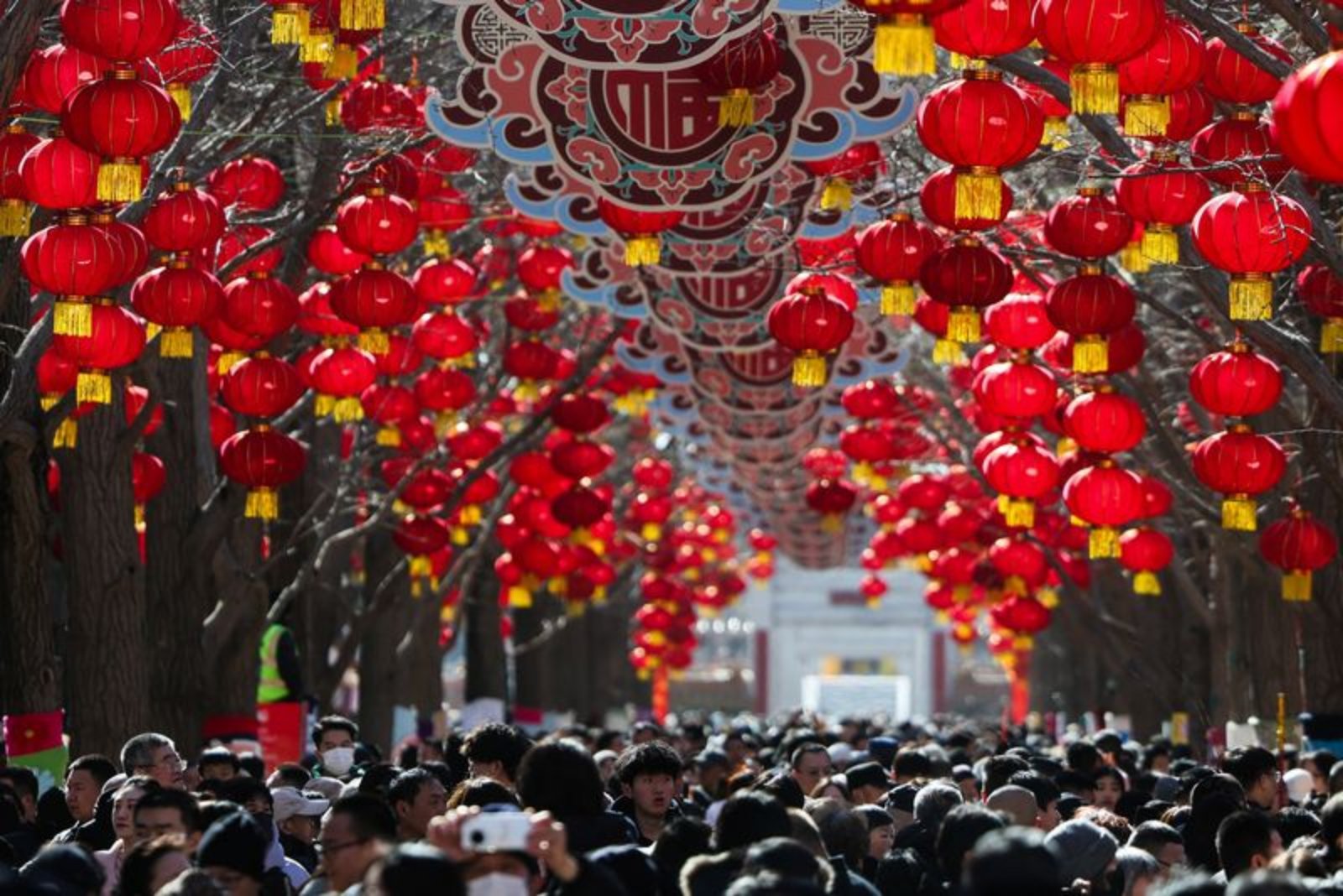
China's decision to allow a nine-day Lunar New Year holiday achieved its objective of encouraging households to travel, shop and seek entertainment, according to official statistics. The Ministry of Culture and Tourism reported that domestic trips over the holiday reached 596 million and tourism spending totaled 803.5 billion yuan, or $116.81 billion. Both figures represented increases of almost 19% compared with the same holiday period a year earlier, which had been one day shorter.
Despite the rise in overall travel and spending, the ministry's data showed that average tourism spending per trip edged down by 0.2%.
Popular scenic destinations experienced heavy crowds. Visitors packed sites ranging from the Great Wall near Beijing to the Danxia landform in Guangdong. Rural and small-town attractions also drew large numbers as tourists sought traditional cultural experiences. In Fujian province, for example, visitors filled villages to watch folk activities such as "you shen", a parade honoring local deities.
"The ticket is 98 yuan, way more than the usual 38, but they’ve got tons of Spring Festival-only shows, so it’s popular. The tickets are gone the second they go on sale, and I just can’t get one," said Liu Jian, a 32-year-old Beijing resident who tried and failed to book a trip to Tangshan to see a traditional molten-iron fireworks display.
Several named scenic areas disclosed holiday visitor totals that reflected the broader uptick. In Sichuan province, the Jiuzhaigou scenic area reported receiving 182,700 visitors during the Spring Festival through February 23, an increase of 17.7% from the previous year. Zhangjiajie, a well-known mountain park in central China, said via its official WeChat account that visitor numbers in the first five days of the holiday rose 10.27% year-on-year.
Major cities registered solid travel and spending gains. Shanghai authorities reported the city hosted 21.67 million visitors over the holiday, up 8.36%, and tourism-related spending climbed to 25.6 billion yuan, an increase of 20.9%. Beijing recorded 19.84 million visitors and total tourism spending of 33.14 billion yuan.
Online travel platforms and hospitality providers signaled demand spread beyond big cities. LY.COM identified Guangdong as a top draw for trips marketed with a "New Year flavour", noting hotel bookings in destinations such as Shantou rose by more than 80% from a year earlier. The search for a more traditional holiday atmosphere also benefited county-level and lower-tier destinations.
Dining firms saw higher footfall and revenue during the break. Sales revenue at key catering enterprises tracked by the Ministry of Commerce increased by 5.2% compared with the holiday in the prior year. Haidilao, a major hotpot chain, said it served more than 7 million customers nationwide in the first five days of the holiday, and that traffic on Lunar New Year’s Eve and the first day of the new year rose by more than 10% from the same period last year.
Fast-casual brands also reported strong volumes in lower-tier markets. Chinese-style fried chicken chain Lin Yu Fried Chicken said its stores received more than 3.7 million visits during the holiday. One outlet in a scenic area of Rizhao in Shandong province recorded order volumes nearly seven times higher than on regular days.
However, the boost to travel and catering contrasted with a notable slump at the cinema box office, a traditional holiday barometer of discretionary consumption. Ticketing platform Maoyan reported Spring Festival box office takings of 5.75 billion yuan, a decline of 39.5% from a year earlier, while total admissions fell 35.8% to 120 million. Several new film releases saw weakening word of mouth that dampened cinema attendance.
Official figures included an exchange-rate reference of $1 = 6.8788 Chinese yuan renminbi.