
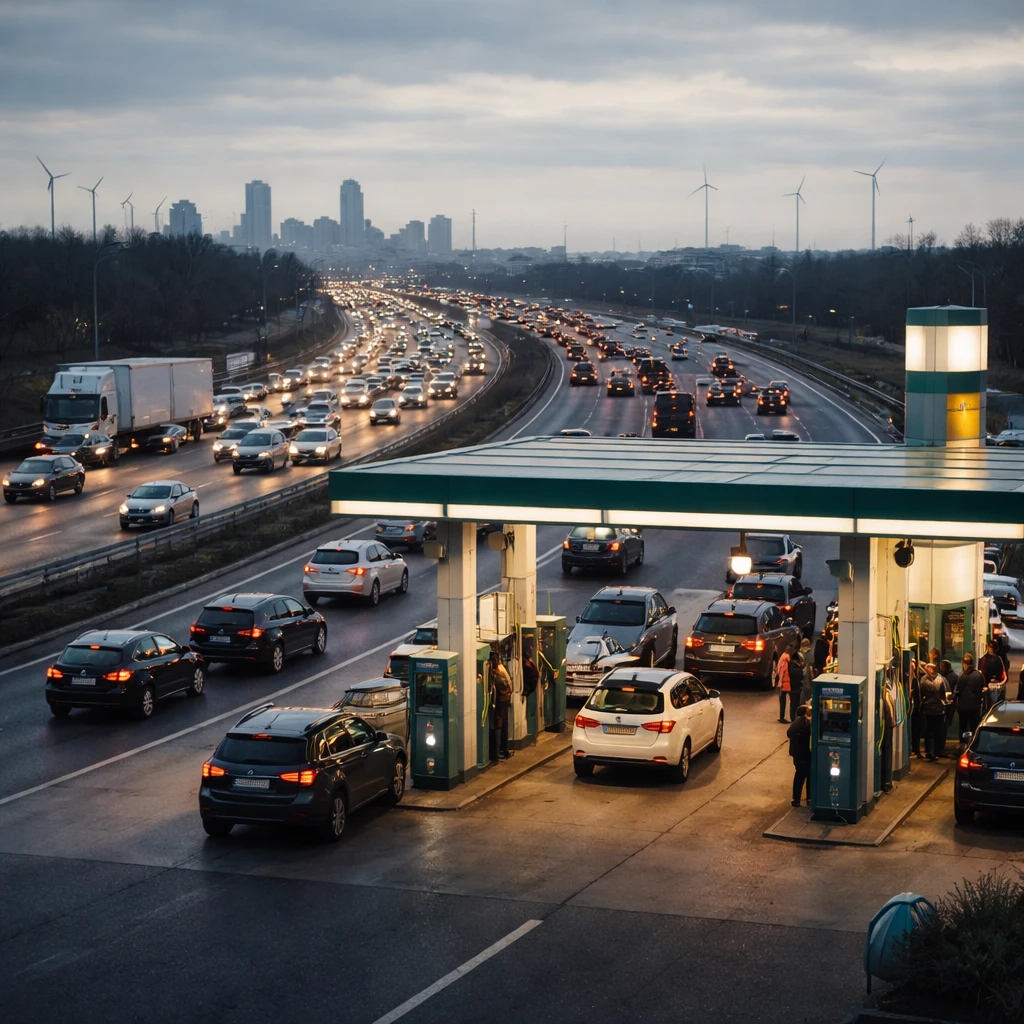
European governments are likely to turn first to reductions in taxes on transport fuels to blunt the impact of a sharp energy price increase, according to a recent note from Citi Research. Economists Michel Nies and Giada Giani outlined how cuts to excise duties would be the immediate policy lever, while cautioning that broader fiscal support could follow if the shock persists or intensifies.
Citi's note tracks sizable moves in energy markets since the onset of the conflict. Crude oil and short-dated gas prices have climbed roughly 45% and 65% respectively compared with levels seen in the first two months of 2026. Those market changes have translated into higher pump prices: petrol in the Euro Area is about 10% above January-February levels, and diesel has increased by 18.3% over the same interval.
Measured at constant consumption volumes, the report calculates that these transport fuel price rises would raise household expenditure by roughly c40 billion a year, equivalent to about 0.25% of GDP. Businesses would see an additional hit of around c20 billion annually. Citi notes that the fiscal cost of policy responses will not necessarily scale linearly with prices - a non-linear relationship that could push governments toward wider measures if an adverse energy price path materialises.
Holding road fuel prices at pre-conflict levels through reductions in the tax wedge would carry an annualised cost of about c60 billion for the Euro Area, or roughly 0.4% of GDP. Citi points out that this figure includes around c11 billion in foregone tax revenue rather than direct new spending. The bank's base case assumes the oil price spike is temporary, in which case actual fiscal costs would be "noticeably lower," the note adds.
Even aggressive cuts to excise duties would not be sufficient in all cases to offset recent price gains. Citi calculates that lowering excise taxes to the European minimum - set at 359c per litre for petrol and 330c per litre for diesel - would still leave some countries short of fully compensating consumers, creating the potential need for temporary VAT reductions as an additional measure.
Some national authorities have already put policies in place. Greece capped profit margins on fuels and on 61 supermarket goods; Portugal enacted a temporary cut in the excise tax on diesel; and Croatia imposed retail fuel price caps. At the EU level, measures including a gas price cap have reportedly been under discussion, with such deliberations reported by the Financial Times on March 11.
By contrast with transport fuels, household energy bills have not yet shown a comparable jump. Citi highlights German retail offers as an indicator: as of last week, gas suppliers were offering new household customers a rate of 8.4c per kWh, down from 10.2c per kWh a year earlier. That difference underscores how the semi-annual timing of utility price resets can delay the consumer-level impact, meaning households may not feel the full effect for months.
Citi warns that a sustained rise in utility bills would be more costly to address. The report notes that an 8% increase in household utility bills would add about c35 billion a year to consumer costs. Unlike transport fuel spikes, utility bill increases have a tendency to be slower to reverse once established, which raises the prospect of more protracted fiscal commitments if they accelerate.
Overall, Citi judges that the mitigation costs remain manageable for now, saying the total fiscal cost of measures looks likely to be "below 0.5% of GDP." Nonetheless, the research team cautions that if utility bills begin to climb sharply, governments may not be able to confine their responses to measures tied to energy taxes and could be forced into broader support actions.
Summary
Governments across Europe are preparing to reduce transport fuel taxes as a first-line response to recent oil and short-dated gas price increases. While this policy action could keep immediate fiscal costs within a modest share of GDP, sustained or broader increases in household utility bills would increase fiscal exposure and might necessitate wider support.