
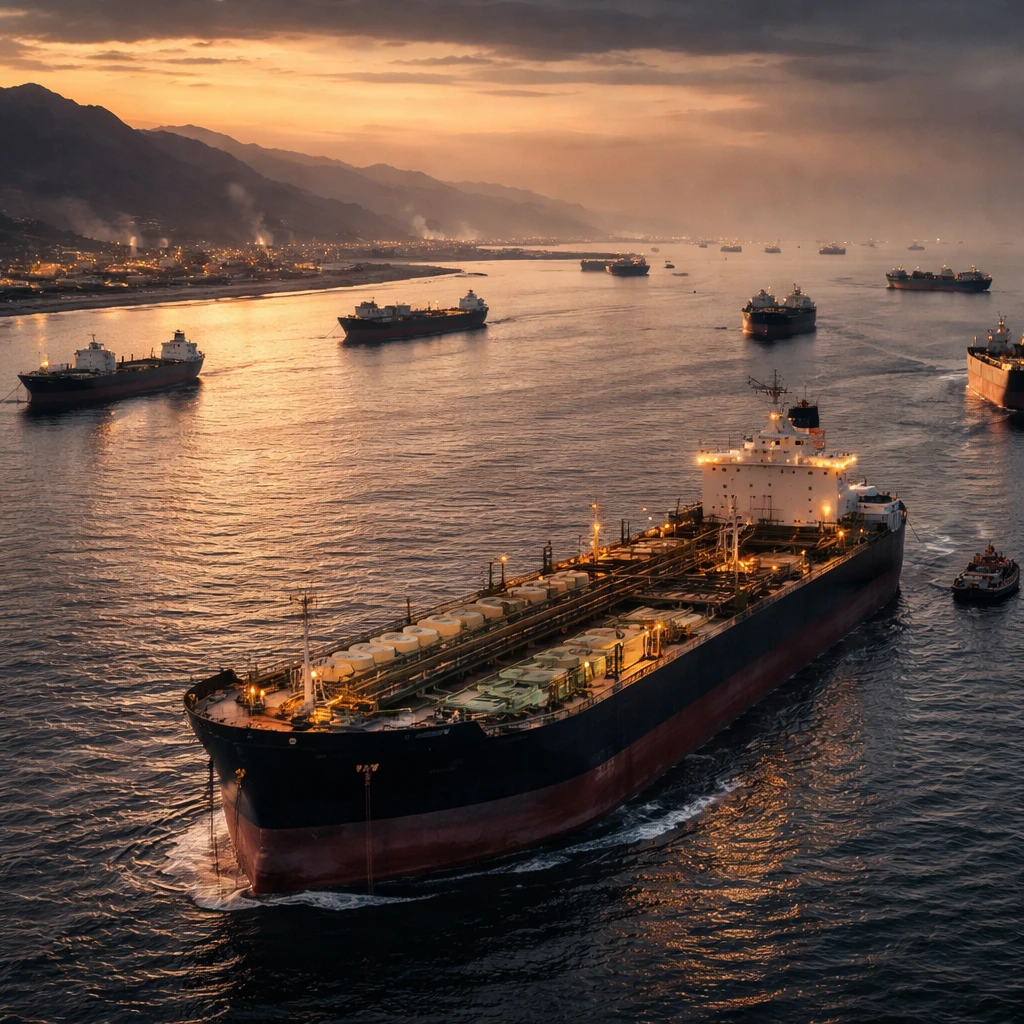
FRANKFURT - The military strikes involving U.S. and Israeli forces against Iran have created a new source of economic friction for Europe by interrupting the flow of petroleum and gas through one of the world's key maritime passages. Those interruptions have translated quickly into higher prices for energy commodities on financial markets, with implications for household fuel costs, inflation measures and the policy calculations of the European Central Bank and the Bank of England.
Chokepoint for oil, gas and related products
The Strait of Hormuz, the narrow waterway between Oman and Iran, serves as a principal export route for oil, liquefied natural gas and chemicals from Gulf producers. Roughly 20% of global oil transits this channel, including shipments from Saudi Arabia, the United Arab Emirates, Iraq, Kuwait and Iran. Large volumes of liquefied natural gas also pass nearby, notably from Qatar.
Europe shifted away from Russian energy suppliers following the invasion of Ukraine, increasing its dependence on Gulf-region imports for some fuels. Among European states, Britain, Italy, Belgium and Poland are particularly reliant on LNG cargoes that move through the Strait of Hormuz, according to U.S. Energy Information Administration data cited by market observers.
Beyond crude oil and LNG, the Gulf is a substantial exporter of propane, butane and ethane - feedstocks and fuels used in heating, transport and agricultural applications - according to data from broker Kpler. Interruptions in shipments of these products can therefore ripple across multiple industrial and household consumption channels.
Immediate market reaction and likely consumer impact
Shipping-data tallies show more than 200 vessels, including oil and liquefied-gas tankers, have anchored in and around the Strait of Hormuz and adjacent waters after the outbreak of hostilities. That sharp falloff in transits has been reflected rapidly in commodity prices: Brent futures rose by nearly 8% to about $78 a barrel, while Dutch natural gas traded up roughly 19% at 38 euros per megawatt-hour.
For context, the European Central Bank's December projection assumed a natural gas price of 29.6 euros per megawatt-hour and a crude price of $62.5 per barrel for the current year. The ECB is scheduled to publish updated macroeconomic projections on March 19, with a cut-off for energy prices and market indicators set at three weeks earlier - that is, this coming Wednesday, according to the timing in public documents. That timing implies the bank's next published forecasts will reflect the recent moves in energy markets, and could result in an upward revision to energy inflation projections.
Some banks have offered immediate market assessments. UniCredit suggested the oil price may be capped near $80 a barrel given available supplies, arguing that a materially higher price such as $100 would likely require major escalation, for example damage to Saudi oil infrastructure. These judgments underscore a view that, absent severe additional disruptions, the shock could be limited in scale.
Beyond crude and gas - shipping routes and trade costs
Commercial trade flows between Europe and Asia normally make heavy use of the Suez Canal route. In late 2023, after attacks in the Red Sea by Yemen's Houthi rebels, many ships began rerouting around Africa. Prior to the current Iran conflict, shipping companies had been reassessing the balance between the Suez route and longer alternatives. With the new tensions, carriers again began diverting vessels around Africa to avoid the Suez Canal and nearby waters, a choice that adds transit distance and time and which can raise freight rates. Higher freight costs would lift the landed cost of imported goods into Europe.
Implications for growth and inflation
The ECB's own sensitivity analysis published in December indicates that the inflationary effects of higher oil and gas prices tend to be larger than the immediate impact on growth. In that exercise, a permanent 14% increase in oil and gas prices would lower euro-zone economic growth by about 0.1% in the current year while increasing inflation by as much as 0.5 percentage points. The analysis shows similar magnitude impacts in the following year, before those effects begin to fade.
Consensus polls compiled by Reuters estimated the euro-zone economy to grow 1.2% this year and 1.4% next year, with the U.K. seen expanding 1.0% in the current year and 1.4% in the next. These are modest rates compared with projections for the United States, where output forecasts are materially stronger. Nevertheless, the prospective hit from the Iran-related energy shock would be small relative to the much larger shock that followed Russia's attack on Ukraine in 2022, which, according to a European Commission study, reduced growth by around one percentage point and raised inflation by two percentage points.
Several factors could temper the economic impact. A relatively strong euro tends to mitigate the domestic-currency cost of energy priced in dollars. The ECB has also noted that growth effects are likely to be temporary, as economies adjust and potential output remains unchanged over the longer run. Moreover, euro-zone inflation is currently below the ECB's target at 1.7%, so a modest near-term rise in inflation would not necessarily jeopardize the bank's objective.
How central banks are responding
Financial markets have already adjusted their expectations for monetary policy. Investors have trimmed the likelihood they attach to a Bank of England rate cut at the next meeting, with market pricing indicating roughly a 69% probability for a quarter-point reduction later this month, down from 78% at the end of the previous trading week. That shift reflects market participants factoring the near-term risks from higher energy prices into their expectations for policy easing.
The ECB, by contrast, is not expected to move quickly in response to short-term market volatility. The bank's communications have emphasized that it does not react to transitory spikes in energy costs and that any policy change would depend on the persistence and breadth of the shock. The central bank also monitors whether a one-off inflation shock begins to feed into longer-term price expectations or becomes embedded in wage and price setting - so-called second-round effects - which would take months to materialize.
On the duration of the military operation, U.S. President Donald Trump commented that the Iran operation could last four weeks. Economists at Commerzbank said in public commentaries that if the conflict remains brief - only a few weeks - they do not expect a major economic impact. However, they warned that if hostilities persist for several months inflation in the euro zone could increase by at least one percentage point and growth would be several tenths of a percentage point lower.
For now, markets-based measures of longer-term inflation expectations remain broadly unchanged, a development likely to support the ECB's current wait-and-see stance. Market-implied pricing shows no interest rate change factored in for the euro-zone central bank for this year, reinforcing the message that policymakers will observe developments before altering the path of policy rates.
Bottom line
The immediate economic effects of the Iran conflict are visible through higher energy and freight prices that lift near-term inflation risks for Europe while shaving modestly at growth. The size and persistence of that impact hinge on how long shipping disruptions continue and whether higher energy costs feed into broader wage and price dynamics. Central banks are likely to prioritize information on the duration and penetration of the shock before adjusting policy paths.