
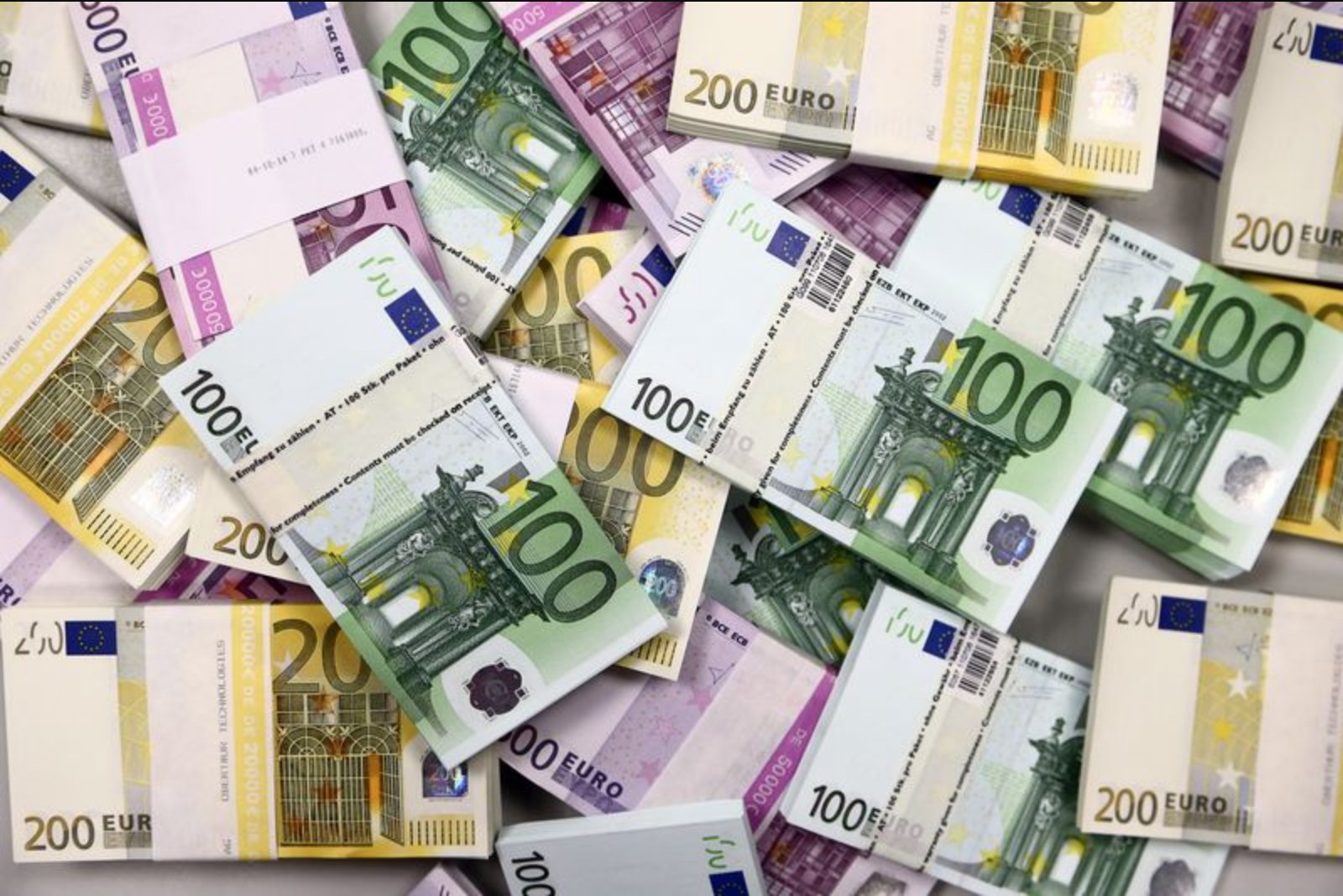
Global foreign exchange markets are witnessing renewed downwards pressure on the U.S. dollar as the euro and the Chinese yuan advance, moves that come amid explicit efforts by officials in Europe and China to enlarge the international footprint of their currencies. The recent exchange rate behavior appears to be unfolding in a manner that suits multiple players, including officials in Washington who, at least publicly on some occasions, have not uniformly resisted a softer greenback.
With the Lunar New Year holidays approaching, China’s offshore yuan has climbed to its strongest levels versus the dollar in almost three years. The dollar has shed roughly 6% against the renminbi since the start of last year. The euro’s advance is even more pronounced - up about 15% against the dollar across the same period - and the exchange rate is hovering near the five-year high above $1.20 reached last month.
Those currency moves coincide with recent, explicit commentary from European and Chinese officials promoting a broader role for their monies in global trade and finance. European Central Bank sources indicated that the ECB intends to underpin its long-standing call for a 'global euro' by expanding euro liquidity provision to more countries, with the goal of reducing costs and frictions for overseas use of the currency and strengthening its international standing.
Separately, Austria’s central bank governor Martin Kocher said the ECB should be ready for a substantial shift, noting heightened interest in the euro among counterparties and suggesting that is one factor behind the currency’s appreciation and its emergence as more of a safe haven.
Meanwhile, on February 1 China’s president reiterated Beijing’s aim for a 'powerful currency' that would be more widely used in international trade, finance and reserves, comments delivered against a backdrop of intensive high-level trade visits and calls for an 'equal, multipolar world.' That language reinforces Beijing’s intent to see wider adoption of the yuan.
Taken together, those signals from Europe and China appear to reflect an assumption that recent policy and diplomatic developments have prompted global investors to reconsider the dollar’s long-standing predominance in international finance. After a period of what the article describes as aggressive, disruptive U.S. diplomacy and trade policy, officials in those regions seem to view the present environment as a window of opportunity to act.
There is, however, an important distinction between welcoming a weaker dollar and embracing an outright recasting of the global monetary order. Some in the U.S. administration have signaled comfort with a softer dollar insofar as it reflects shifts in cross-border investment that could accompany a rebalancing of global trade. Former President Trump described January’s sharp dollar drop as 'great.' At the same time, Treasury Secretary Scott Bessent has invoked the long-standing 'strong dollar' formula, while clarifying that he interprets the phrase as referring more to policy choices that yield strength over time rather than to current exchange rate levels.
Questions also remain about whether exchange-rate considerations are implicitly addressed in the various bilateral trade deals the administration has pursued, particularly those engaging Asian partners. Those matters are not settled publicly, and the article makes clear that there is no definitive public accounting of any implicit currency understandings embedded in those negotiations.
Market participants, for their part, appear reluctant to regard the dollar’s recent setback as a temporary blip. One notable feature of the current backdrop is the relative stability of the euro/yuan bilateral exchange rate: despite a U.S. tariff shock in April last year, that cross-rate has moved little. For two regions with substantial trade linkages, that stability matters, even as the dollar weakens against each currency.
Weightings in trade-weighted currency baskets underscore why movements versus one currency feed through to others. In the ECB’s trade-weighted euro basket, the yuan accounts for about 15.5% of the weight, close to the 17.4% weight allocated to the dollar. Conversely, in China’s trade-weighted yuan basket the euro holds roughly an 18% share, nearly matching the dollar’s role. And in the Federal Reserve’s broad trade-weighted dollar basket the euro’s weighting is about 21%, more than double the yuan’s approximate 10% share. This interdependence suggests dollar weakness against either the euro or the yuan will rapidly influence valuations versus the other.
Those dynamics carry clear implications for cross-border asset allocation, especially in government bond markets. Investors weighing higher-yielding U.S. Treasuries against European or Chinese sovereign debt now face a more complex calculus when multi-year currency appreciation is plausible. As an illustration from market commentary cited in the material, the 220-basis-point yield premium on five-year U.S. Treasuries over comparable Chinese bonds would be neutralized by an additional roughly 10% decline in the dollar against the yuan between now and 2031, potentially making lower-yielding Chinese debt comparatively attractive.
Relatedly, China’s inflation has been running at least 200 basis points below that of the United States for more than five years, a differential that one commentator argues helps underpin the case for yuan appreciation on fundamental grounds.
Reports this week that Chinese regulators have encouraged domestic banks and investors to rethink concentrated holdings of U.S. Treasuries have intensified downward pressure on the dollar as interpreted by market participants. For euro-denominated debt, currency-driven calculations may be even more compelling: sustained euro strength could increase the pressure on the European Central Bank to consider more accommodative policy, which in turn would alter relative returns on euro assets and influence investor demand.
All told, these developments raise the possibility that market forces alone - rather than a coordinated international accord - might drive a meaningful unwinding of previous dollar overvaluation. That outcome could be acceptable to many of the interested parties, the article suggests, though it also cautions that currency shifts can accelerate rapidly and unpredictably.
Given the combination of public policy advocacy for greater use of the euro and the yuan, visible shifts in exchange rates, and reported guidance from Chinese regulators to domestic investors, stakeholders from central banks to sovereign debt managers and private fixed-income investors will need to monitor the situation closely. Rapid moves in currency markets can quickly alter the risk-reward trade-offs in global bond allocations and in cross-border trade and finance.
Key takeaways
- Official push from Europe and China to expand international use of the euro and yuan coincides with significant recent dollar weakness, affecting FX markets and global investor calculations.
- Relative weightings in trade-weighted currency baskets mean that dollar moves against either the euro or yuan can quickly transmit into the other, with implications for cross-border bond allocations.
- Sovereign bond markets and cross-border investors face altered return calculations as currency appreciation could offset yield differentials between U.S., Chinese and European government debt.
Risks and uncertainties
- Policy ambiguity on U.S. exchange-rate preferences: public comments from U.S. officials have ranged from praising a weaker dollar to invoking a 'strong dollar' policy, leaving uncertainty for markets and investors in government bonds and FX.
- Potential for rapid market shifts: currency markets can 'snowball' quickly, creating abrupt changes in cross-border asset valuations and risk exposures for sovereign debt managers and fixed-income investors.
- Unclear implications of bilateral trade deals: it is not publicly established whether recent trade negotiations contain implicit exchange-rate understandings, creating uncertainty for exporters, importers, and trade-exposed sectors.