
Economy January 22, 2026

EU Poised to Restart Ratification Process on U.S. Trade Agreement Following Tariff Threat Withdrawal

Positive Signals Emerge as European Parliament President Confirms Suspension Lifted After U.S. Backtracks on Tariff Plans

By Ajmal Hussain
EU Poised to Restart Ratification Process on U.S. Trade Agreement Following Tariff Threat Withdrawal

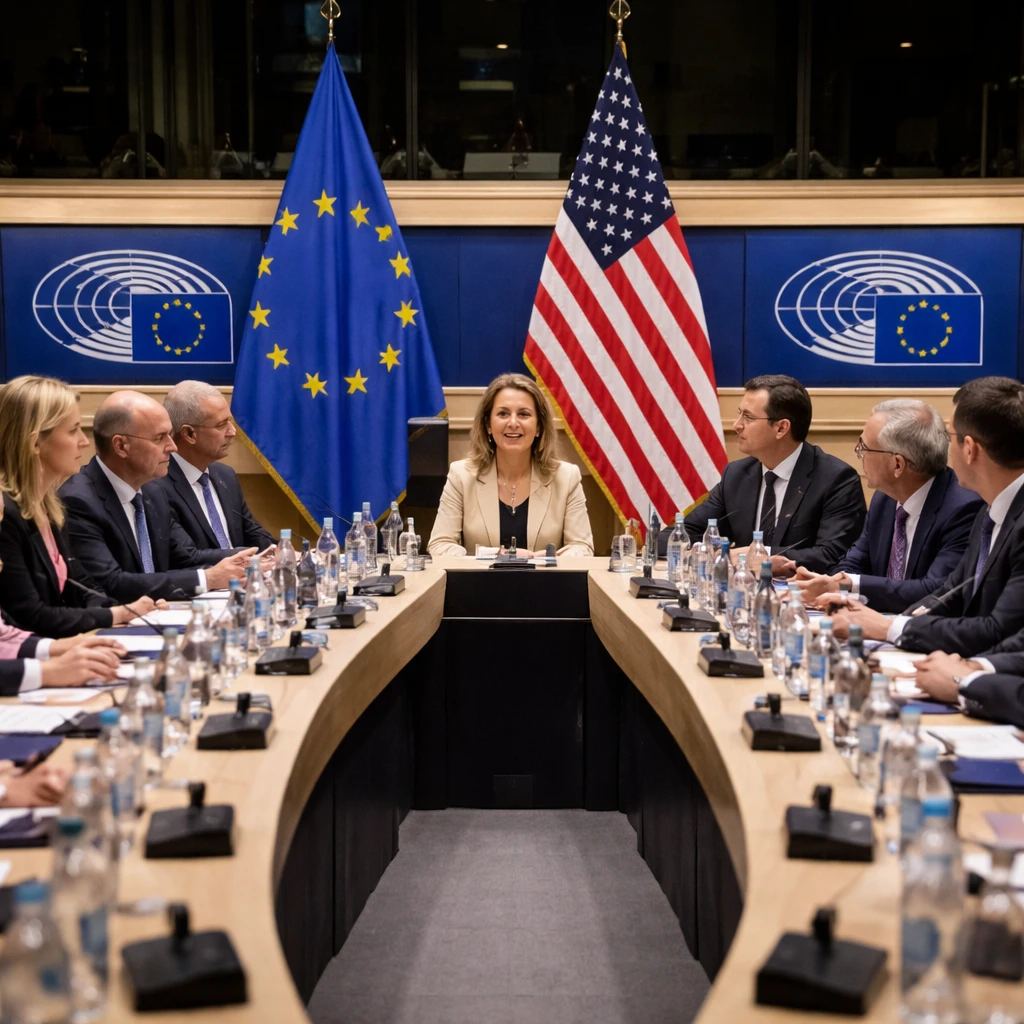
The European Union is expected to resume its ratification of a trade deal with the United States after U.S. President Donald Trump retracted a proposed tariff threat linked to his interest in acquiring Greenland. European Parliament President Roberta Metsola confirmed that the removal of this escalation allows internal discussions to proceed, reviving a trade agreement that had been temporarily halted. The deal aims to reduce import duties on U.S. goods, including zero tariffs on U.S. lobsters, but faces scrutiny due to perceived asymmetries in tariff cuts and concerns about trade surges.

Key Points

  • The European Parliament will likely restart work on the EU-U.S. trade agreement following the withdrawal of a U.S. tariff threat linked to Greenland acquisition plans.
  • Key aspects of the deal include removing many EU import tariffs on U.S. goods and maintaining zero tariffs on U.S. lobsters, with legislative approval needed from both Parliament and EU governments.
  • Lawmakers remain concerned about the perceived imbalance in tariff reductions, with the EU cutting most duties while the U.S. holds a 15% tariff rate; conditions like an 18-month sunset clause and import surge measures are under consideration.

The European Union is set to likely recommence its legislative process concerning a trade agreement with the United States after President Donald Trump withdrew a threatening tariff that had stalled progress on the deal. Roberta Metsola, President of the European Parliament, indicated on Thursday that the step back from tariff escalation removes an immediate barrier to further internal EU deliberations.

"We are happy to see that the escalation is off the table for now," Metsola stated, adding that this development paves the way for continued discussions surrounding the EU-U.S. trade treaty. These talks had paused amid concerns about potential tariffs prompted by Trump's approach to purchasing Greenland, which had caused unease among EU legislators.

This week, the European Parliament decided to suspend work related to the trade deal due to these emerging tariff threats. The agreement under consideration involves significant removal of many EU import duties on U.S.-origin goods, a core component agreed upon in Turnberry, Scotland at the end of July. Additionally, it aims to sustain the existing zero-duty arrangement for U.S. lobsters, initially established during discussions with Trump in 2020. Approval of these legislative proposals requires endorsement by both the Parliament and individual EU member states' governments.

Despite some support, numerous lawmakers have criticized the deal as unbalanced. The EU appears obliged to reduce the majority of its import duties on U.S. products, whereas the United States maintains a broadly applied rate of 15%. Nonetheless, prior acceptance of the deal was conditional, incorporating elements such as an 18-month sunset clause and safeguards to handle potential surges in U.S. imports.

The European Parliament’s trade committee had originally scheduled votes to finalize its stance on January 26 and 27. Metsola expressed optimism that the resolution of tariff issues would allow these conversations to resume promptly, restoring momentum to the trade deal process.

Risks

  • Potential disagreement among European lawmakers persists due to the unequal tariff obligations, risking delays in ratification and impacting trade relations.
  • The temporary suspension and the prior threat of tariffs illustrate volatility in negotiating conditions, possibly affecting market confidence in sectors reliant on transatlantic trade.
  • Uncertainty remains around the management of import surges from the U.S., which could disrupt sectors sensitive to sudden trade volume changes.

More from Economy

Bessent Says Signs Point to Stronger Labor Demand After Capex Surge Feb 20, 2026 Bessent: Administration to Shift Tariff Strategy After Supreme Court Ruling Feb 20, 2026 Trump Repeats Call for Much Lower Interest Rates, Criticizes Fed Chair Feb 20, 2026 White House to Apply 10% Global Tariff for 150 Days, Citing Trade Act Authority Feb 20, 2026 Trump directs temporary 10% global tariff under Trade Act after Supreme Court rebuke Feb 20, 2026