
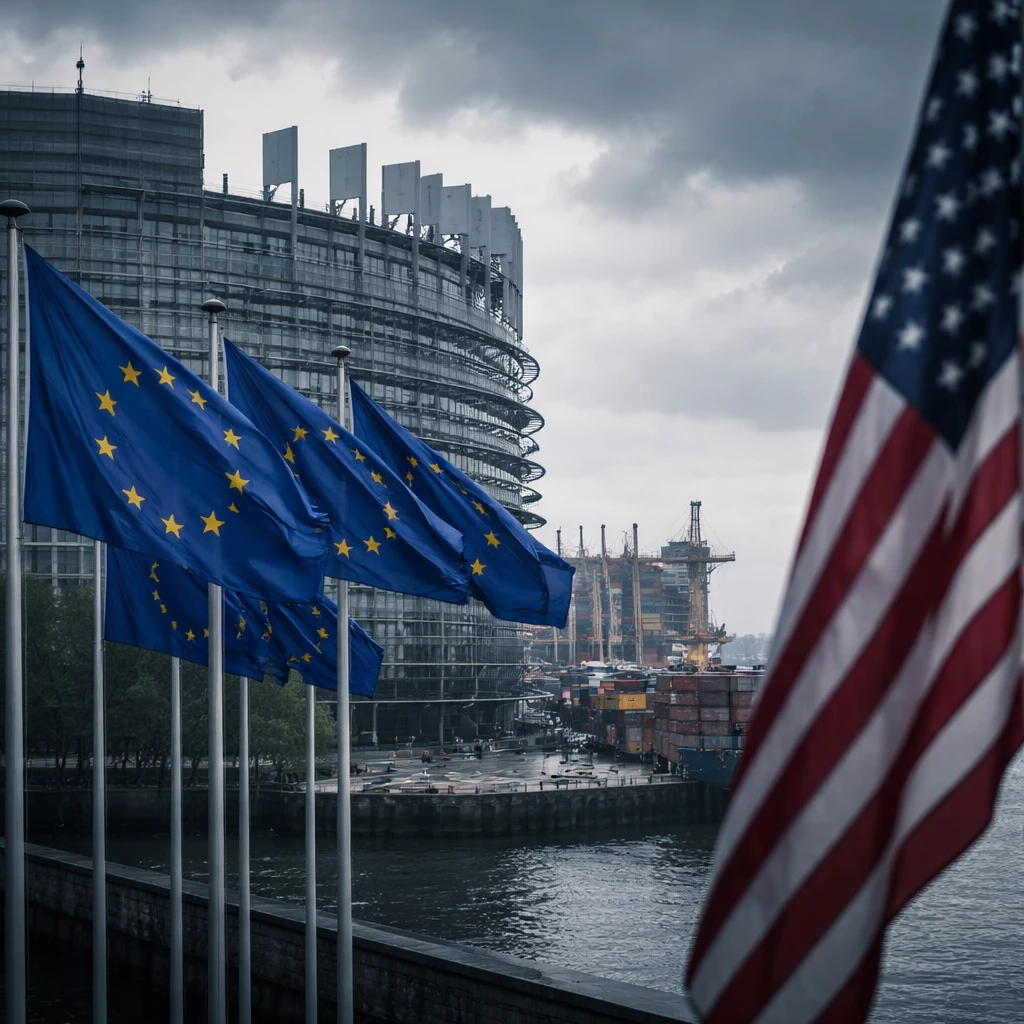
The European Union has moved to suspend the legislative ratification process for a trade agreement signed with the United States last year, as Brussels seeks clearer information regarding Washington's recent tariff decisions.
Main political groups in the European Parliament announced that the formal work to approve the accord will be put on hold starting Monday, stating that the current circumstances require greater certainty before proceeding.
Over the weekend, President Donald Trump announced a 15% global tariff after the U.S. Supreme Court struck down his use of emergency powers to impose broad levies on numerous trading partners, including the EU. A White House communication had said the tariffs would initially be set at 10% as of Tuesday, but the president later raised that rate to 15%.
Legally, Congress could extend the across-the-board 15% tariffs after they expire in 150 days, since U.S. trade authority resides with lawmakers and was central to the Supreme Court's reasoning. Analysts at ING cautioned that, in practice, the president could allow the surcharge to lapse, declare a new emergency, and begin a fresh 150-day span, a sequence that analysts described as creating a "de facto perpetual tariff instrument."
Speaking for a major center-right group, the lead negotiator of the European People's Party on the U.S. trade agreement said there was "no other option" but to delay the approval process until the situation around U.S. tariff plans becomes clearer. The negotiator's comments underline the political sensitivity in the European Parliament about moving forward without a stable picture of U.S. trade policy.
The EU is a major supplier of goods to the United States. U.S. Census Bureau figures show the European bloc accounted for a 20.2% share of total U.S. imports between January and May of last year, representing roughly $303 billion in value. That concentration helps explain the urgency among European lawmakers to assess the impact of the newly announced U.S. levies.
Parliamentary leaders have scheduled an emergency meeting of the trade committee on Monday to reassess the status of the U.S.-EU trade deal. In addition, EU ambassadors are due to meet to discuss next steps and coordinate a response.
Lawmakers in Brussels have previously paused the ratification process in response to earlier provocations by the U.S. administration, such as a diplomatic episode involving Greenland, a territory of EU-member Denmark.
Under the terms agreed last summer, the EU had planned to impose a 15% tariff on most exports to the U.S. while removing tariffs on certain U.S. industrial goods entering the bloc. The agreement left a 50% levy on European steel and aluminum in place on the U.S. side.
Markets reacted to the renewed uncertainty. European stocks fell to session lows on Monday as investors adjusted to the prospect of renewed trade frictions and stalled ratification of the pact.
Context and next steps
EU political authorities and trade officials are pausing formal approval until they can evaluate whether the U.S. tariffs will remain temporary, be extended by Congress, or be subject to repeated emergency declarations that could prolong their effect.
The suspension of legislative action and the scheduling of emergency meetings indicate that both lawmakers and diplomats in Brussels view clarity on the U.S. tariff path as a precondition for advancing the trade accord.