
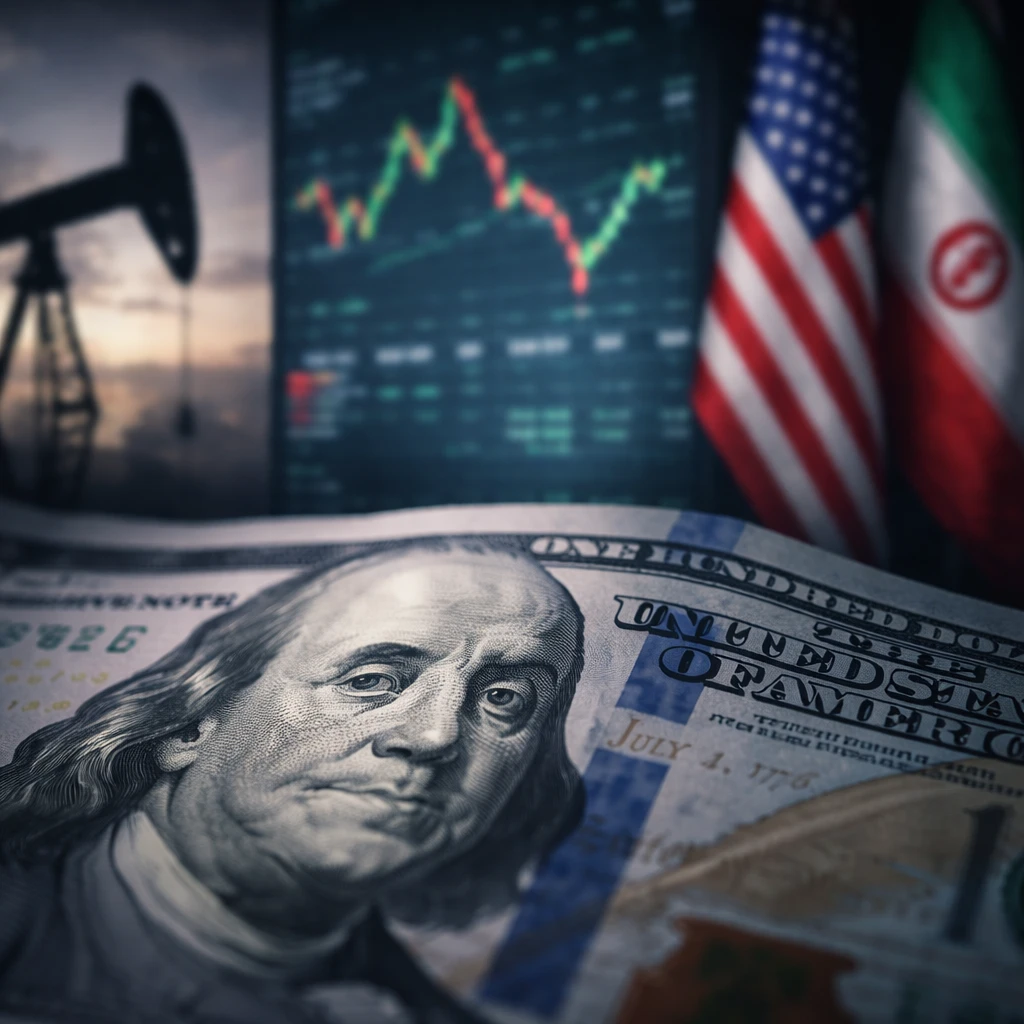
The U.S. dollar climbed on Friday following a hotter-than-expected reading for January producer prices and renewed market concern over escalating tensions between the United States and Iran.
Data from the Bureau of Labor Statistics showed the Producer Price Index (PPI) for final demand rose 0.5% in January, after December's figure was revised down to a 0.4% gain. Economists surveyed by Reuters had been looking for a 0.3% increase in January, following the previously reported 0.5% advance in December.
Market analysts said the stronger-than-expected PPI reinforced worries that inflation remains elevated early in 2026. "There’s a real deep unease in markets about inflation and growth so far in 2026," said Adam Button, chief currency analyst at investingLive. "There’s this expectation that inflation will moderate, but it’s not showing up in the numbers."
Not all observers read the headline increase as an unequivocal sign that inflation is reaccelerating. Chris Low, chief economist at FHN Financial, noted that some of the upward pressure came from trade services, a category the BLS calculates in a manner that may not capture true price changes in real time. "While the PPI headline increase was alarmingly big, pressure came from trade services," Low said. "Otherwise, there is evidence of price moderation."
Currency and market moves
The dollar index, which measures the greenback against a basket of currencies including the euro and the yen, ticked up 0.06% to 97.79. The euro was largely unchanged on the day at $1.1797.
On a monthly basis the dollar index is on track for a 0.64% rise, which would mark its first monthly gain since October. The euro is poised to record a 0.42% decline for the month, its first down month since October.
Against the Japanese yen, the dollar inched up 0.03% to 156.16, putting it on course for a 0.9% gain versus the yen for the month.
Expectations around U.S. monetary policy continue to shape currency flows. The Federal Reserve is widely expected to keep interest rates on hold through at least June amid concerns that inflation remains above desired levels. At the same time, traders are pricing in roughly 60 basis points of rate cuts by year-end on growing worries about a weakening labor market.
Geopolitical risk and commodities
The dollar received additional support from a safety-driven bid as markets monitored developments between the United States and Iran. Mediator Oman said the two countries made progress in talks over Tehran’s nuclear program, but hours of negotiation ended without any sign of a breakthrough that might avert potential U.S. strikes amid a substantial military buildup. The unresolved tensions contributed to a risk-off tilt.
Oil prices reacted to the heightened geopolitical risk, rising about 3% on Friday as traders weighed the possibility of supply disruptions should relations deteriorate further.
Other currencies and market drivers
Market participants also noted a number of other drivers. Overall market moves this week were muted as investors balanced geopolitical uncertainty with the effects of recent trade-policy developments. Last week, the U.S. Supreme Court struck down U.S. President Donald Trump’s emergency tariffs, a factor traders are still digesting.
China’s yuan paused following a 10-day rally after the People’s Bank of China took steps to slow the pace of appreciation. The central bank said it would scrap foreign exchange risk reserves for some forward contracts - a move seen as one that could encourage dollar buying.
Sterling weakened 0.22% to $1.3451 and is set to end February with a 1.75% drop, which would break a three-month streak of gains. Domestic political developments played a role: a local election in Manchester delivered a significant victory for the Green Party and dealt a blow to Prime Minister Keir Starmer’s Labour Party, whose popularity has fallen notably over the past year. Traders expect more potential volatility around upcoming domestic events, including next week’s budget update from finance minister Rachel Reeves, although current moves have been contained.
In cryptocurrencies, bitcoin declined 2.30% to $65,924.
Outlook
Investors are now parsing the PPI details alongside geopolitical developments and central bank guidance. The stronger PPI headline adds to concerns about persistent inflation, but some analysts caution that specific components may overstate immediate price pressures. Meanwhile, developments on the U.S.-Iran front and evolving policy steps from major central banks and governments will likely continue to influence currency and commodity markets in the near term.