
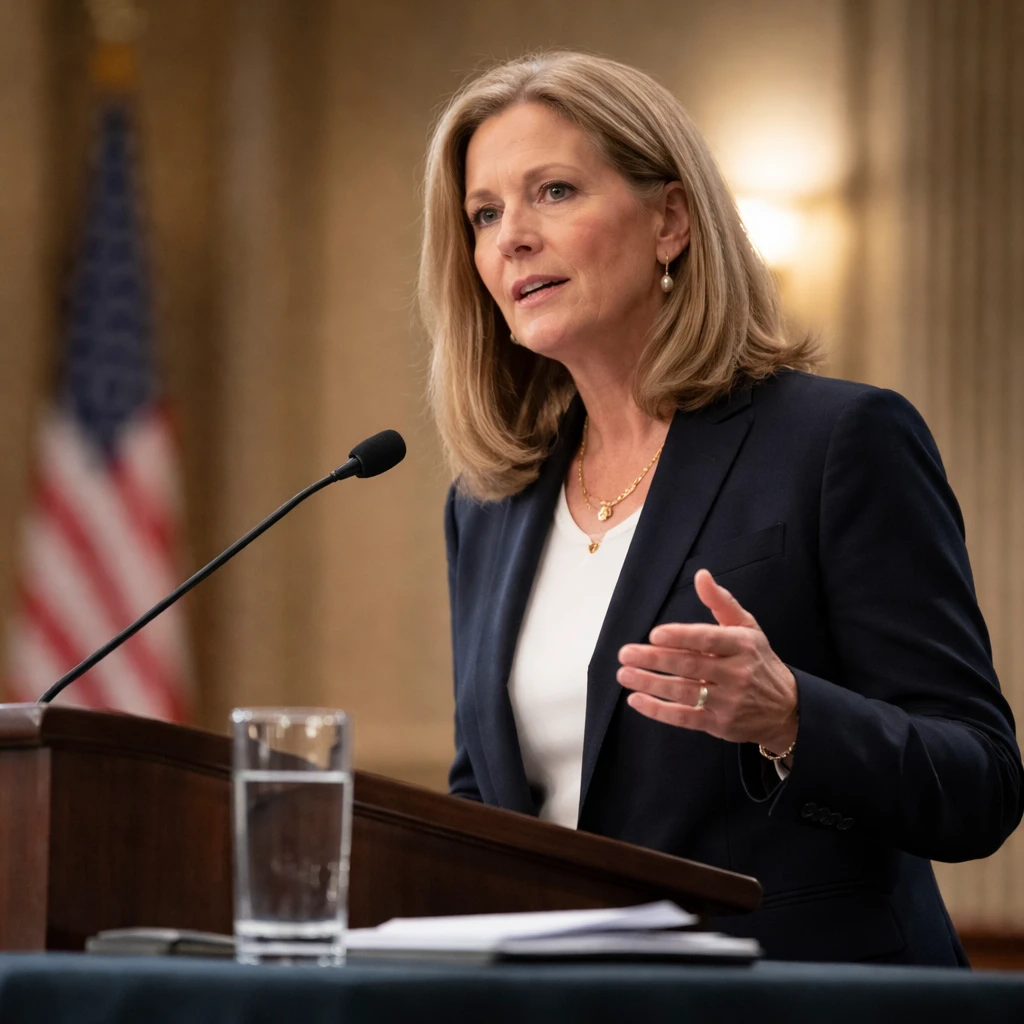
Federal Reserve Bank of Cleveland President Beth Hammack said Friday that she does not see an immediate requirement to change the Fed's monetary policy while inflation remains elevated.
Delivering remarks at the U.S. Monetary Policy Forum in New York City, Hammack described the current policy stance as appropriately placed to navigate the tension between persistently high inflation and a softening jobs backdrop. She noted the Fed's interest rate target has moved to a neutral level - a setting she characterized as neither clearly stimulative nor restrictive for economic growth - following rate cuts implemented last year.
Under her central forecast, Hammack said policy should remain on hold for quite some time. She emphasized that action should wait until there is convincing evidence that inflation is on a sustainable downward path and that the labor market has stabilized further. Hammack also warned that two-sided risks to the path of interest rates remain, saying alternative scenarios can be readily imagined.
The Fed trimmed its federal funds target rate range by three quarters of a percentage point last year, bringing the range to between 3.5% and 3.75%. According to Hammack, that reduction aimed to support a flagging jobs market while retaining sufficient restraint to bring down inflation, which has remained well above the central bank's 2% goal.
Hammack, who holds a vote on the rate-setting Federal Open Market Committee this year, said she was skeptical of the decision to cut rates last year in the face of high inflation. She pointed to recent geopolitical developments - specifically President Donald Trump's attack on Iran - as another complicating factor for the Fed's outlook, noting such events have pushed up energy prices and reignited concerns about persistent inflationary pressures.
In her remarks, Hammack stressed that inflationary pressures are broad based. She said tariffs are only one facet of the issues businesses are confronting, and that firms are also reporting rising costs for health insurance and electricity, which are contributing to higher overall expenses.
A substantial portion of Hammack's address focused on the U.S. dollar and its position as the world's dominant reserve currency. She attributed the dollar's continued prominence to strong U.S. institutions and the country's legal framework, and stated that there are no realistic contenders poised to displace it. Hammack pointed to available evidence indicating no significant retreat from dollar holdings so far.
Hammack also observed that the emergence of dollar-denominated stablecoins could support demand for the currency. She said it is hard to foresee near-term, fundamental shifts in the dollar's international role, adding that widespread use of a currency reinforces network effects and increases the benefits of continued adoption.
She reported that her contacts are not indicating any notable movement away from the dollar, and she reiterated that the euro is not yet in a position to supplant the dollar. In her view, dislodging the dollar from its global role would require substantial change.
Contextual note: Hammack's remarks reflect her assessment of the current balance between inflation and labor market dynamics, and outline the considerations she believes should guide the Fed's policy stance going forward.