
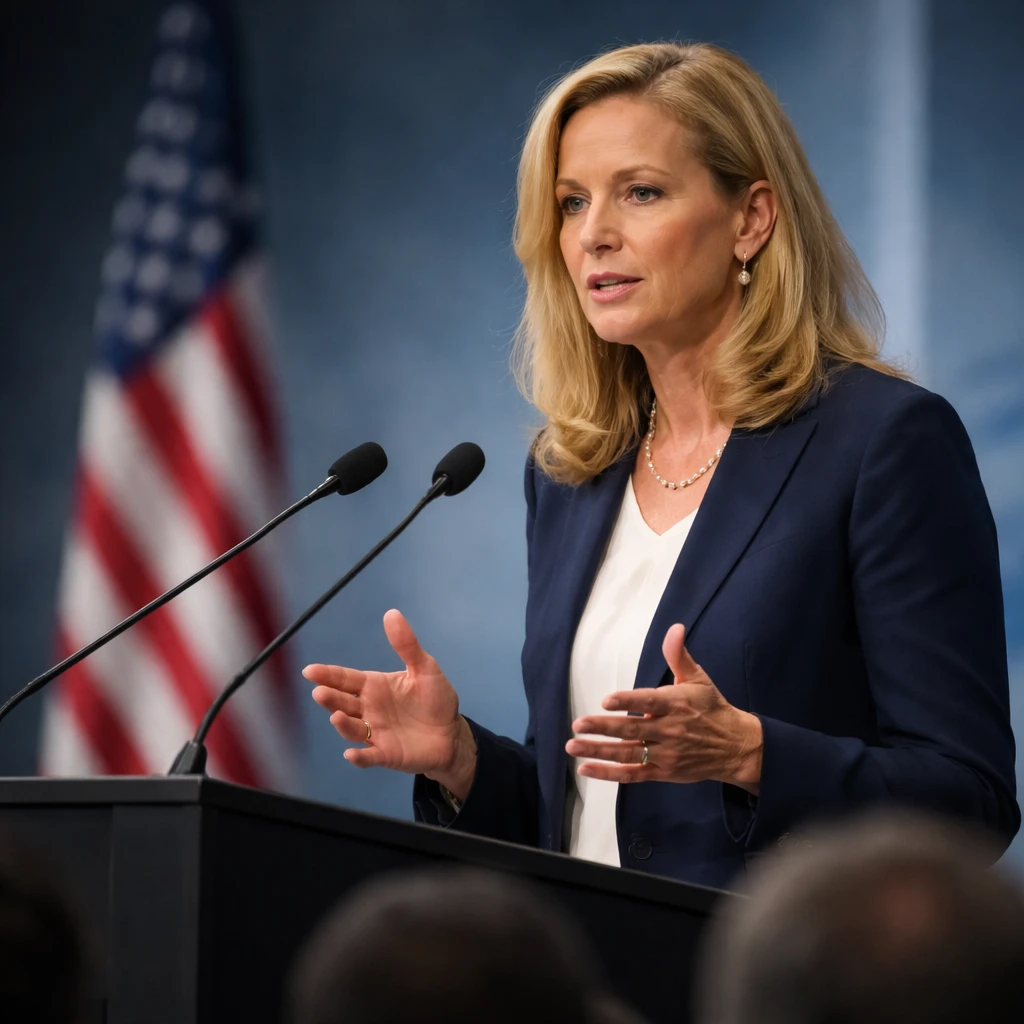
NEW YORK, March 6 - Federal Reserve Bank of Cleveland President Beth Hammack said Friday that she does not see an immediate need to alter the central bank's policy stance, even as she reiterated concern that inflation remains "too high." Speaking before the U.S. Monetary Policy Forum in New York City, Hammack framed the current policy mix as broadly appropriate given the balance between elevated price pressures and a softening labor market.
Hammack said the combination of persistent inflationary pressures and rate cuts implemented last year have left monetary policy "in a good position," where the effect of the Fed's interest rate target on the economy sits roughly neutral. That assessment underpins her view on the path of rates.
"Under my base case, I think policy should be on hold for quite some time as we see evidence that inflation is coming down and the labor market stabilizes further," Hammack said. She added that she sees risks on both sides, noting "it's easy to envision other scenarios, as well, so I see two-sided risks to rates."
Hammack reiterated facts about the policy moves of the prior year: the Fed trimmed its federal funds target rate range by three quarters of a percentage point last year to between 3.5% and 3.75%. Those reductions were aimed at supporting a weakening jobs market while the central bank continued to maintain enough restraint to drive down inflation that has remained well above the Fed's 2% objective.
Hammack, who holds a vote on this year's rate-setting Federal Open Market Committee, expressed skepticism about last year's push to cut rates in the context of elevated inflation. She pointed to recent geopolitical developments as a complicating factor for policy outlooks, saying that the impact of President Donald Trump's attack on Iran has pushed up energy prices and reintroduced the prospect of sustained gains in inflation.
On the topic of price dynamics more broadly, Hammack said, "I see inflationary pressures as broad based," and emphasized that firms are raising a range of input costs. She noted, "tariffs are only one area of concern for businesses, which also report that rising prices for health insurance and electricity are pushing up costs."
Much of Hammack's address centered on the international role of the U.S. dollar. She argued that the dollar's dominance derives from strong U.S. institutions and legal frameworks, and she observed that there are currently "no real rivals to displacing the dollar," with little evidence so far of a pullback from dollar holdings.
Hammack also discussed technological developments in payments, noting that the rise of stablecoins denominated in dollars could further support demand for the currency. "It's difficult to envision imminent major changes to the dollar's international role," she said. "One reason is that the more people use a currency, the stronger the network effects and the bigger the benefits," she added.
Takeaway - Hammack favors leaving policy unchanged for an extended stretch under her base case, while acknowledging that elevated inflation, rising energy costs tied to geopolitical events, and broad-based input-cost pressures for businesses create meaningful uncertainties for the outlook.