
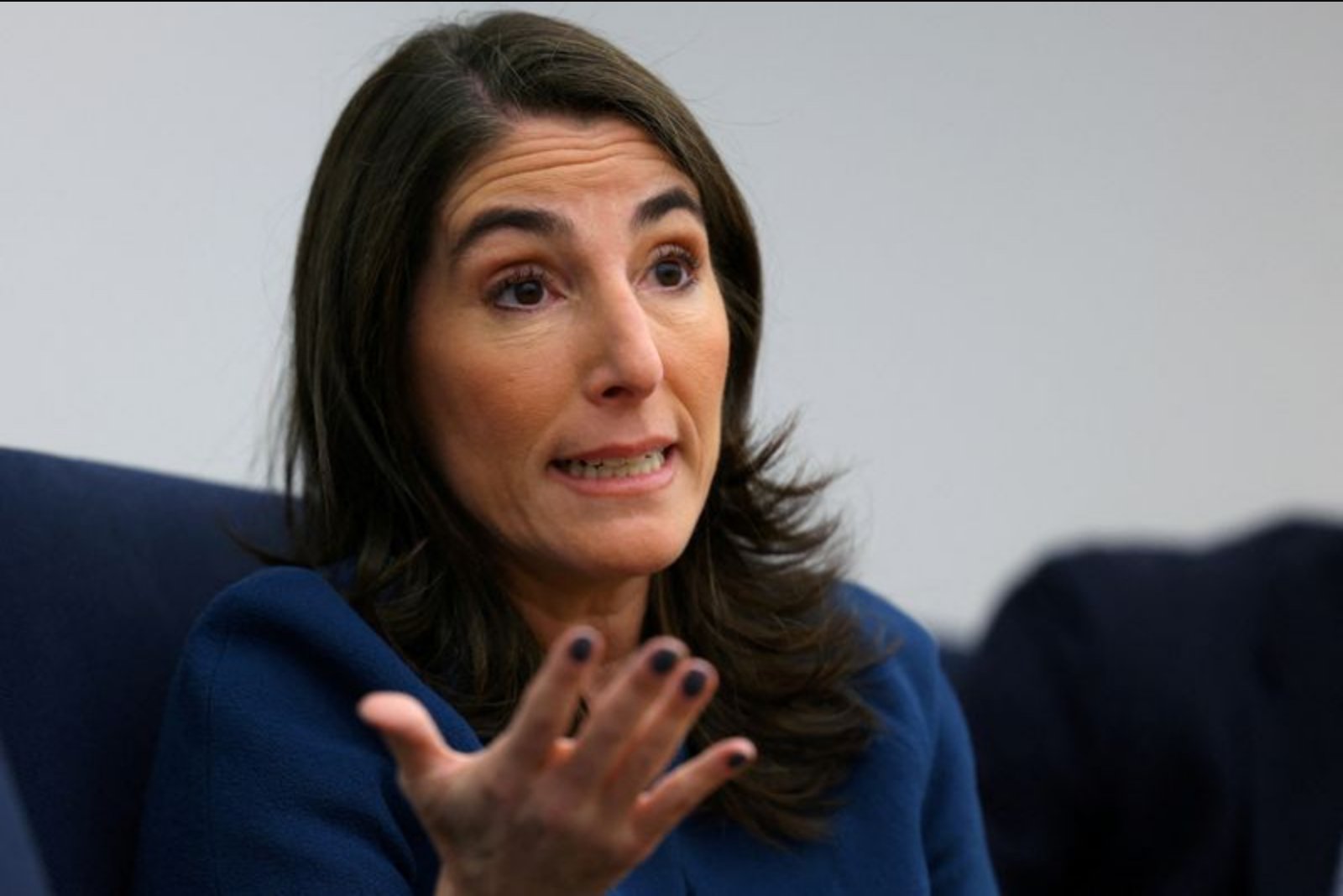
Federal Reserve Bank of Cleveland President Beth Hammack said Friday that while she anticipates inflation pressures will moderate, the U.S. central bank may need to shift to a tighter stance if inflation is not clearly trending toward the Fed’s 2% objective later in the year.
“My expectation has been that inflation would start making progress towards our 2% target. I don’t think we’ll get there by the end of this year by any stretch, but I think we’ll make some decent progress,” Hammack said in an interview with Reuters. She added that, based on the current outlook, "rates should be on hold for …quite some time."
That said, Hammack cautioned that a failure of inflation to decline as she expects could prompt the Fed to consider more restrictive policy measures. "If inflation is not making progress towards our goal in the latter half of this year, as I expect that it should, that might be a reason why we might need to be more restrictive from policy perspective," she said.
Hammack discussed the horizon to the 2% target and how it factors into decisions about easing monetary policy. She said it is possible but not guaranteed that inflation will be at the 2% goal by 2027. Crucially, she noted the Fed does not require inflation to have already hit the target before cutting rates. Instead, confidence that inflation is on a credible path to 2% could support easier policy.
At the same time, Hammack said significant uncertainty remains, particularly in light of a recent jump in oil prices tied in her remarks to President Donald Trump’s war on Iran. On that front she emphasized the need to understand both the magnitude and the persistence of the oil shock before judging its full economic impact. "It is 'too early to know' how all this will play out," she said. "I try to look at what's the magnitude and what's the persistence? So, is this something that lasts for a week? Does it last for two months? Depending on what you know, what that time frame is, (that) will determine some more of the underlying economic impact."
Hammack said a sustained oil shock could have a dual effect: increasing inflation while simultaneously weighing on growth and hiring. In such a scenario, she suggested the Fed would need to weigh those outcomes carefully when deciding whether to alter policy.
The comments came on the same day the government released a payrolls report showing that the U.S. economy lost 92,000 jobs in February and the unemployment rate rose to 4.4%. The weaker-than-expected hiring figures, combined with disruptions in energy markets and higher fuel prices, create a potentially conflicting set of pressures for policymakers.
On one hand, sustained and large gasoline price gains risk pushing up already elevated headline inflation, potentially influencing public expectations of future price increases and increasing the rationale for holding interest rates at current levels or even tightening policy further. On the other hand, a weakening labor market can argue for monetary easing to support employment.
Hammack noted that the Fed cut its target range for the federal funds rate by three-quarters of a percentage point last year to 3.5% - 3.75% to bolster the job market, even as inflation remained above the 2% objective. The Federal Open Market Committee is scheduled to meet March 17-18 and is widely expected to keep rates unchanged at that meeting. Hammack is a voting member of the FOMC this year.
Regarding the latest labor data, Hammack said she sees signs of stabilization and that she is closely watching the unemployment rate amid uncertainty tied to the payroll number. She emphasized that the unemployment rate is her preferred labor market indicator at the moment given the mixed signals in the data.
Turning to financial stability, Hammack said she did not observe major systemic problems in markets today but flagged private credit difficulties as an area of concern that could cause pain for investors if they develop further. She defended the structure of post-crisis banking regulations the Fed currently enforces, arguing those rules have made the system safer.
"I believe that the system has been made safer by a number of the regulations that were put in place" after the great financial crisis, she said, adding that those regulations helped banks navigate the COVID-19 pandemic and enabled them to be "a source of strength and a source of lending into the real economy" during that period. "I think it's important that we maintain that level of support," Hammack said, while conceding that some rules might be reviewed and adjusted.
The central message from Hammack was one of conditional patience: with the current outlook, an extended period of unchanged rates makes sense, but the Fed remains prepared to respond with greater restrictiveness should inflation fail to retreat toward the 2% goal later in the year. At the same time, she signaled attention to labor market developments and emerging private credit strains that could shape the policy path.