
Overview
Citigroup has lowered its recommended Nifty 50 multiple to 19 times one-year forward earnings, down from 20 times, and reaffirmed a December 2026 index target of 27,000. The move accompanies a warning that an ongoing Middle East confrontation, now in its second week, could meaningfully affect India’s macro outlook if supply disruptions persist.
Disruption in the Strait of Hormuz
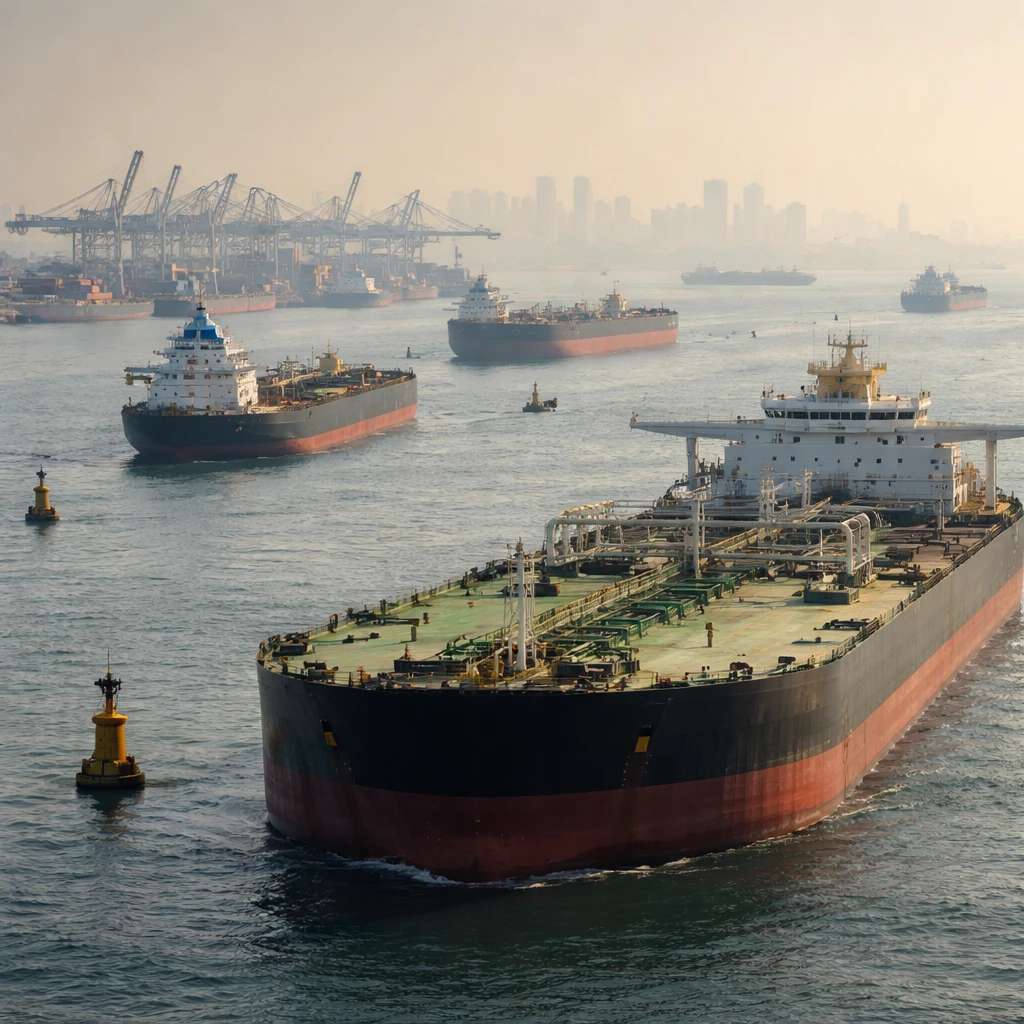
The brokerage notes that a blockade in the Strait of Hormuz has reduced ship traffic by up to 90%, interrupting an estimated 6-7 million barrels per day of Gulf oil production. Citi characterises the impact as extending beyond a conventional energy price shock to a "quantity" disruption, with downstream spillovers into fertiliser, petrochemical, LPG and LNG supply chains.
Three-month disruption scenario - macro effects
Under an assumption of roughly three months of disruption, Citi quantifies several risks to its forecasts for fiscal year 2027 (FY27):
- 20-30 basis points of downside to its real GDP growth forecast, which it currently estimates at 7.1% for FY27.
- 50-75 basis points of upside risk to its average consumer price index (CPI) forecast of 4%.
- About $25 billion of upside risk to the current account deficit (CAD).
- Roughly 0.1 percentage point of upward pressure on the central fiscal deficit as a share of GDP.
Oil price scenarios and domestic pass-through
Citi modelled Brent crude at $80, $100 and $120 per barrel. Under the scenario where Brent averages $100 per barrel for a three-month period, the bank projects: domestic retail fuel prices face upward pressure of about 10 Indian rupees per litre; inflation increases by around 15-20 basis points; and the current account deficit widens by approximately $20 billion. In contrast, if Brent averages $80 per barrel, Citi expects no change to retail fuel prices.
Bear case and market implications
In a bear-case constellation where crude prices remain above $100 per barrel for a sustained period, Citi warns that FY27 NIFTY earnings per share (EPS) could be downgraded to single-digit year-on-year growth from current projections of roughly 15%. Under that stress scenario the brokerage expects the market multiple to remain subdued at about 18 times.
Wider economic linkages
Citi highlights additional transmission channels that widen the shock beyond energy markets. The Gulf Cooperation Council (GCC) accounts for 38% of India’s remittances and 14% of its goods exports, increasing the potential economic impact. Commodity prices have already moved: fertiliser prices are up 30-40% since end-February, petrochemical prices have risen by more than 30%, and shipping costs on some routes are higher by 15-20%.
Sectors and company-level effects
The brokerage has adjusted sector and company recommendations in response. Automakers were downgraded to neutral, and Mahindra & Mahindra and Mahanagar Gas were removed from Citi’s top picks.
Company-specific impacts cited by Citi include:
- Reliance Industries - could register a 5-12% upside to FY27 earnings if refining cracks strengthen.
- Hindustan Petroleum Corporation Limited (HPCL) - identified as facing the sharpest downside; Citi estimates that every $5 per barrel increase in oil combined with a $5 per barrel rise in refining cracks could trim HPCL’s earnings by roughly 25%.
- InterGlobe Aviation - Citi projects EBITDAR could fall by more than 75% if crude hits $100 per barrel and fares are not increased.
Monetary policy view
On central bank policy, Citi retains its expectation that the Reserve Bank of India (RBI) will pause at the April Monetary Policy Committee meeting. The note points to headline inflation of 3.2% at present - down from about 6% at the onset of the Russia-Ukraine war - as creating more flexibility for the RBI in light of the evolving supply-side shock.
Conclusion
Citi’s revised multiple and scenario analysis reflect a cautious stance: the bank quantifies a range of macro and corporate risks stemming from a supply-constrained shock in the Gulf that has both energy and non-energy transmission channels. The scale of impacts will hinge on the duration and severity of the Strait of Hormuz disruption and the path of crude prices across the modelled scenarios.