
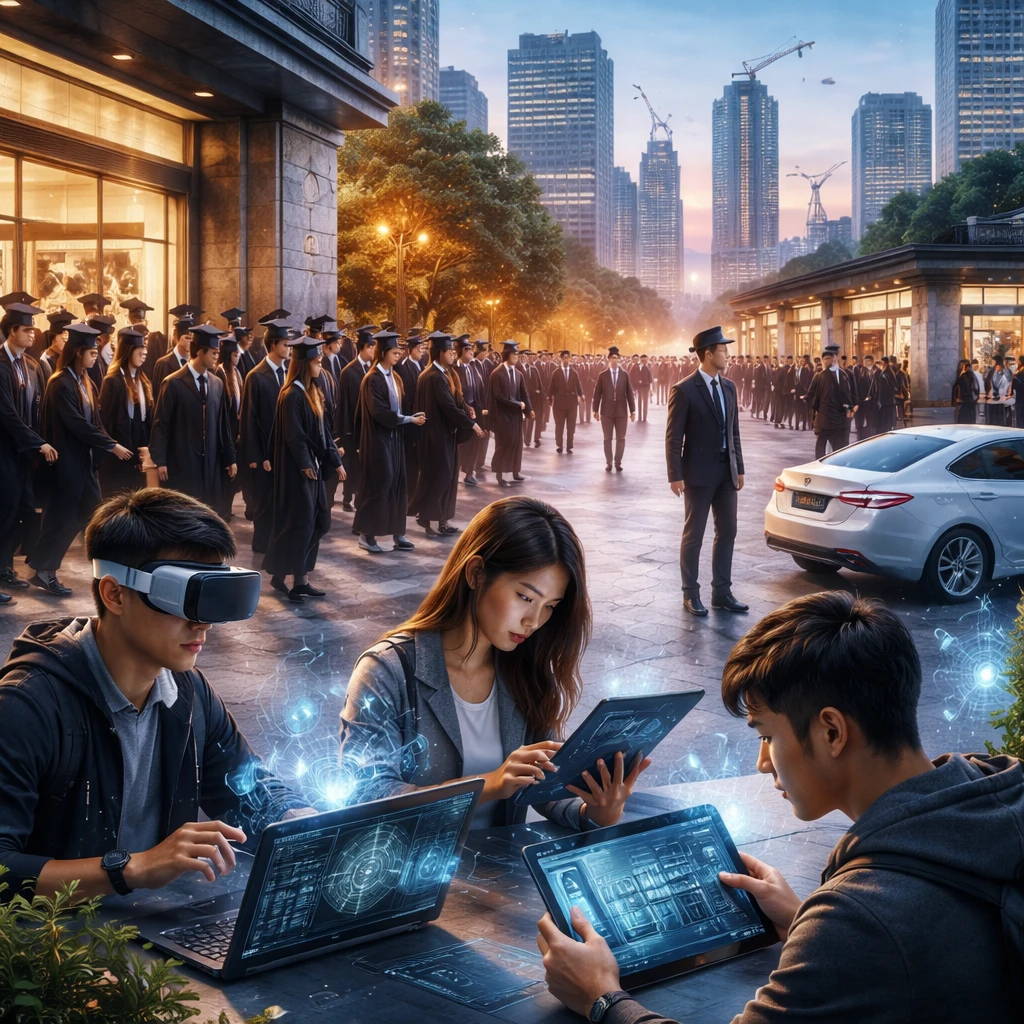
China has announced a concerted effort to use artificial intelligence as a central tool for managing an unprecedented influx of 12.7 million university graduates entering the labor market this year, a cohort larger than the entire population of Belgium. The scale of the intake has prompted a strategic pivot in Beijing toward tech-driven employment measures amid mounting demographic and economic pressure.
Markets registered the move. The Shanghai Shenzhen CSI 300 closed the week at 3,842.15 as investors assessed the potential implications of state-led AI deployment against signs of a cooling domestic economy.
At a press conference held during the National People’s Congress, Human Resources and Social Security Minister Wang Xiaoping outlined the government’s intention to harness AI to "upgrade" traditional occupations and open new employment channels. Wang also warned that "growing uncertainties" continue to threaten broader employment stability across mainland China, signaling that the policy push does not erase near-term risks.
Policy measures and sector focus
To reach its stated objective of adding 12 million urban jobs in 2026, the government is rolling out extensive internship and training initiatives concentrated on rapidly expanding sectors. Officials have singled out vocational development within the so-called "low-altitude economy," new-energy vehicles (NEVs), and generative AI as priority areas for workforce development.
The emphasis on these sectors suggests an intentional reallocation of labor away from traditional manufacturing roles toward industries with higher technological intensity and value-add. Programs being promoted combine hands-on internships with targeted training designed to bridge immediate employability gaps.
Investor and analyst perspectives
Global investors are watching the policy shift closely, mindful that its success will be pivotal to maintaining China’s targeted surveyed jobless rate of 5.5% through 2030. Analysts at Goldman Sachs have observed that integrating AI could lift long-term productivity. At the same time, they flagged the short-term impediment posed by a "skills gap" among new graduates who must compete in a tight labor market.
China’s approach frames AI as a generator of employment opportunities rather than solely a source of automation-driven displacement. By promoting AI as a mechanism for "role upgrading," authorities are aiming to stabilize youth unemployment figures that have been under intense scrutiny over the past year.
Market participants are also monitoring upcoming US-China trade discussions for indications of how domestic labor strategies might interact with international technology export restrictions. Observers note that such intersections could influence the pace and scope of AI deployment across industries.
Outlook
Beijing’s turn to AI and targeted vocational interventions underscores the scale of the challenge presented by this year’s record graduate cohort. Officials are deploying a combination of training, internships and sectoral prioritization to create pathways into employment, while continuing to caution about ongoing uncertainties in the labor market.