
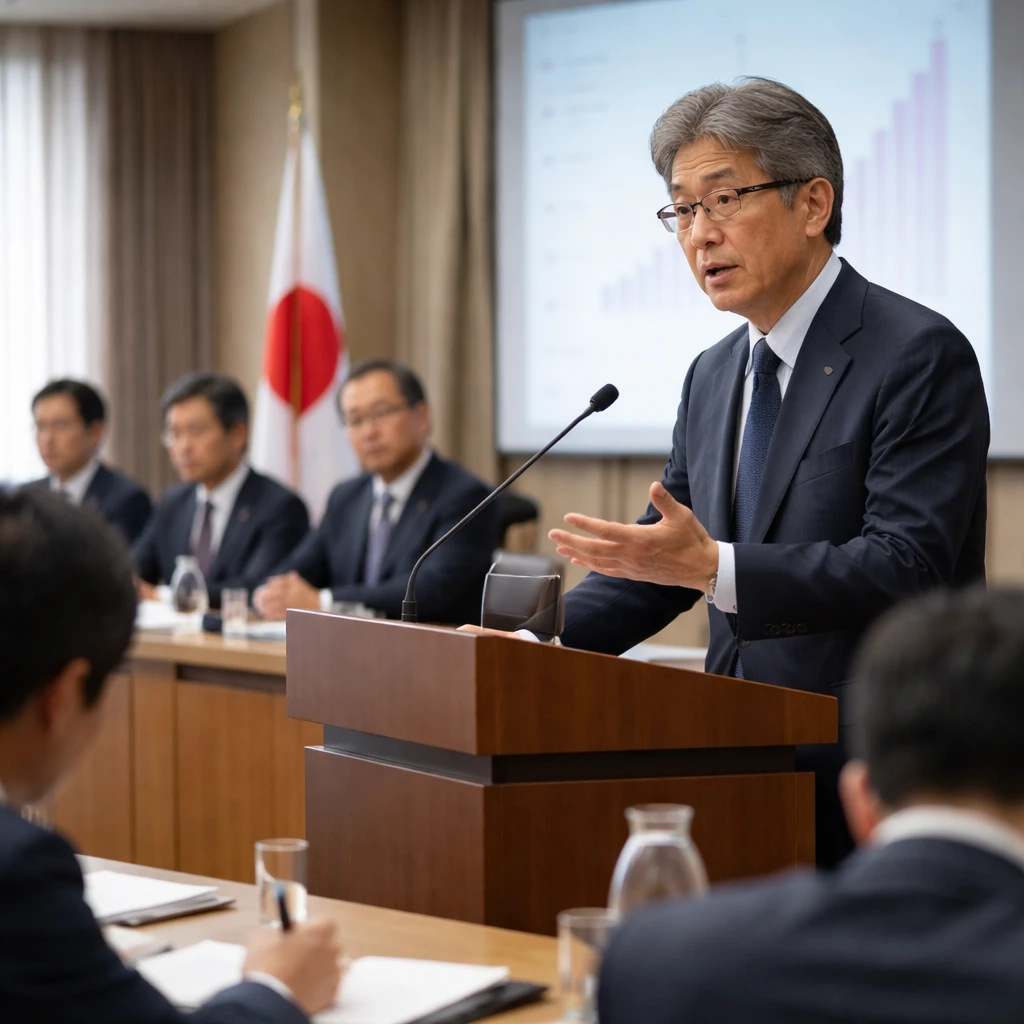
Bank of Japan Deputy Governor Ryozo Himino said on Monday that the central bank is likely to pursue further interest rate increases as it transitions gradually to a more neutral monetary policy stance.
Delivering remarks at a meeting in Wakayama in the Kansai region, Himino emphasized that underlying inflation is currently short of the BOJ's 2% objective but is expected to move closer to that benchmark over time. He highlighted the central bank's intention to calibrate policy so that it becomes less accommodative through measured, moderate rate rises.
The central bank has raised rates four times since early-2024, taking them out of negative territory and to 0.75%. Himino noted that those increases have had a limited effect on the Japanese economy to date.
Himino reiterated the Bank of Japan's broader posture that policy rates will be increased in step with economic growth and inflation if both evolve in line with the BOJ's forecasts. Nonetheless, he acknowledged there are signs that complicate the path forward: a recent string of weaker-than-expected gross domestic product and inflation readings has introduced uncertainty over the extent of the BOJ's remaining room to tighten policy.
Most recently, Tokyo consumer price index data for February showed underlying inflation slipping below the BOJ's 2% annual target, a data point that has contributed to questions about policy momentum.
"The inflation gap remains slightly negative at present but is expected to approach zero in the future… while the Bank’s policy remains somewhat accommodative, it should gradually shift to a more neutral stance through moderate policy rate hikes," Himino said.
Himino's comments underscore the BOJ's current approach: to move away from accommodation slowly, using moderate increases in the policy rate while watching whether growth and prices firm sufficiently to justify further tightening.
Summary of key facts:
- The BOJ has raised rates four times since early-2024, bringing the policy rate to 0.75%.
- Underlying inflation is currently below the 2% target but is expected by the BOJ to rise toward that level.
- Recent weak GDP and inflation readings have created uncertainty about how far the BOJ can raise rates.