
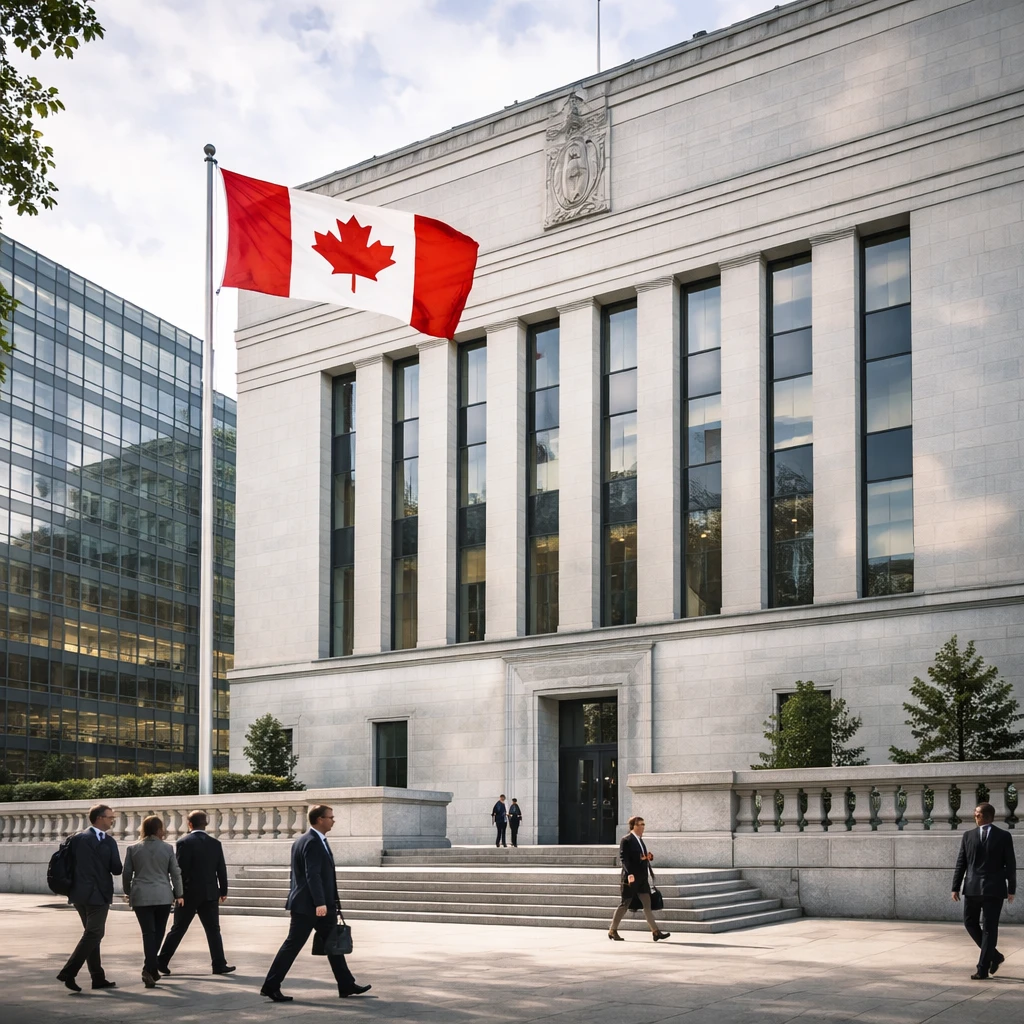
Bank of America expects the Bank of Canada to leave its policy rate unchanged at 2.25% at the June 10 meeting and to remain on hold through year-end, citing the central bank's need to assess incoming data and to monitor external developments.
According to Bank of America, the BoC will point to recent economic weakness as a primary reason for pausing. The bank highlights two consecutive quarters of contraction and a soft labour market as evidence that demand conditions are subdued. That weakness, the note suggests, has created a negative output gap that weighs against further rate increases and is helping to keep core inflation contained.
At the same time, Bank of America says the BoC is likely to acknowledge a material upside risk to inflation. Elevated oil prices are singled out as a factor that could push inflation persistently higher, prompting the central bank to adopt a cautious tone in its forward guidance. Bank of America expects forward guidance to stress flexibility and adaptability as the BoC gauges how higher oil prices feed through to the economy and as the USMCA review progresses.
Bank of America also notes that the BoC will be attentive to geopolitical developments, specifically citing the Iran conflict as a factor the bank is monitoring. Those external uncertainties, together with the domestic data backdrop, are expected to shape the BoC's messaging and policy stance over the coming months.
Market behaviour in recent weeks has reflected a diminished chance of near-term hikes, with rates rallying and the yield curve steepening as investors priced out immediate tightening. Bank of America views a prolonged BoC pause as supportive for its foreign exchange outlook.
The Bank of Canada's next policy decision is scheduled for June 10. Bank of America expects that decision to confirm a hold at 2.25% and that the central bank will remain on hold through year-end while it monitors data, oil-price developments, the Iran conflict and the USMCA review.
Clear summary
Bank of America expects the Bank of Canada to keep its policy rate at 2.25% on June 10 and to remain on hold through the end of the year, citing weak domestic activity and a soft labour market that create a negative output gap, while warning that higher oil prices could sustain inflationary pressure. The BoC is also likely to monitor developments in the Iran conflict and the USMCA review and to adopt forward guidance that is cautious but flexible.
Key points
- Bank of America expects a rate hold at 2.25% on June 10 and no hikes through year-end.
- The BoC is expected to underline recent economic weakness - two quarters of contraction and a soft labour market - which argues against further tightening.
- Elevated oil prices are identified as an upside risk to inflation; the BoC's guidance should be cautious and stress flexibility as external factors evolve. These developments affect bond markets, foreign exchange and energy sector outlooks.
Risks and uncertainties
- Inflation could remain persistently high if elevated oil prices continue to exert upward pressure - a risk for inflation-sensitive markets and the energy sector.
- Geopolitical developments related to the Iran conflict could alter global risk dynamics and influence central bank decision-making.
- Outcomes of the USMCA review remain a source of uncertainty that the BoC will monitor as it sets forward guidance.