
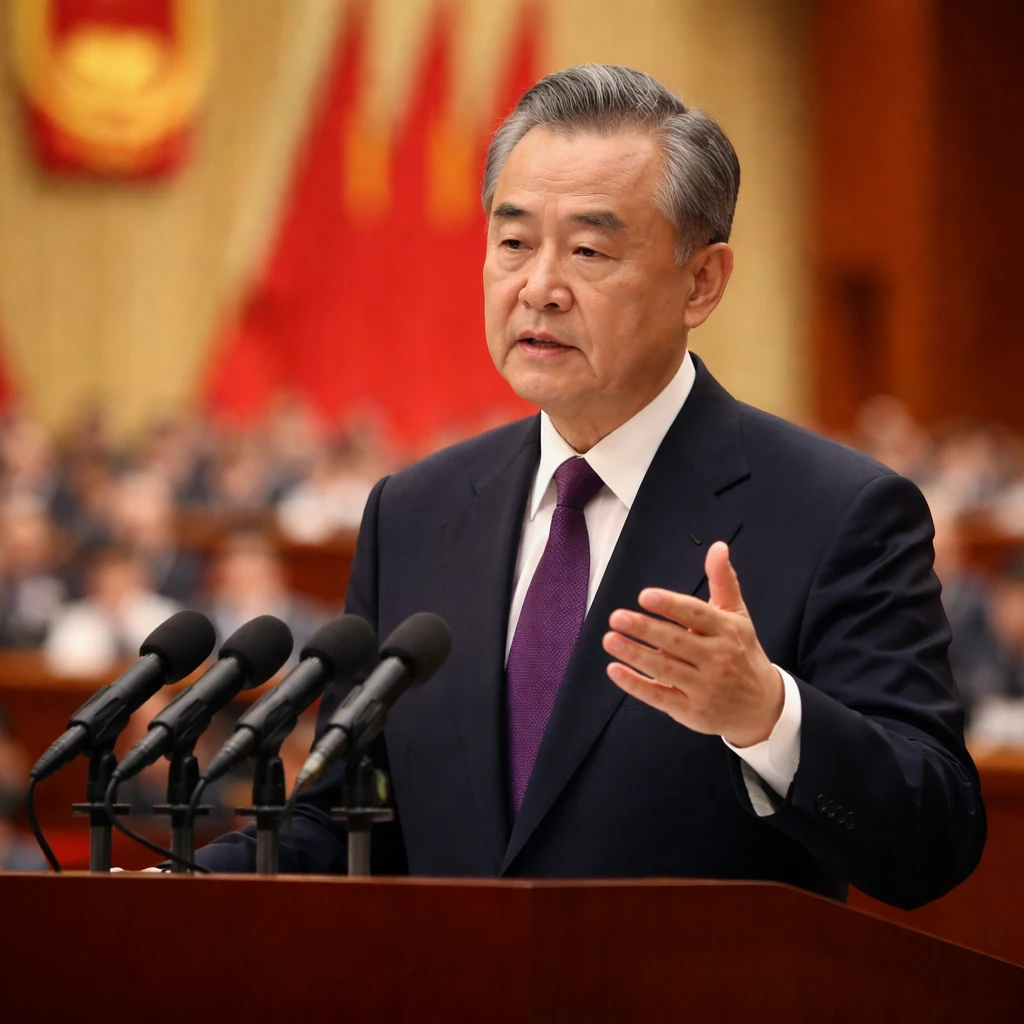
China’s senior diplomat, Wang Yi, delivered a pointed appeal for de-escalation in the Middle East during his annual high-profile briefing on the sidelines of the National People’s Congress in Beijing, while also signaling that a transformational year for relations with the United States remains achievable despite recent regional hostilities.
Speaking publicly on Sunday, Wang reiterated China’s opposition to the use of force and publicly criticized U.S. military strikes. He voiced optimism about an upcoming meeting between President Donald Trump and Chinese leader Xi Jinping, describing the broader bilateral relationship as capable of reaching a "landmark" status if risks are managed and disruptions are removed.
Wang urged both sides to take steps to "remove unnecessary disruptions" and to manage cross-border risks so that 2026 can become a year of "sound, steady, and sustainable" growth in U.S.-China ties. The diplomat’s comments linked diplomatic restraint to economic stability and the prospect of delivering concrete commercial outcomes from negotiations.
The timing of Wang’s remarks comes as a week-long escalation in the Middle East has lifted global energy prices toward $95 a barrel, adding pressure to an already delicate pause in trade tensions that was negotiated last year. While a one-year trade pause was secured previously, the relationship recently encountered renewed volatility after the U.S. Supreme Court struck down a key tariff regime, introducing fresh legal uncertainty into the negotiation landscape.
Wang explicitly criticized any attempts at forced political change in Iran, saying that "plotting color revolutions or seeking regime change will find no popular support." That statement appeared directed at the Trump administration’s declared objectives for the Iranian leadership and underscored Beijing’s rhetorical alignment with the Global South in opposing Western military interventions.
Markets and investors are monitoring the situation closely as senior trade and treasury officials from Washington and Beijing plan to meet in Paris next weekend. Those talks are expected to set the foundation for a new agreement and reportedly include arrangements that would involve a substantial Boeing order for nearly 500 jets.
China’s interest in preserving a stable relationship with the United States is heightened by domestic economic constraints. Beijing is pursuing its lowest economic growth target in decades and faces headwinds including a domestic property sector crisis and sluggish consumer demand. Ensuring steady commercial ties with the U.S. is therefore a priority as Chinese leaders weigh the trade-offs between strategic competition and practical economic cooperation.
The Beijing summit planned for later this month is being cast as a potential turning point. U.S. Treasury Secretary Scott Bessent and Trade Representative Jamieson Greer have been tasked with extracting tangible economic deliverables that could deliver President Trump a measurable political achievement ahead of a critical domestic election cycle.
Wang’s appeal for "sincerity" in negotiations suggests that Chinese leadership may be prepared to tolerate near-term regional turmoil in exchange for broader concessions that emphasize commercial agreements over strategic rivalry - a characterization Wang framed as a pragmatic route to stabilizing ties and trade lanes.
How the upcoming high-level meetings conclude will likely shape the tone of the global economy for the rest of the year. A successful summit could help steady trade flows and act as a buffer for the Chinese economy as it navigates both structural and cyclical pressures.
Summary: Wang Yi used his annual briefing to call for an end to the Iran conflict, to criticize forceful regime-change efforts, and to press both China and the U.S. to minimize disruptions ahead of trade and treasury talks in Paris and a planned Beijing summit. Rising oil prices and legal uncertainty over U.S. tariffs add urgency to efforts to secure commercial deliverables, including a reported Boeing order for nearly 500 jets, that could stabilize bilateral relations and provide economic relief to China’s strained economy.