
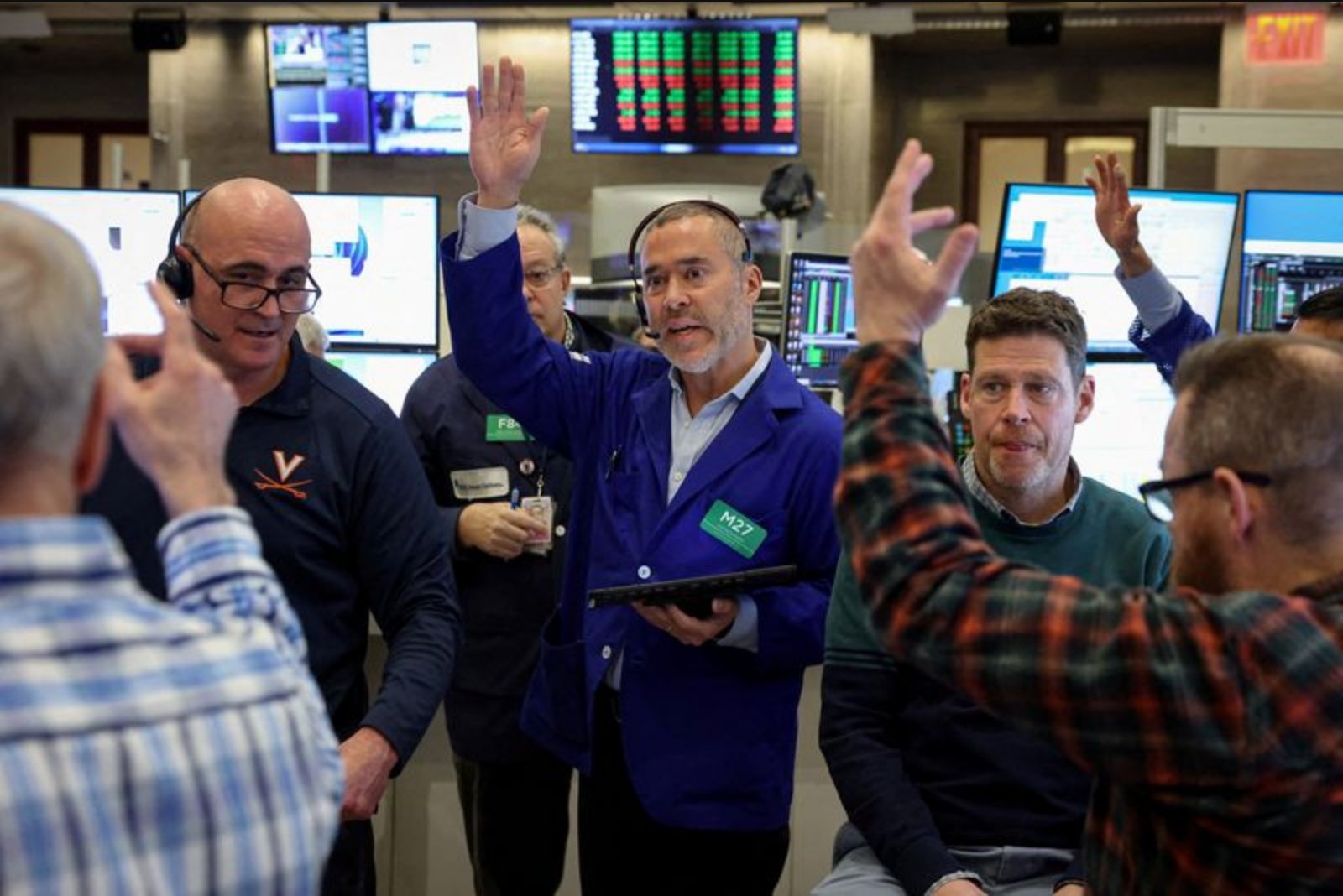
U.S. equity futures slipped on Friday as investor apprehension around artificial intelligence rippled through technology markets and broader risk appetite weakened. The Nasdaq approached what would be its steepest monthly fall since March 2025, driven by concerns about the pace and payoff of AI investment across software and services firms.
Market volatility was further amplified by trade-policy developments. The U.S. Supreme Court's recent decision to void most of the duties imposed last year set off renewed uncertainty over tariffs. In response, the president announced a temporary global tariff of 10% that came into effect on Tuesday, adding a fresh variable for multinational companies and investors to price in.
Against that backdrop, individual names illustrated the market mood. Nvidia inched up 0.4% in premarket trading after sliding more than 5% in the previous session despite reporting strong earnings, underscoring that sentiment toward AI-related stocks remained fragile. Zscaler fell 9.1% after the cloud security firm reported a wider net loss in the second quarter. Intuit slipped 3.6% after forecasting third-quarter profit below estimates.
Software stocks have been especially volatile this month as market participants wrestle with the implications of AI-led disruptions. The unease has extended beyond pure software plays to hit financial brokerages, data analytics and legal services, real estate services and trucking, all sectors cited as being affected by brewing AI concerns.
Major indices recorded losses in the prior session, with both the S&P 500 and the Nasdaq closing lower. The Nasdaq also finished below its 50-day moving average for the 17th consecutive session, a commonly watched indicator of the intermediate-term market trend.
Investors were also preparing for an economic data point that could influence expectations for the U.S. Federal Reserve's interest rate pathway. A January producer prices reading was scheduled for release before the opening bell and was expected to provide insight into inflationary pressures that inform policymakers.
At 06:00 a.m. ET on Friday, futures showed Dow E-minis down 271 points, or 0.55%; S&P 500 E-minis lower by 24.75 points, or 0.36%; and Nasdaq 100 E-minis off by 78 points, or 0.31%. Most megacap and growth names were trading slightly lower in premarket action, while chipmakers including AMD and Broadcom also retreated.
Not all large-cap moves were negative. Netflix gained 7.4% after investors welcomed its decision to exit the contest for Warner Bros Discovery; Warner Bros Discovery fell 2% on the news. Paramount Skydance advanced 7.8% after it won the bidding race for several coveted TV and film assets.
Some corporate actions and guidance also drove sharp single-stock moves. Block surged nearly 19% after announcing plans to cut over 4,000 jobs, nearly half its workforce, as part of a restructuring intended to embed artificial intelligence across its operations. Dell jumped 10.6% after the PC-maker said it expects revenue from its AI-optimized servers business to double in fiscal year 2027 and pledged to return more cash to shareholders. By contrast, Duolingo plunged almost 25% after forecasting first-quarter and full-year 2026 bookings below expectations.
The market environment remained one of heightened sensitivity to AI narratives, corporate guidance and policy shifts. With tariff dynamics evolving and a key inflation gauge due before the open, traders and portfolio managers were parsing a mix of earnings-related newsflows and macro data for clues about near-term market direction.