
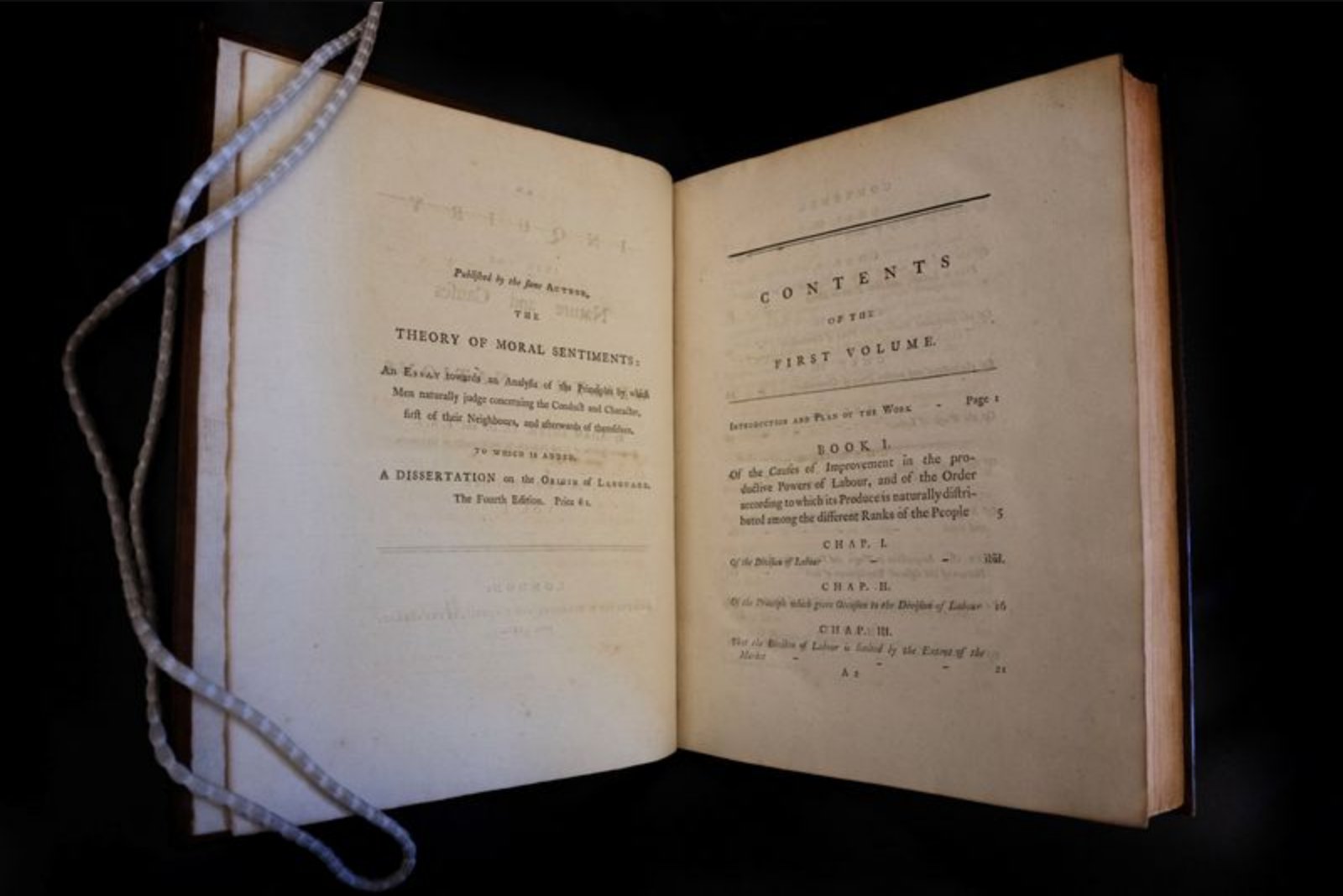
LONDON, March 8 - Adam Smith's seminal work, "Wealth of Nations", marks 250 years on March 9. The book, long central to classical economic thought, continues to be read and discussed for its defense of free trade, its critique of monopolistic privileges and its account of how production can be improved by dividing labour into many distinct tasks.
Smith's arguments have had a lasting presence in economic conversation. The passages below capture some of the most frequently quoted lines from the text, grouped by the topic each passage addresses.
ON MONOPOLIES
"A monopoly granted either to an individual or to a trading company has the same effect as a secret in trade or manufactures."
ON THE BENEFITS OF TRADE
"By means of glasses, hotbeds, and hotwalls, very good grapes can be raised in Scotland, and very good wine too can be made of them at about thirty times the expense for which at least equally good can be brought from foreign countries."
ON SELF-INTEREST
"It is not from the benevolence of the butcher, the brewer, or the baker, that we expect our dinner, but from their regard to their own interest."
ON GOVERNMENT
"Civil government, so far as it is instituted for the security of property, is in reality instituted for the defence of the rich against the poor, or of those who have some property against those who have none at all."
ON WEALTH AND INEQUALITY
"Wherever there is great property, there is great inequality. For one very rich man, there must be at least five hundred poor, and the affluence of the few supposes the indigence of the many."
"All for ourselves, and nothing for other people, seems, in every age of the world, to have been the vile maxim of the masters of mankind."
ON TAXATION
"It is not very unreasonable that the rich should contribute to the public expense, not only in proportion to their revenue, but something more than in that proportion."
ON SOCIETY
"No society can surely be flourishing and happy, of which the far greater part of the members are poor and miserable."
What are the best investment opportunities in 2026? The original text includes a brief note about data-driven investing tools, noting that better data helps identify opportunities. It argues that relying on intuition alone can produce mistakes or analysis paralysis, and it references a product that combines extensive data with AI-driven insights to support investment decisions, while noting such tools cannot guarantee winners. Readers are invited to consider these data and AI tools when evaluating potential investments in 2026.