
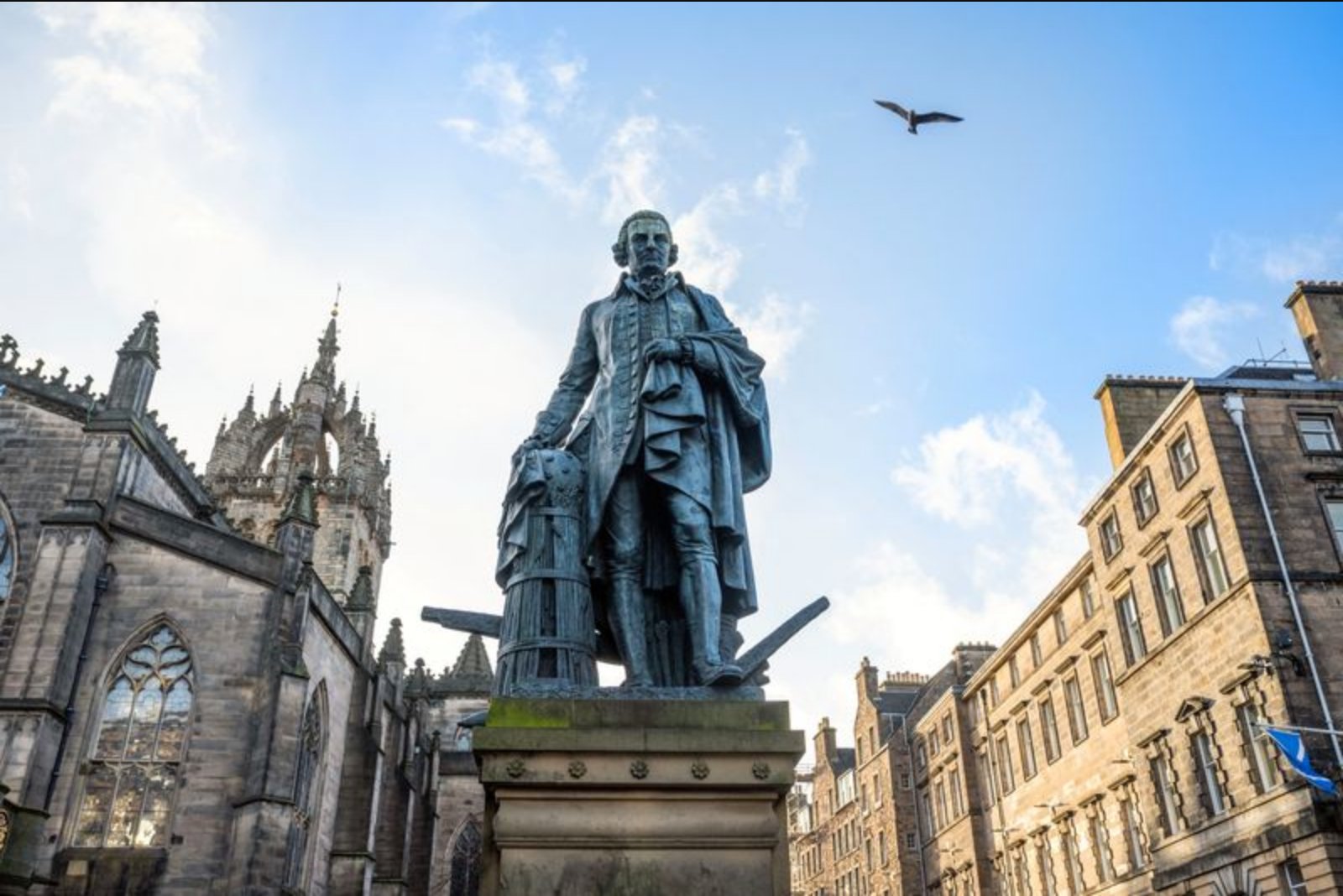
Calls to tax the wealthy, roll back protectionist measures and break up dominant firms echo arguments that appear across modern political debate - yet they could also be lifted from passages in Adam Smith’s 18th century masterwork. The author of An Inquiry into the Nature and Causes of the Wealth of Nations set out critiques of trade barriers, cautions about concentrated affluence, and warnings about the political influence of commercial power in a book first published on March 9, 1776.
Smith’s writing ranges widely, drawing analogies from grape-growing to pin factories, and it arrives at conclusions that cut across today’s familiar left-right split. On one hand he articulated principles that have been adopted by free-trade advocates - captured in the well-known line that "It is the maxim of every prudent master of a family never to attempt to make at home what it will cost him more to make than to buy." On the other hand, he was explicit that the affluent should shoulder a larger share of public costs: "It is not very unreasonable that the rich should contribute to the public expense, not only in proportion to their revenue, but something more than in that proportion," he wrote, adding elsewhere that "No society can surely be flourishing and happy, of which the far greater part of the members are poor and miserable."
These and other passages help explain why Smith can be summoned by such different political camps. Some readers emphasize his advocacy for open markets and competition; others highlight his concern about distribution, monopoly and the political capture of public institutions. "You can find a 'Smith' to support anything you want to say," said Leo Steeds, a research associate at King’s College London, reflecting the broad range of contemporary interpretations.
Smith placed his case against mercantilism at the centre of his critique. He questioned the logic of protectionist policies designed to minimise imports and maximise exports, asking rhetorically whether it would make sense "to prohibit the importation of all foreign wines, merely to encourage the making of claret and burgundy in Scotland?" At the same time, he did not regard tariffs as categorically illegitimate. Smith accepted circumstances in which the state might defend temporary trade restrictions - for example when "the terms of trade were unfair or for reasons of security" - a stance observers note resonates with modern policy arguments about protection for sensitive industries.
Analysts who emphasise Smith’s pro-trade orientation stress that he saw such exceptions as transient. "Smith did understand those arguments," said Eamonn Butler, director of the Adam Smith Institute in London. "But he thought these things (tariffs) really should be as temporary as possible. He thought the more trade you have, the better everybody is."
Perhaps no image from the work has had more cultural traction than the "invisible hand" - the phrase often taken to signal how self-interest in markets can yield broadly beneficial outcomes. Smith framed the idea with the observation that "It is not from the benevolence of the butcher, the brewer, or the baker, that we expect our dinner, but from their regard to their own interest."
Yet students of the book caution that the invisible hand appears only once in the text and should be read alongside Smith’s broader concerns. He devoted significant attention to how special interests, monopolists and powerful actors can capture the state to their advantage. As Pratap Bhanu Mehta, a leading Indian academic and public intellectual, put it, "This book ... is actually a critique of the way in which special interests, monopolists, powerful people, lobbies capture the state. He says: You fix that, then free markets come."
Joseph Stiglitz, a U.S. economist and Nobel laureate, similarly stressed that Smith’s conception of self-interest was not the crude, maximising model sometimes associated with modern economics. "It was much more of an enlightened self-interest looking at society more broadly," Stiglitz said. "Modern economics is based on infinitely selfish people. And clearly, Adam Smith didn’t believe that."
Smith’s moral concerns are visible throughout the work. Drawing on his background as a teacher of moral philosophy at the University of Glasgow, he wrote starkly about selfishness and its social consequences: "All for ourselves, and nothing for other people, seems, in every age of the world, to have been the vile maxim of the masters of mankind."
Interpretation of Smith’s views continues to provoke debate among scholars and commentators. Some recent readings place him closer to a moderate progressive position - in the mould of a contemporary European social democrat - because of his insistence that the wealthy ought to contribute more to public expense and his concern about large disparities in living standards. Yet others caution against over-reaching reinterpretations. Mehta argued that Smith and many of his contemporaries would likely have accepted levels of inequality that would be unacceptable by current standards.
Critics of the industrial-scale application of Smith’s ideas have argued that elements such as the division of labour could be used in ways that leave workers with repetitive, morale-sapping tasks. That point was later amplified by critics including Karl Marx, who argued that the specialisation Smith described could be deployed in factories to the detriment of workers’ morale and dignity.
Despite contested readings and the passage of two and a half centuries, the Wealth of Nations remains a touchstone in public and academic debates. The book’s full title - An Inquiry into the Nature and Causes of the Wealth of Nations - and its placement in a turbulent historical window help explain some of its enduring appeal: it was published in the same year as the U.S. Declaration of Independence, 13 years before the French Revolution, and during the early convulsions of the Industrial Age.
There are plans to mark the 250th anniversary with events across Scotland and Britain, including Glasgow, Edinburgh, London and Smith’s birthplace of Kirkcaldy on the Scottish coast. Those programmes will range from academic conferences to cultural interpretations; last year, for example, a satirical musical at the Edinburgh festival featured the ghost of Smith as a character in a piece addressing the 2008 collapse of a major bank.
Scholars of economic history note that the very plurality of interpretations has helped keep the book alive as an intellectual resource. "It is a tool," said Richard van den Berg, a professor of economic history at Goldsmiths, University of London. "A tool for producing ideas."
What remains clear from close reading of Smith’s text is that his contributions are not reducible to a single policy prescription. His defence of open markets sits beside explicit concern for the distributional effects of wealth accumulation, a tolerance for limited and temporary state intervention under certain conditions, and a pointed critique of concentrated economic power. Those strands explain why Smith’s arguments are still enlisted on multiple sides of contemporary debates over trade policy, taxation and the regulation of dominant commercial actors.